


In this article
- What is in the plan for 25,000 fewer civil servants?
- Why isn't the number the most important question?
- Why did digitalisation in government create more work before?
- How do you get AI in government right?
- Which government work can AI take over, and which can't it?
- Why is AI in contact with citizens riskier than in business?
- What would I tell the House of Representatives before the debate on 1 December?
- What does the plan mean for businesses?
- Frequently asked questions
On Monday 26 October, Dutch state secretary Eric van der Burg sent his letter on a "decisive government" to the House of Representatives. The central government wants around 25,000 fewer civil servants by 2035 and to save 3.5 billion euros. AI and chatbots are supposed to help. Since then, the debate has been mostly about the number: too many, too few, achievable or not. I think that's the wrong discussion. Whether 25,000 fewer civil servants works out doesn't depend on the number, but on the approach. And the letter says little about that approach so far.
What is in the plan for 25,000 fewer civil servants?
The Dutch central government wants about 25,000 fewer full-time jobs by 2035, out of a total of 160,016 at the end of 2025. That's more than one in six. The savings start at 900 million euros in 2027 and rise to 3.5 billion euros a year. The police, Defence, the Public Prosecution Service and the prison service are excluded.
Van der Burg himself calls the number "a rough estimate". There's no figure per ministry yet. Choices about what the government will stop doing will follow within six months. The cuts per ministry come in the spring budget memorandum of 2027, and the AI targets in the first quarter of 2027.
A few figures in the plans stand out. There are more than 175 advisory councils and committees. The government carries out around 400 policy evaluations a year, while according to Van der Burg perhaps 10 to 20 are needed. There are almost 1,700 central government websites. And since 2018, the civil service has grown by 41 percent, or more than 46,500 full-time jobs.
Why isn't the number the most important question?
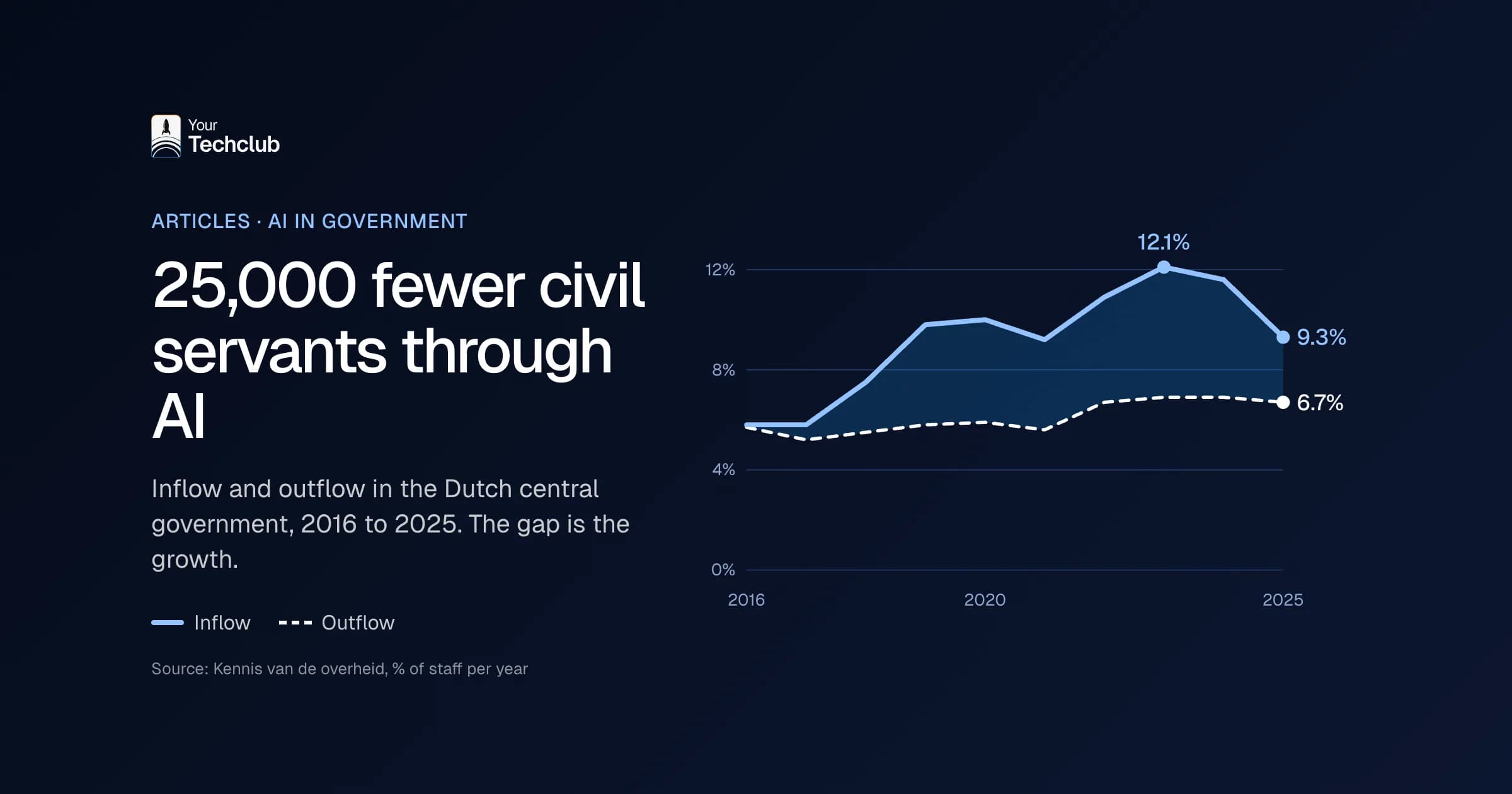
Because most of it can happen through natural turnover. In 2025, 6.7 percent of central government staff left, through retirement, another job or a contract ending, according to Kennis van de overheid, the Dutch government's workforce statistics. That's around 10,700 people a year, and an estimated 90,000-plus by 2035. So the real question isn't how many people have to go, but which work will be done differently.
This is a rough calculation. Outflow is measured in people and the target in full-time jobs. And not everyone who leaves can be spared. You don't replace an experienced caseworker at an implementing agency with a chatbot.
That's exactly why the approach matters so much. If the work stays the same, every leaver has to be replaced. Then you won't reach 25,000 fewer civil servants, or you'll reach it at the expense of public services. If the work does change, the workforce can shrink without citizens or colleagues noticing.
Why did digitalisation in government create more work before?
Because the old process stayed in place and a system was added on top. The government says so almost word for word: earlier digitalisation brought new tasks, more capacity and more contractors. According to the letter, efficiency gains of at most 0.5 percent a year cover only a third of the savings. The rest has to come from dropping tasks.
I recognise that pattern, outside government too. A paper form becomes a digital form, with the same five checks and the same three signatures. The system then has to be managed, integrated and secured. On balance it takes more people, not fewer.
With AI, it goes wrong again if you make the same mistake. Put a chatbot in front of a complicated scheme and you get a complicated scheme with a chatbot in front of it. The government rightly warns about this. I'd just go a step further: not only warn, but set out how to do it properly.
How do you get AI in government right?
Start with the work, not with the technology or the number. Map the largest processes in each organisation, measure what they cost today, and then choose per process: drop it, simplify it, automate it or leave it as it is. Only then does AI come into the picture, with clear agreements upfront on what the AI may do by itself and where a person decides.
In practice that's five steps. In our own AI audits we follow the same order, for businesses too:
- Set a baseline. How many hours go into a process now, how many errors get corrected and what is left undone? Without a baseline you won't know afterwards whether it paid off.
- Drop first, automate second. A check nobody needs shouldn't be made faster. The letter itself mentions 400 evaluations a year, of which perhaps 20 are needed.
- Decide per process who decides. What does the AI do by itself, what goes for approval first and when does a person take over?
- Get the basics in order. The government itself names security, data quality and sovereignty as preconditions. Without clean data and clear permissions, AI mainly creates new problems.
- Measure and adjust. Compare with the baseline after three months. If it works, expand it. If it doesn't, stop.
Which government work can AI take over, and which can't it?
AI can mainly take over work that repeats, comes in large volumes and follows fixed rules. Think of reading documents, sorting applications, completing case files and drafting reports. Where it comes to judgements about people, exceptions or trust, a person is still needed. There, AI can at most help with the preparation.
| Suitable for AI | Better with a person, with AI as support |
|---|---|
| Reading documents and checking them for completeness | Deciding on a benefit, allowance or fine |
| Sorting incoming post and email and passing it on | Conversations with citizens in a vulnerable situation |
| Summaries and first drafts of evaluations | Trade-offs between policy and implementation |
| Answering standard questions from fixed sources | Assessing complaints and objections |
| Maintaining websites and texts and making them accessible | Supervision and enforcement |
Van der Burg himself gives the digital checking of tax returns as an example. That fits the left-hand column, as long as a person assesses the exceptions. The 1,700 government websites are an opportunity too: management, updates and accessibility currently take a lot of manual work. If you want 25,000 fewer civil servants without citizens noticing, you start in this left-hand column.
Why is AI in contact with citizens riskier than in business?
Because a citizen can't switch. A customer who meets a bad chatbot picks another shop. A citizen can't go to another tax authority. According to the Nationale Voice Monitor 2026, consumers say only 12 percent of questions to chatbots are answered well. That's no basis for automating contact with citizens at scale.
After the Dutch childcare benefits scandal, everyone knows what happens when a system decides and nobody is watching. The EU AI Act is clear too: systems that decide on access to public services are high-risk, with strict requirements for human oversight.
Emeritus professor Frits van der Meer pointed out to EenVandaag that there are shortages in prisons, at Rijkswaterstaat (the national roads and waterways agency) and at implementing agencies. The Netherlands also already has relatively few civil servants: 70.9 per 1,000 inhabitants, against a European average of 94. Shrinking without changing how the work is done quickly hits public services. My conclusion: use AI in the back office first, so the people at the front have time left for citizens.
What would I tell the House of Representatives before the debate on 1 December?
The parliamentary debate on the letter has been moved to 1 December. I'd have MPs ask three questions. Not "is 25,000 too many?", but: per which process, with which baseline and with whom in charge? That's the difference between a cut that works and the next round that fails.
- Targets per process, not per ministry. A flat 20 percent cut per organisation rarely worked over the past twenty years. The government writes so itself.
- Free up first, then shrink. Let AI take over the repetitive work and put the time freed up into the shortages first. The shrinking follows through natural turnover.
- Openness about what it delivers. Publish the baseline and the result after a year for each process. Then it becomes a decision based on facts, not a matter of feeling.
What does the plan mean for businesses?
Two things. Government suppliers will face tenders in which AI becomes a standard question, because the government wants to look systematically at where AI helps when it buys. And every business faces the same lesson as the government: first find out where AI really pays off, then build.
What the Dutch government is trying with 25,000 fewer civil servants at national level, we also see at many small and mid-sized businesses on a small scale. They buy an AI tool, hope for less work and see little difference after six months. The pattern is the same: technology on top of an old process.
Do you work for or with government? Our public sector page explains how we approach it, and the playbook AI in your tender helps with procurement.
Frequently asked questions
How many civil servants does the Dutch government want to cut?
About 25,000 full-time jobs in the central government, by 2035. That's more than one in six of the 160,016 full-time jobs at the end of 2025. The police, Defence, the Public Prosecution Service and the prison service are excluded. State secretary Van der Burg himself calls the number a rough estimate.
Will civil servants be made redundant?
That hasn't been decided. There won't be a hiring freeze, and there's no figure per ministry yet. Every year about 6.7 percent of central government staff leave, for example through retirement or another job, so a large part can happen through natural turnover.
What role does AI play in the plan?
AI and chatbots are meant to take over part of the administrative work and customer contact. The government itself warns against overestimating the effects of AI. The AI targets will be worked out in the first quarter of 2027.
When do the cuts start?
The savings start at 900 million euros in 2027 and rise to 3.5 billion euros a year by 2035. The choices per ministry come in the spring budget memorandum of 2027.
Sources
- Kamerbrief over een slagvaardige overheid (26 oktober 2026), Tweede Kamer
- Commissiedebat Slagvaardige overheid en regeldruk, verplaatst naar 1 december 2026, Tweede Kamer
- In- en uitstroom overheidspersoneel, Kennis van de overheid
- Niet 35.000 maar 25.000 ambtenaren minder, Binnenlands Bestuur
- Kabinet wil 25.000 rijksbanen schrappen, maar waarschuwt zelf: overschat de effecten van AI niet, AI Insider
- Van der Burg wil 25.000 ambtenaren minder, pas in 2035, Dagelijkse Standaard
- Kabinet rekent op AI voor forse bezuiniging op personeel, Computable
- Hoe haalbaar is het schrappen van duizenden ambtenaren? Op veel plekken juist een tekort, EenVandaag
- Nationale Voice Monitor 2026, Frankwatching