

 SERVICESCUSTOM WEBSITE
Custom websites your editors can keep up to date themselves
Strategy, design and development in one team. The result: a website that looks good, loads fast and actually does its job.

 ISO 9001 & 27001
What is Custom website?
A custom website is designed and built from the ground up around one organisation's brand, content and audience, rather than set up inside an existing theme or template. Design, page structure and the CMS are matched to how the marketing team wants to manage the site and the story the brand wants to tell. At Your Tech Club we combine strategy, UX design and front-end development with a headless CMS, so the site is both visually distinctive and easy to maintain.
Built for clients including Tata Steel, M&G Investments, Digistore24, Toppers in Concert, Bar-le-Duc and Loogman


Three situations we come across again and again with organisations having a new website built.

The website no longer says who you are
Your positioning and visual identity have moved on, but the site still runs on a template from years ago. Visitors see a different brand from the one the rest of the organisation stands for.

Every content change goes through the agency
The marketing team can't add a new page, edit some text or replace a product photo themselves. Every request goes through a ticket, an outside supplier and days of waiting.

The site doesn't grow with new services or brands
A new product line, sub-brand or language version doesn't fit the existing structure. Every addition becomes a stopgap on top of a foundation that wasn't built for it.
When a theme-based site starts working against you
A bought theme is a fine start if your brand is still taking shape and you mainly want to get online quickly. It becomes a problem once your brand is clearly defined, because then you're fighting choices someone else made for you. Every change becomes an exception to the exception.
The second sticking point is speed. A theme is built to do everything, so it loads functionality you don't use. That's exactly what Core Web Vitals penalise, and it's almost impossible to fix afterwards without pulling the theme apart.
- A theme starts to pinch once your brand is clearly defined
- Unused theme functionality costs you speed
- The price depends on the number of templates, not the number of pages

Your editors publish a page themselves, without us
The most common complaint about a custom site isn't that it looks bad. It's that every change has to go through a developer. A landing page then takes two weeks, so it doesn't happen, so the site gets out of date and slowly stops being true.
That's why we build a set of components your editors use to put pages together themselves: headings, text blocks, images, lists and calls to action, in whatever order the editors choose. What's fixed is the typography, colours, spacing and responsive rules, so the design doesn't fall apart when someone is in a hurry.
- Components your editors combine themselves
- Typography, colour and rhythm are fixed, the content isn't
- Agreed up front what's flexible and what isn't

Two things you can't cheaply fix afterwards
Speed and accessibility aren't a layer you add at the end. They follow from choices made in the first week: how you structure pages, how much you send along, which fonts you load and how you handle images. Trying to fix that at the end means rebuilding in practice.
We build accessibility in from the information architecture onwards. Contrast, heading structure, keyboard-only navigation and text alternatives for images are design choices, not repair work. We work to WCAG 2.1 AA, which is a requirement for public organisations and, for everyone else, simply means more people can use your site.
- WCAG 2.1 AA from the information architecture onwards
- Core Web Vitals measured and delivered
- Images, fonts and structure chosen for speed from day one

Not a design agency and a separate development team side by side, but one team that builds brand, design and technology together and stays accountable for the result after go-live.
Brand, design and code in one team
Brand strategy, UX/UI design and front-end development don't sit in separate teams or agencies with us. That stops the tone of voice and visual identity in the design from getting diluted by the time the website goes live.
A CMS your marketing team really runs themselves
We set up the CMS with reusable content blocks within fixed brand guidelines, so new pages, campaigns and copy can be published without a developer. No separate channel for small changes that keep landing on our desk.
Speed and SEO as part of the design
We take load time, structured data and semantic markup into account from the first design decision, not as a repair afterwards. That way a strong brand story never has to come at the expense of findability or performance.
Sitemap and page structure
An information architecture that matches your services and audiences, with clear paths to conversion instead of a generic menu.
From Figma design to front end
We translate every page from visual design into fast, responsive code, without losing any of the visual identity along the way.
Go-live without losing search visibility
We carefully carry over content, redirects and metadata, so your existing search engine rankings aren't lost in the switch.
- projects delivered
- returning clients
- from 127 reviews
- ISO27001 and 9001 certified
A website builder, a small web agency or a partner with one team.
- Your editors build pages themselves, within the brand styleWebsite builder or theme: partly · Small web agency: varies
- Accessible to WCAG 2.1 AA, from the build onwardsWebsite builder or theme: no · Small web agency: varies
- Integration with stock, ERP and accountingWebsite builder or theme: no · Small web agency: partly
- ISO 9001 and ISO 27001 certifiedWebsite builder or theme: varies · Small web agency: rarely
- Speed measured and deliveredWebsite builder or theme: partly · Small web agency: varies
- Tells you when Shopify is the better fitWebsite builder or theme: no · Small web agency: varies
- Further development and conversion after go-liveWebsite builder or theme: no · Small web agency: varies
- Dedicated contacts, office in AmsterdamWebsite builder or theme: no · Small web agency: varies
A considered approach that puts your brand and your users first, from the first workshop to go-live.
- 01
Brand exploration & discovery
We start with a workshop on positioning, audience and competitors. Then we take stock of existing content, visual identity and the page structure needed to tell your story in full.
- 02
Sitemap & content strategy
Based on the discovery we define the information architecture: which pages there will be, what content each page needs and how visitors move towards conversion through navigation and internal links. We also lay the groundwork for SEO, such as URL structure and headings.
- 03
UX/UI design
We first design wireframes and develop them into a visual design in Figma, based on your visual identity. We tune every page to brand experience and conversion, with a feedback round at every design milestone.
- 04
Front-end development & CMS setup
We build the website with modern front-end technology and set up a headless CMS with content types that match how your marketing team works: pages, blog articles, cases and landing pages they can edit themselves without a developer.
- 05
Content migration, review & QA
We migrate existing content while preserving its SEO value, including redirects and metadata. We test on different devices and browsers, check load times and go through every page with you before go-live.
- 06
Go-live & CMS training
After go-live we train your marketing team in the CMS: creating pages, editing content, uploading images. That way the website stays in your own hands, and we remain available for further development and support.
A custom website is never finished at go-live
- PerformanceWe monitor load times, Core Web Vitals and availability, so the site always stays fast and reachable.
- CMS supportWe teach your marketing team to update pages, campaigns and news items in the CMS independently.
- SecurityWe patch the CMS, the front end and underlying packages against newly discovered vulnerabilities.
- SEO & insightWe track rankings, traffic and conversions and turn them into concrete improvements to content and structure.
- Further developmentWe add new landing pages, sections or functionality as soon as the brand calls for it.

No account manager. Your first conversation is with someone who does the work, often with one of the founders. After that you work with a dedicated team from our office in Amsterdam.
- Office on the Duivendrechtsekade in Amsterdam
- ISO 9001 and ISO 27001, certified by Kiwa
- 500 projects delivered
- 4.8 from 127 reviews
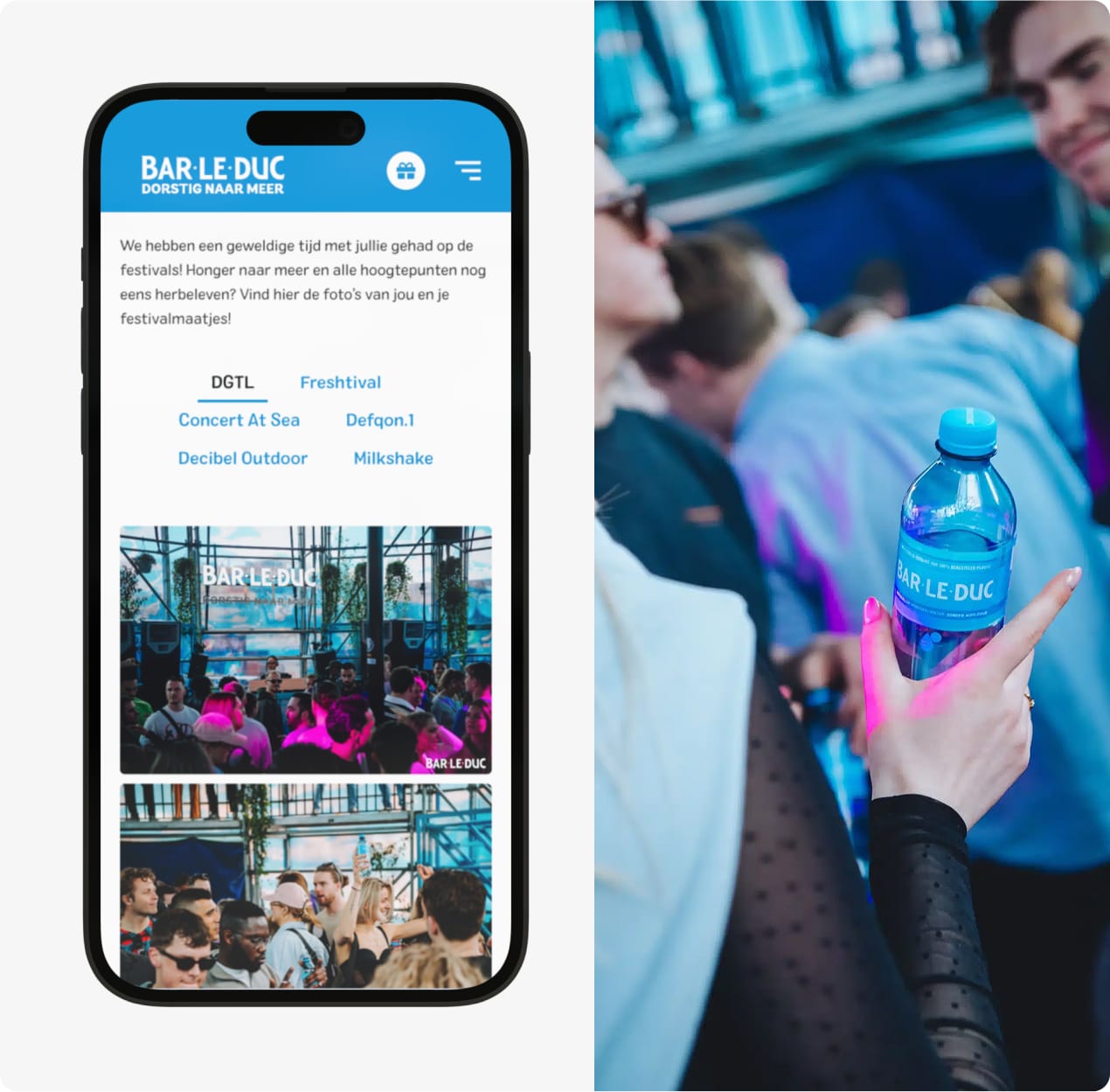
A brand website that shows the story rather than telling it.
Brand experience in 3D
For Bar-le-Duc we built an interactive 3D product experience and a festival calendar, so the brand's origins and character can be felt rather than just described.
A campaign on 1.5 million bottles
Under the caps of more than 1.5 million bottles in supermarkets was a campaign code. The competition on the site drew tens of thousands of entries, and many of those entrants visited the website for the first time.
How much does a custom website cost?
That depends on the number of page types, the languages, the integrations and how much your editors need to be able to put together themselves. A site with a few core pages is a different project from a multilingual brand platform with a headless CMS. After the first conversation we define the scope, so the price is tied to a clearly defined result.
What's the difference between a custom website and one built with a theme or website builder?
With a theme or builder you work within the limits of an existing design and the constraints of the platform; with a custom website your brand determines the design and technology, not the other way round. That means your own design system, code that only contains what the website needs, and no stack of plugins getting in the way of speed and maintenance.
Which CMS do you use for a company website, and can our marketing team work with it themselves?
We usually set up Strapi as a headless CMS, with content blocks the marketing team combines into new pages themselves without involving a developer. We define the structure of fields and components, so every new page stays within the brand identity, even when someone other than the designer puts it together.
How long does it take to build a custom company website?
A focused brand or marketing site with discovery, design and development usually takes eight to fourteen weeks. A larger platform with multiple languages, custom content types and integrations with, for example, a CRM or marketing automation is more likely to take four to six months.
Will our website still rank well in Google after switching to a custom website?
With a careful migration your website keeps its visibility, or improves it: URLs are redirected one to one, structured data and metadata are set up again, and the technical foundation, such as load time and semantic HTML, is usually stronger than on the old platform. If you already have a website, we include a migration plan in the project.
Do you also build multilingual websites?
Yes, we set up multilingual support at CMS level, so translations, separate content per market and language-specific SEO metadata can be managed independently. That works both for a simple Dutch/English version and for a website with several country domains.
Do you also provide maintenance and further development after go-live?
Yes, after go-live we stay involved for hosting, monitoring, security updates and developing new pages or functionality based on user data. A brand website is never really finished: content, campaigns and services change along with your organisation.
Related services

Get in touch with us directly. We'll get back to you as soon as we can

 Your message goes straight to our team in Amsterdam.