

 SERVICESSTRAPI DEVELOPMENT
Strapi, a headless CMS that stays yours
Strapi v5 specialists, with Next.js integrations, custom workflows and EU hosting for clients with strict GDPR requirements. No vendor lock-in, full ownership of the code.

 ISO 9001 & 27001
What is Strapi development?
Strapi is an open-source headless CMS built in Node.js and TypeScript that separates content from the presentation layer. Strapi development means building custom content types, components and plugins tailored to an organisation, often connected to a Next.js front end. The platform delivers content through a REST or GraphQL API and runs either in the cloud or self-hosted within the EU, without vendor lock-in.
Built for clients including Tata Steel, M&G Investments, Digistore24, Toppers in Concert, Bar-le-Duc and Loogman


These are the bottlenecks we hear most often from companies moving to Strapi.

Stuck with a closed CMS
Content sits in Contentful, Sanity or an outdated WordPress. Costs rise per seat or per API call, and switching feels like a project in itself because you have no access to the source code.

Every new section needs a developer
Content types were once set up quickly for a handful of pages. Dynamic zones and reusable components are missing, so the editors depend on engineering for every new block on a page.

No guarantee of where content and media are stored
The current CMS or hosting platform gives no certainty about where content, media and user data are stored, while clients in healthcare, government or finance explicitly require EU storage and demonstrable security.
A headless CMS or just WordPress: which fits you?
WordPress isn't wrong. For a site made up mostly of pages and blog posts, managed by one editorial team, it's a perfectly good choice and cheaper to run. It gets tricky as soon as you need the same content in several places: a website, an app, a screen in a shop.
That's what headless is for. Your content is separate from the design and can be fetched anywhere through an API. Update it once, and it's current everywhere. For organisations with several brands or languages, that's the difference between keeping up and falling behind.
- One source for your site, app and other channels
- Strong with multiple brands or languages
- The front end needs a developer, the content doesn't

The content model decides whether your editors can keep it up
A headless CMS is only as usable as the model underneath it. Make it too loose, and within a year you have ten versions of the same thing and a site that no longer looks like itself. Make it too strict, and your editors call us for every exception.
We design that model together with the people who work in it every day, not with the client alone. The question is always the same: what do you want to be able to change without help, and what should stay fixed so it can't go wrong?
- Model designed with the editors, not just the client
- Agreed what's flexible and what isn't
- Validation and a preview while you fill it in

Open source means your environment is yours
Strapi is open source and runs on your own infrastructure. That means your content and user data don't sit with a vendor who could change their prices or terms tomorrow. For organisations that handle personal data, that's often the deciding factor.
It also means you're responsible for updates and backups yourself. That's not a problem as long as someone owns it, and it's a real risk if everyone assumes someone else is doing it. We agree that explicitly at handover.
- Open source, on your own infrastructure
- Updates and backups explicitly assigned at handover
- Hosting within the EU, with a record of what's stored

We've been building with Strapi since version 3 (2020) and know the codebase from the inside, not just the documentation.
Strapi expertise since v3, our own open-source plugins
We've now delivered dozens of Strapi v5 implementations, from content model to custom plugin, and publish our own open-source plugins at github.com/yourtechclub. That means we've hit Strapi's limits and know how to build around them rather than suffer from them.
EU hosting and GDPR by design, no catch
As standard, we self-host Strapi on Hetzner Cloud EU, so content and personal data stay within the EU without depending on an American parent company. For clients in healthcare, government or finance, that's a precondition up front, not something to sort out afterwards.
Strapi and Next.js from one team, no handover between agencies
The content model, API and front end are designed by the same team, so you don't have to coordinate two agencies on populate strategy or performance. Every project starts with a content modelling workshop with your editors, so the CMS matches how they actually work.
A custom content model and workflows
We design content types, dynamic zones and draft/publish workflows that fit your organisation's content and processes.
Plugins for what Strapi lacks
From payment integrations to approval flows and audit logging: functionality that isn't standard in Strapi, we build as a plugin.
An API connected to your front end
A REST or GraphQL API with preview mode, connected to Next.js or the front-end framework you already use.
- projects delivered
- returning clients
- from 127 reviews
- ISO27001 and 9001 certified
A website builder, a small web agency or a partner with one team.
- Your editors build pages themselves, within the brand styleWebsite builder or theme: partly · Small web agency: varies
- Accessible to WCAG 2.1 AA, from the build onwardsWebsite builder or theme: no · Small web agency: varies
- Integration with stock, ERP and accountingWebsite builder or theme: no · Small web agency: partly
- ISO 9001 and ISO 27001 certifiedWebsite builder or theme: varies · Small web agency: rarely
- Speed measured and deliveredWebsite builder or theme: partly · Small web agency: varies
- Tells you when Shopify is the better fitWebsite builder or theme: no · Small web agency: varies
- Further development and conversion after go-liveWebsite builder or theme: no · Small web agency: varies
- Dedicated contacts, office in AmsterdamWebsite builder or theme: no · Small web agency: varies
Architecture first, then an iterative build with the content team in the loop.
- 01
Content modelling workshop
Together with your content and marketing team, we map the content: which content types, reusable components and dynamic zones are needed, and how content relates. This sets the schema architecture before a line of code is written.
- 02
Architecture and hosting
We choose between self-hosted on Hetzner Cloud EU or Strapi Cloud, set up the database and media storage, and decide which functionality is standard Strapi and what we build as a custom plugin, including the roles and permissions structure.
- 03
Strapi build
We build the content types, custom plugins, lifecycle hooks and draft/publish workflows. The admin panel is set up around how your editorial team works, not the other way round, so managing content doesn't become a hassle.
- 04
Front-end integration
The front end, usually Next.js, is connected via REST or GraphQL with a selective populate strategy for fast load times, and with preview mode so editors can review drafts before publishing.
- 05
Content migration
When moving from WordPress, Contentful or another CMS, we transfer existing content, media and URL structure, including redirects, so no content or SEO value is lost.
- 06
Go-live, training and hypercare
After launch we train the content team in the admin panel and stay available for questions and adjustments for the first few weeks, so your team can manage content independently without needing us.
Strapi keeps moving after launch
- Updates and version controlWe follow new Strapi releases and plugin updates and apply them in a controlled way, without breaking custom content types or workflows.
- Evolving the content modelWe add new content types, components and dynamic zones to match what the content team turns out to need in practice.
- Permissions and accessWe manage roles and API tokens, and regularly check who can edit or publish which content types and fields.
- API performanceWe monitor response times of REST and GraphQL calls and optimise populate strategies if the front end slows down.
- Training the content teamWhen new content types or workflows arrive, we walk through the Strapi admin with the editors, so they can keep publishing independently.

No account manager. Your first conversation is with someone who does the work, often with one of the founders. After that you work with a dedicated team from our office in Amsterdam.
- Office on the Duivendrechtsekade in Amsterdam
- ISO 9001 and ISO 27001, certified by Kiwa
- 500 projects delivered
- 4.8 from 127 reviews
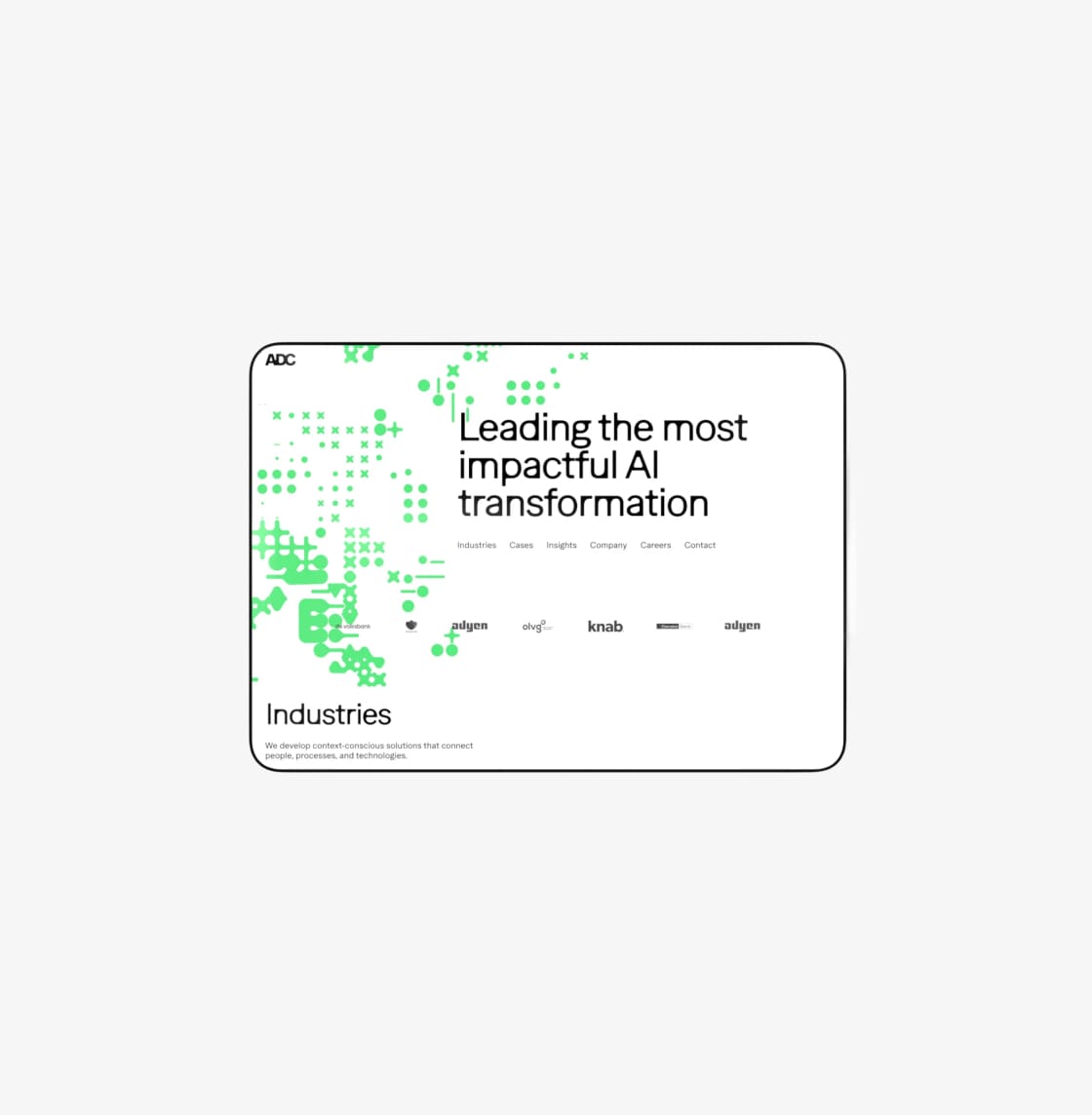
A headless architecture that grows with you, not a second redesign in five years.
From rebrand to platform
What started as a redesign became a full Strapi architecture with a Next.js front end for ADC: structured content types for cases, insights and sector pages that link to one another.
A deliberately chosen foundation
Open source, self-hostable and free of vendor lock-in: ADC decides how the platform grows, instead of being tied to a single supplier.
How much does a Strapi website or platform cost?
That depends heavily on the scope: a custom build with standard content types is a different project from a multi-tenant platform with several custom plugins. The investment is mainly driven by the number of content types, the number of custom plugins and whether a migration is involved. We agree scope and a quote in a no-obligation conversation.
Strapi v4 or v5: which should I choose in 2026?
Choose Strapi v5 for every new project: it has been the current version since April 2024, and v4 is heading towards end of life between 2026 and 2027. If you have an existing v4 project, we recommend an upgrade path rather than putting it off.
Can I host Strapi myself, or does it have to be Strapi Cloud?
Either works. As standard, we self-host Strapi on Hetzner Cloud EU, because that gives full control over data location and lower costs at scale. Strapi Cloud is quicker to set up and managed by Strapi itself, but the ownership sits in the US, even if the server is in an EU region.
Does Strapi work with Next.js?
Yes. Strapi is a headless CMS that delivers content through a REST or GraphQL API, which makes it framework-agnostic, and Next.js is the front-end combination we build most often. For Vue or Nuxt teams, the same Strapi back end works just as well.
Can you build a custom plugin for Strapi?
Yes. We build custom Strapi plugins for things like workflow approval, multi-tenant management, integrations with Mollie or Stripe, and audit logging. Because Strapi is open source, there's no hard limit on what can be built, unlike closed CMS platforms.
How long does a migration from WordPress or Contentful to Strapi take?
Allow 6 to 12 weeks, made up of a content audit, the Strapi build with data migration, the front-end integration and a hypercare period. The timeline depends heavily on the number of content types and the amount of existing content that needs to come across.
Will we be tied to an agency if we choose Strapi?
No. Strapi is open source and the code remains fully owned by your organisation, so there's no vendor lock-in as there is with closed CMS platforms. Any other agency with Strapi knowledge can take over the project, because there's no proprietary layer in between.

Get in touch with us directly. We'll get back to you as soon as we can

 Your message goes straight to our team in Amsterdam.