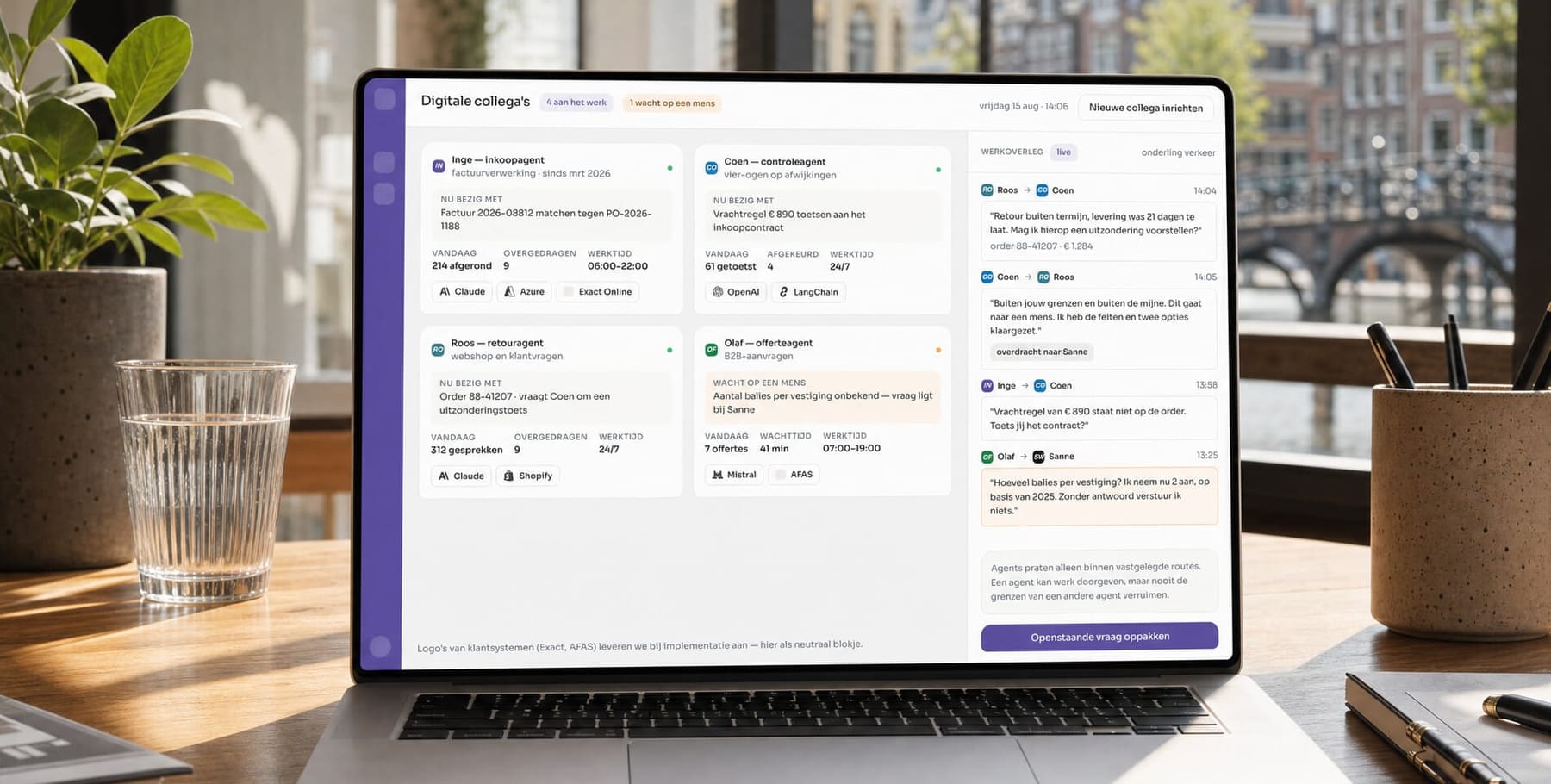
We don't look for places to add AI. We look for where your organisation can work better. For each workflow we set out what may happen automatically and where a person decides.
★★★★★4.8 from 127 reviews
ISO 9001 & 27001
500 projects delivered
Audit reportday 5 of 5
What it costs now
The three biggest opportunities
What we wouldn't do
The first 90 days
Opportunity 1 · highest valueWork orders sit idle until someone calls the technician
Audit reportday 5 of 5
What it costs now
The three biggest opportunities
What we wouldn't do
The first 90 days
In five days, know where manual work is holding back your growth. Explore the audit →
Built for clients including Tata Steel, M&G Investments, Digistore24, Toppers in Concert, Bar-le-Duc and Loogman
Sound familiar?
Where AI projects usually get stuck
Three situations we keep seeing at organisations that have already tried something with AI.
The pilot never gets past the demo
Something is running that impresses in a presentation, but it doesn't touch a real process and nobody owns it. After three months it grinds to a halt.
Confidential data ends up in public tools
Employees solve their own problems with whatever they can find. Understandable, and exactly why it gets out of control.
Nobody knows what it delivered
Without a baseline measurement up front, there's no way to tell afterwards whether it worked. Then it becomes a matter of opinion instead of a decision.
Do you recognise one of these situations?
What's included
Where do you start?
If you don't know yet where the opportunity is, start at the top. If you already know, skip that step.
Not sure which step is yours? That's the first question we answer together.
Why Your Tech Club
A standalone AI tool, a freelancer or a team
Three ways to bring AI into your organisation, side by side.
Works in your own systems, such as ERP, CRM and emailStandalone AI tool: partly · AI freelancer: yes
ISO 9001 and ISO 27001 certifiedStandalone AI tool: varies · AI freelancer: rarely
Starts with the process, not the technologyStandalone AI tool: no · AI freelancer: varies
Tells you when AI isn't the answerStandalone AI tool: no · AI freelancer: varies
A person decides where needed, with loggingStandalone AI tool: partly · AI freelancer: varies
Strategy, design, software and AI in one teamStandalone AI tool: no · AI freelancer: no
Management and further development after go-liveStandalone AI tool: via subscription · AI freelancer: varies
Dedicated contacts, office in AmsterdamStandalone AI tool: no · AI freelancer: varies
What to look for
Standalone AI tool
AI freelancer
Your Tech Club
Works in your own systems, such as ERP, CRM and email
Partly
ISO 9001 and ISO 27001 certified
Varies
Rarely
Starts with the process, not the technology
Varies
Tells you when AI isn't the answer
Varies
A person decides where needed, with logging
Partly
Varies
Strategy, design, software and AI in one team
Management and further development after go-live
Via subscription
Varies
Dedicated contacts, office in Amsterdam
Varies
AI employees
An AI employee in your own systems
Not a standalone chatbot next to your work, but an employee that works in your mailbox, accounting software or planning tool. It reads along, prepares what can be prepared and passes the exceptions to a person.
Answers from your own knowledge, with the source shown
Colleagues spend less time searching: the assistant answers from your own handbooks, agreements and policies, and shows where it found the answer. If it isn't there, it says so and the question goes to a colleague.
Only from your own documents
A source with every answer
Knowledge assistant
What warranty do we give on a heat pump?
According to the service handbook, the manufacturer's warranty covers parts, plus our own warranty on the installation.
Source: Service handbook, chapter 4
How it works
From first conversation to AI in production
Four steps. First find out where it pays off, then start small and expand what works.
In the AI Opportunity Audit we map where manual work is holding back your growth, what it costs and what we wouldn't do.
02
Build (a few weeks)
A first AI employee for one process, in your own systems, with logging and a person handling the exceptions.
03
Pilot and measure
We run alongside one team and measure what it delivers against the baseline from the audit.
04
Roll out
To the rest of the organisation, with an owner for each workflow and clear agreements on management.
Go-live is not the end
MonitoringWe keep track of errors, exceptions and costs, and see it when something deviates.
Fine-tuningWe improve instructions, rules and integrations based on real results.
ExpandingNew tasks are added as soon as they demonstrably add value.
Amsterdam
Who you'll talk to
You talk to the founders
No account manager. Your first conversation is with someone who does the work, often with one of the founders. After that you work with a dedicated team from our office in Amsterdam.
AI agents that take over the repetitive work, with a person handling the exceptions.
Clear rules on what may happen automatically
For each workflow it is set out what the agent handles itself, what goes for approval first and when an employee takes over.
Made measurable before the build
We first measure how long the process takes now. That way you can establish afterwards what it delivered, instead of arguing about it.
Explained
AI for business: where do you start and what does it deliver?
Four questions that come up in almost every first conversation.
1
Which processes are suitable for AI?
Work that repeats, follows fixed rules and comes in at volume. Think of reading and matching invoices, sorting incoming email, drawing up quotes from your own price list, answering recurring customer questions and moving data between systems.
Less suitable is work where every situation is different, or where a mistake has serious consequences without anyone checking. There, AI supports at most, and a person decides.
2
AI agent, automation or chatbot: what do you need?
A chatbot answers questions. An automation carries out fixed steps between systems. An AI agent reads information, decides within agreed limits and acts in your systems itself, such as your accounting software, CRM or planning tool.
The rule of thumb: if the rules are fixed and the input is clean, ordinary automation is faster, cheaper and easier to manage. A model only becomes worthwhile when language is involved or the input is messy, such as invoices that differ per supplier or questions in free text.
Often the right solution is a combination of all three. And sometimes a simple integration is enough; then we say so, because it is cheaper and easier to manage.
3
How do you make AI safe and reliable?
Reliability is a design choice, not something you hope for afterwards. For each workflow we set out what may happen automatically and where a person decides.
Answers only from your own sources, with the source shown
A person handles the exceptions
Every action logged and traceable
Hosting and processing within the EU
Set up in line with ISO 27001 and the EU AI Act
4
How do you calculate what AI delivers?
Start with what it costs now: the hours spent on the work, the errors that need fixing and the work that is left undone. Set the cost of building and running a solution against that, and you know whether it pays off and where to start.
That is exactly what the AI Opportunity Audit does. It may also conclude that AI isn't worth it in a particular place; that is what makes the other recommendations credible.
Frequently asked questions
Questions about AI and automation
Where do you start with AI if you have nothing in place yet?
With the process, not the technology. We look at where time or quality is leaking away and whether AI is the right answer. Sometimes the answer is an integration between two systems you already have, and then we say so. The AI Opportunity Audit is the starting point for this.
What can AI actually take over?
Work that repeats and follows fixed rules: reading and matching invoices, sorting email, putting together quotes from your own catalogue, answering recurring questions from your own documentation and moving data between systems. Anything that involves judgement or an exception stays with a person.
How do you stop AI from making things up?
By letting it answer only from your sources and showing the source with every answer. If the answer isn't there, it says so and hands over to a colleague. That is a design choice, not something you hope for afterwards.
What does the EU AI Act mean for us?
That depends on what you use AI for. Assessing job applicants or employees counts as high risk and requires demonstrable human oversight. Most office work does not. For each workflow we set out what may happen automatically, what goes for approval first, when a person steps in and how actions are logged.
Where is our data stored with an AI solution?
We set up hosting and processing within the European Union. Which data the model gets to see is decided in the design, and what is stored is agreed for each implementation. Your Tech Club is ISO 27001 certified for information security.
What is the difference between an AI agent and a chatbot?
A chatbot answers questions. An AI agent carries out tasks in your systems: it reads an invoice, matches it to the right order and gets it ready for approval. A chatbot talks, an agent does the work, within limits you set in advance.
Will AI replace our employees?
No, it takes over the repetitive work. Your people keep the exceptions, the judgement calls and the contact with customers. In practice, the time it frees up goes to work that is currently left undone.
How long before an AI solution is up and running?
A first working version for one process is usually ready within a few weeks. We start with a pilot in one team, measure what it delivers and then roll it out to the rest of the organisation.
What is the difference between using ChatGPT and having your own AI solution?
ChatGPT doesn't know your business data, and whatever you paste into it leaves your own environment. Your own solution answers from your own documents and systems, follows the same roles and permissions as the rest of your software and records which question got which answer.
Can AI work with our existing software and databases?
Yes, and that is usually the real work. Your CRM, ERP, document management system or database becomes the source the AI reads from, or the place where it completes a task, through the integration or API that system offers.
How do we know it works after go-live?
By agreeing up front what working means: how many cases it handles correctly on its own and how often an employee has to correct an outcome. After that we check against fixed test cases and track the outcomes in production, so a deviation is spotted before a customer notices it.
What does an AI solution cost a business?
That depends on the number of processes and the systems the solution has to work with. We work with a fixed price per phase: you know in advance what a phase costs and you see what the first step delivers before you build further.
Get in touch with us directly. We'll get back to you as soon as we can
Your message goes straight to our team in Amsterdam.
Cookies & privacy. We use functional cookies (always) and analytics and marketing cookies (only with your consent) to improve the site. Read our privacy policy.