
 SERVICESLARAVEL DEVELOPMENT
Laravel back ends for complex business logic
Laravel 11+ specialists, with TypeScript Next.js front ends, Filament admin panels and APIs for mobile apps. ISO 27001 certified for enterprise and the public sector.

 ISO 9001 & 27001
Every change tested and reviewed before it goes live. See our approach →
What is Laravel Development?
Laravel development is building back ends and APIs with Laravel, the most widely used PHP framework for professional web applications. The framework itself handles things like database access (Eloquent ORM), authentication and background jobs (queues), and its ecosystem provides admin packages such as Filament that plug straight into it, so custom logic doesn't have to be rebuilt every time. In practice, a Laravel back end is often the API-first foundation beneath a separate front end such as React or Next.js, or beneath a mobile app. Your Tech Club delivers this as an ISO 27001 certified agency, with senior PHP engineers who have worked with Laravel since version 5.
Built for clients including Tata Steel, M&G Investments, Digistore24, Toppers in Concert, Bar-le-Duc and Loogman


From a separate front end without a stable API to an admin panel nobody maintains any more: these are the bottlenecks we see most often before a team comes to us.

Front end and app are waiting for an API that doesn't exist
The new website or app is being built in React or Next.js, but the existing back end doesn't provide a consistent API. Data is locked into an old CMS or sits directly in the database, so every integration becomes another one-off.

An outdated PHP foundation slows down every change
The application still runs on an old Laravel version, a leftover Symfony codebase or a home-grown framework without tests. A small change in the ordering module breaks something elsewhere, making releases slow and risky.

The admin team can't change anything without a developer
Customer details, orders or content changes go through a developer because there's no proper admin panel, or the existing screen lacks permissions, filters and validation. Every change becomes a ticket in the backlog.
Why Laravel, and when something else fits better
Laravel is strong where there's a lot of business logic: approval flows, invoicing, roles and permissions, scheduled tasks, integrations with other systems. The framework has ready-made building blocks for those things, which means you build instead of reinventing infrastructure.
Just as important, it's a widely supported choice. There are plenty of Laravel developers, so you can hire staff or switch suppliers without first paying for a translation exercise. With an exotic framework that's different, and you only notice when you need it.
- Strong for business logic, roles and integrations
- Widely used, so staff or suppliers are easy to find
- A different choice for real-time or heavy data processing

Taking over a legacy application without throwing it all away
Rebuilding is the reflex, and usually the most expensive answer. An application that has been running for years contains hundreds of decisions someone once made for a reason, and they're rarely written down anywhere. Start again and you rediscover them one by one, in production.
So we start by understanding what's there and where it hurts. Often a small part of the code turns out to cause most of the problems, and replacing that part alone buys you room.
- First understand what's there and why
- Replacing a small part is often enough
- Shift step by step instead of one big switchover

What it costs when you put off updates
Laravel releases a new version every year and supports older versions with security updates for a limited time. If you run on a version that's out of support, you no longer get patches for vulnerabilities that are publicly known. It's the kind of risk that stays invisible for a long time and then becomes visible all at once.
The second effect is that upgrading gets more expensive the longer you wait. Two versions behind is an afternoon; six versions behind is a project with testing, because things have changed along the way that affect your code.
- Staying on a supported version, planned rather than reactive
- Automated tests make upgrading routine
- ISO 27001 certified, hosting within the EU

Not a generic PHP team, but developers for whom Laravel architecture, Filament and API-first back ends are a specialism.
Senior PHP architects, not a junior team
Our Laravel team consists of developers with years of PHP experience, not juniors learning on your project. Domain-driven design from the first sprint, PHPStan at the highest level and Pest tests are a standard part of the build for us, not an extra.
API-first, so your front end stays independent
We build Laravel as a standalone back end with a clear API layer. The same endpoints feed a Next.js front end, a mobile app and a Filament admin panel at the same time, without tying you to Blade templates or a monolithic structure.
Working with sensitive data sources
Many Laravel projects revolve around business-critical data: customer files, financial data, process information. We work to ISO 27001 and ISO 9001; that certification applies to our organisation and its defined scope. We can include security reviews and a penetration test as standard in an enterprise project, and for each system we record who has access, what is logged and how vulnerabilities are handled.
Business logic in testable building blocks
We write pricing rules, approval flows and exceptions as separate Actions and Services, not as a controller full of rules nobody can follow any more.
Filament tailored to your data model
Every panel follows the permissions, validation rules and relationships in your Eloquent models, instead of a generic CRUD scaffold that needs polishing afterwards.
Tested and reviewed before go-live
Pest tests and PHPStan checks come with every pull request, with code review as a fixed step before anything goes to production.
- projects delivered
- returning clients
- from 127 reviews
- ISO27001 and 9001 certified
Three ways to get software, side by side.
- Fits the way you work, not the other way roundOff-the-shelf package: no · Freelancer or small agency: yes
- You own the source code and the dataOff-the-shelf package: no · Freelancer or small agency: varies
- ISO 9001 and ISO 27001 certifiedOff-the-shelf package: varies · Freelancer or small agency: rarely
- Integrations with what's already runningOff-the-shelf package: partly · Freelancer or small agency: yes
- Tells you when a package is the better fitOff-the-shelf package: no · Freelancer or small agency: varies
- Design, software, data and AI in one teamOff-the-shelf package: no · Freelancer or small agency: no
- Management and further development after go-liveOff-the-shelf package: via the vendor · Freelancer or small agency: varies
- Dedicated contacts, office in AmsterdamOff-the-shelf package: no · Freelancer or small agency: varies
Domain-driven design, code reviews by senior architects, and CI/CD from the first commit.
- 01
Discovery and domain modelling
Business logic, entities and relationships mapped, database schema and API contract defined before a single line of code exists.
- 02
Architecture and technology choices
Monolith or modular, Filament or custom admin, synchronous or queued processing, Octane or not. Choices recorded in an architecture document, not made up along the way.
- 03
Build in two-week sprints
Eloquent models, services and actions, form requests and API resources. A working demo every sprint, not separate parts that only come together at the end.
- 04
Testing and code quality
Pest tests on services and API endpoints, PHPStan at the highest level, and code review by a senior Laravel engineer on every pull request.
- 05
Go-live
Database migrations in production, queue workers and scheduler set up, monitoring (Pulse, logging, error tracking) switched on before traffic arrives.
- 06
Hypercare and further development
6 months of priority on bug fixes and performance issues, then a move to a dedicated team or monthly sprints for new features.
A Laravel back end isn't finished at go-live
- MonitoringWe keep an eye on queues, API endpoints and errors via Pulse, Horizon and Sentry, so a slow job or failing endpoint is visible straight away.
- SecurityWe follow up Laravel security releases, run composer audit on all dependencies and check API tokens (Sanctum or Passport) and rate limits.
- OptimisationWe track down N+1 queries, tune the Redis cache and adjust Octane workers based on real production load, not assumptions.
- Scaling upWe expand queue workers and Octane worker pools and add database read replicas as soon as the number of tenants or the traffic grows.
- ExtensionWe build new API endpoints and Filament resources as soon as the front end, a mobile app or a third-party integration needs them.

No account manager. Your first conversation is with someone who does the work, often with one of the founders. After that you build with a dedicated team from our office in Amsterdam.
- Office on the Duivendrechtsekade in Amsterdam
- ISO 9001 and ISO 27001, certified by Kiwa
- 500 projects delivered
- 4.8 from 127 reviews
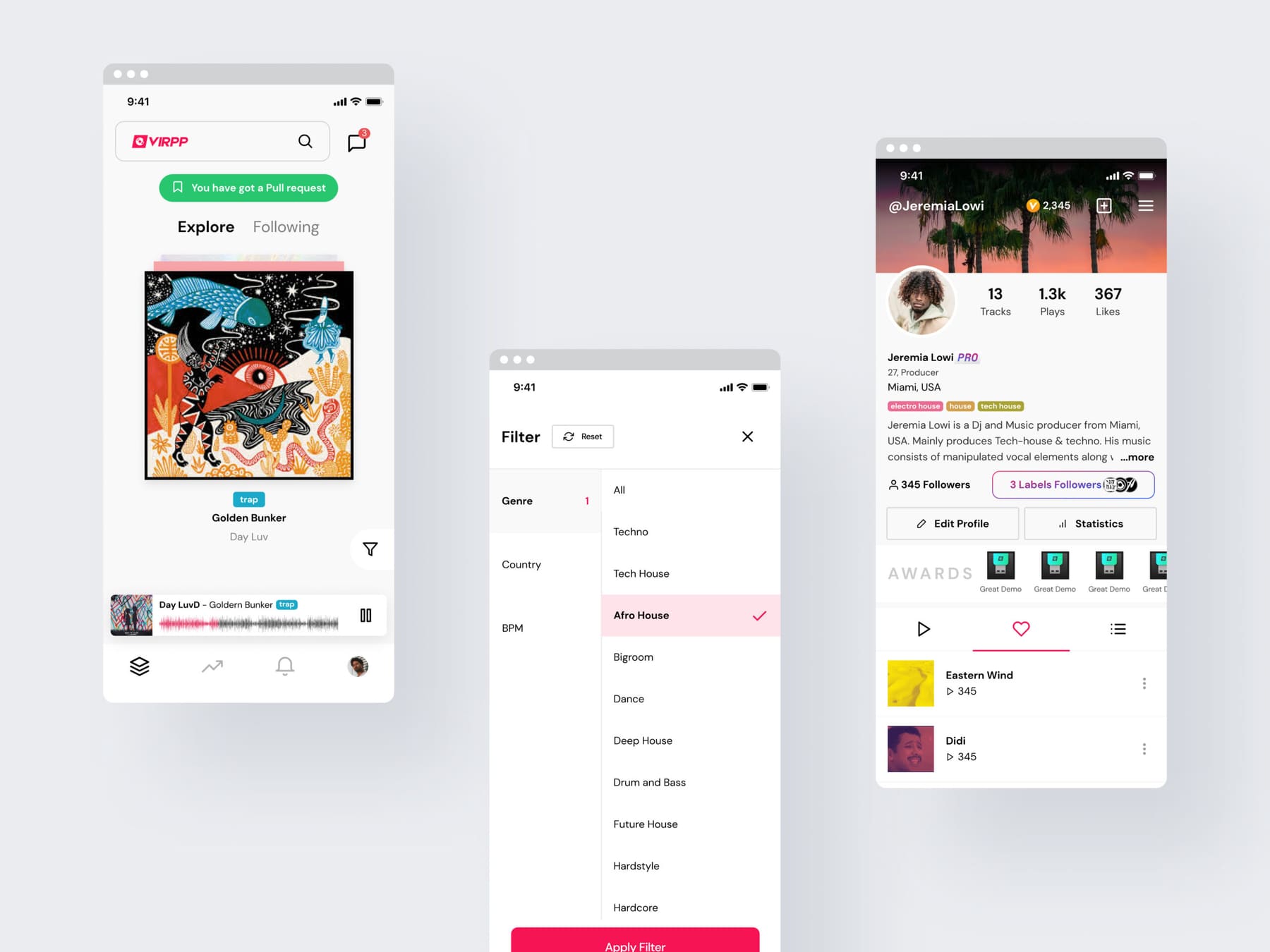
A Laravel backend serving a music platform with multiple apps at once.
One backend, multiple front ends
For VIRPP's music platform we built a Laravel backend that feeds both the web application and the React Native app with real-time data, without duplicating logic.
PHP that scales with the organisation
Laravel gives authorisation, jobs and API traffic a structure that grows with the platform, instead of loose scripts that have to be reinvented with every extension.
How much does it cost to build a Laravel back end?
That depends heavily on the scope: a custom API or admin panel is a different project from a multi-tenant SaaS platform or a complex ecommerce back end. The investment is mainly driven by the number of integrations, the complexity of the business logic and whether a front end is included too. In a no-obligation conversation we define the scope and quote.
Is Laravel or Symfony better for my project?
For most of the projects we see, Laravel is the better choice: faster development, a larger ecosystem (Filament, Nova, Octane) and easier long-term maintenance. Symfony can be more attractive with very strict enterprise architecture requirements, or if your organisation already has a Symfony team.
Can Laravel serve as the back end for a Next.js or React front end?
Yes, it's one of the most requested combinations we build: Laravel as the API back end, via REST or GraphQL with Lighthouse, with a separate Next.js or React front end on top. That gives you the flexibility of a modern front end and the robustness of Laravel for your business logic.
What is Filament, and is it suitable for our admin panel?
Filament is an admin panel package for Laravel that lets us quickly build a full, secure admin panel: user management, data overviews, forms and reports, without writing everything from scratch. For the vast majority of admin panels we build, Filament is the fastest and most maintainable route; only with very specific UI requirements do we opt for a fully custom panel.
What's the difference between Laravel and Laravel Octane?
Laravel Octane keeps the application in memory between requests, via Swoole or FrankenPHP, so response times under heavy load are noticeably lower than with standard Laravel. For most websites and internal tools, standard Laravel is more than enough; Octane becomes relevant for platforms with many concurrent users or heavy API traffic.
Can you take over an existing Laravel project?
Yes, we regularly take over existing Laravel projects, from outdated installations to codebases without tests or documentation. We always start with a technical audit of code quality, security and performance before drawing up a migration or development plan.

Get in touch with us directly. We'll get back to you as soon as we can

 Your message goes straight to our team in Amsterdam.