

 SERVICESECOMMERCE
An online store that fits your product range and your logistics
We combine commercial insight, experience and technology in online stores that sell more and cost less to maintain.

 ISO 9001 & 27001
What is a professional online store?
A professional online store is an online point of sale built on the platform that suits a business's scale and growth plans, from Shopify for a new store to headless commerce for a brand with complex integrations. Unlike an off-the-shelf template, the catalogue, checkout and integrations with payment providers, ERP and marketing tools are set up around how the business actually works. Your Tech Club gives independent advice on which platform fits each project, and builds and maintains the store from Amsterdam.
Built for clients including Tata Steel, M&G Investments, Digistore24, Toppers in Concert, Bar-le-Duc and Loogman


Before an online store is ready for its next stage, most businesses hit the same three walls.

You've outgrown the platform
The store still runs on the package you started with, but variants, tiered pricing or order volume no longer fit comfortably, and every addition becomes a workaround.

Stock and orders are out of step
Stock levels, prices and orders are kept separately in the store and in the ERP or accounting software, leading to wrong delivery times and manual updates.

Checkout and payment options are a compromise
The checkout is a standard template with no room for your own payment methods, shipping rules per country or prices per customer group, so customers drop off just before they pay.
Shopify, custom or headless, and why it depends on your process
The question is rarely which platform is best. It's which platform fits the way you sell. If your sales process fits within what Shopify does out of the box, it goes live faster, costs less to run and is easier to hand over. So that's what we recommend, even when it's the smaller job.
That changes as soon as your process becomes unusual. A configurator that calculates prices from dozens of options, stock that has to come from an ERP, tiered pricing per customer, or an order flow that runs through three systems. Then you end up fighting the platform, and that costs more than building it properly from the start.
- If your process fits Shopify, that's our advice
- Headless if you want a free front end and a standard back end
- Fully custom when your sales process sets you apart

Stock, ERP and the accounts that have to add up
Most online stores that get stuck don't get stuck on the shop. They get stuck on what happens behind it. Stock that doesn't match the warehouse, orders retyped into the accounts, and a customer service team that has to check three systems to answer one question.
That's why integrations aren't something for the final week. They're part of the design. What is the source of truth for stock, what happens when the ERP is briefly unavailable, and who is allowed to override a price? Those questions take a conversation up front, or an incident later.
- The source of truth agreed up front
- Error handling and logging on every integration
- Customer service sees one view instead of three systems

Speed is the cheapest conversion improvement you have
Before you start on button colours, there's a duller question: how fast is your store on a phone with a mediocre connection? That's where most of your visitors are, and it's where people drop off before they've even seen a product.
We measure speed with Core Web Vitals, and those scores are part of the handover. That's a concrete agreement rather than a promise, and it's also why we're cautious with third-party apps and scripts. Every tracker you add costs you something. That's fine, as long as you know what.
- Core Web Vitals at handover, not a promise afterwards
- Cautious with third-party apps and scripts
- As few steps to checkout as possible

We're not tied to any one platform, and we build online stores that grow with your brand instead of needing a rebuild after two years.
Platform advice with no agenda of our own
We don't sell licences and we're not tied to any platform. Whether Shopify, Shopify Plus, WooCommerce or a headless set-up fits best, we decide based on your catalogue, order volume and growth plan, not on what we happen to sell.
A store that grows with your brand
We build the first version of your store so that a later move to Shopify Plus, a headless front end or extra sales channels doesn't require a rebuild. You pay now for what you need and keep the freedom to scale later.
Integrated with the rest of your business
An online store never stands alone. We build the connections to your ERP, stock system, accounting and marketing tools, so orders, stock and customer data stay in sync automatically instead of sitting apart from the rest of your organisation.
A catalogue that stays easy to navigate
We set up categories, filters, variants, bundles and B2B price lists so customers and administrators quickly find what they're looking for.
A checkout that's ready for launch
We build and test the checkout on the payment methods, shipping rules and devices your customers actually use, before the store goes live.
A back office for your own team
You update products, content and promotions yourself, with roles and permissions that suit your organisation, without needing a developer.
- projects delivered
- returning clients
- from 127 reviews
- ISO27001 and 9001 certified
A website builder, a small web agency or a partner with one team.
- Your editors build pages themselves, within the brand styleWebsite builder or theme: partly · Small web agency: varies
- Accessible to WCAG 2.1 AA, from the build onwardsWebsite builder or theme: no · Small web agency: varies
- Integration with stock, ERP and accountingWebsite builder or theme: no · Small web agency: partly
- ISO 9001 and ISO 27001 certifiedWebsite builder or theme: varies · Small web agency: rarely
- Speed measured and deliveredWebsite builder or theme: partly · Small web agency: varies
- Tells you when Shopify is the better fitWebsite builder or theme: no · Small web agency: varies
- Further development and conversion after go-liveWebsite builder or theme: no · Small web agency: varies
- Dedicated contacts, office in AmsterdamWebsite builder or theme: no · Small web agency: varies
From brand strategy to launch: we work in short sprints and validate with data and users along the way.
- 01
Platform choice and scale
We start with a sober analysis of where you are now and where you're heading: number of SKUs, order volume, international sales, B2B or B2C logic. That points to the platform that fits, from Shopify for a quick start to Shopify Plus or a headless set-up for brands hitting the limits of their current store.
- 02
Architecture and integrations
Before a line of code is written, we map the data flows: which integrations with ERP, PIM, stock and payment providers are needed, and how that information stays in sync between systems. That way integrations don't end up grinding against the architecture later.
- 03
Design focused on conversion
We design product pages, category pages and the checkout around buying behaviour, not around a standard template. We test wireframes and clickable prototypes on mobile behaviour and the key conversion paths before we start building.
- 04
Building in sprints
We deliver the theme, front end and integrations in short sprints, with interim reviews so you can follow along and adjust before a choice is locked into the code.
- 05
Testing performance and payment flows
We run every checkout and payment flow on the main devices and payment methods, and check Core Web Vitals, load time under peak traffic and the security of customer and payment data.
- 06
Launch and ongoing optimisation
After launch we monitor the store closely for the first few weeks, at peak moments and on conversion behaviour. Then we carry on with targeted CRO iterations: changes to the checkout, filters or product pages backed by data from the store itself, not assumptions.
An online store keeps growing after launch
- MonitoringWe keep an eye on checkout conversion, product page load times and payment provider outages, including at peak moments such as Black Friday.
- EvaluationWe analyse where visitors drop out of the buying process and which categories, filters and search results sell best.
- SecurityWe keep the platform, plugins and payment integrations up to date and watch for PCI DSS compliance and suspicious order patterns.
- ScalingWe make sure the store can handle the rush around sales and seasonal peaks, and expand into new countries, currencies or sales channels when that's needed.
- OptimisationWe test changes to the checkout, product pages and filters, and keep improving the store based on click behaviour and sales data.

No account manager. Your first conversation is with someone who does the work, often with one of the founders. After that you work with a dedicated team from our office in Amsterdam.
- Office on the Duivendrechtsekade in Amsterdam
- ISO 9001 and ISO 27001, certified by Kiwa
- 500 projects delivered
- 4.8 from 127 reviews
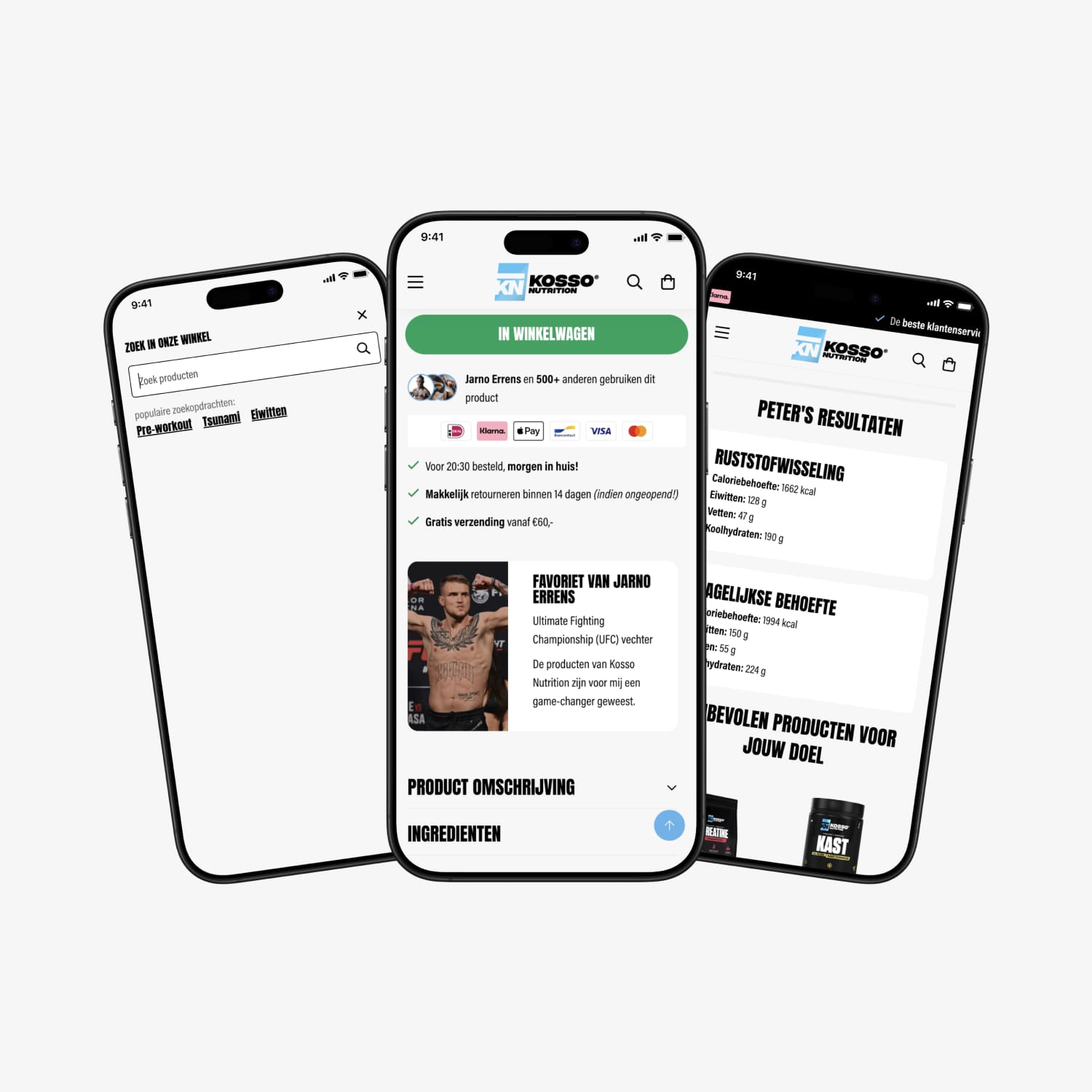
An online store only proves its worth when things get busy.
100,000 visitors, zero downtime
The first big promotion after launch was the stress test straight away: 100,000 visitors, 10,500 orders and 11.9% conversion in one day, without the store missing a beat.
In their own words
“Since launching the new online store, we've been running big promotions without any problems and our conversion rate is much higher. Your Tech Club delivered exactly what we needed.” Albert, founder of Kosso Nutrition.
Which ecommerce platform is the best fit for my online store?
That depends on your scale. For a new or mid-sized B2C store, Shopify is often the best choice. With high order volumes or international sales, Shopify Plus fits better. And with complex B2B logic or a lot of custom work, we sometimes choose a headless set-up with Next.js. We advise based on your catalogue, integrations and growth plan, not on what we'd most like to build.
How much does a professional online store cost?
An online store on Shopify with a custom theme typically starts from around €10,000. A Shopify Plus environment with integrations usually costs between €25,000 and €80,000, and a headless or fully custom platform starts from around €60,000. The final price depends on the product catalogue, integrations and internationalisation.
How long does it take to build an online store?
Your Tech Club usually delivers a Shopify store with a custom theme within four to eight weeks. A Shopify Plus migration or a headless build takes three to six months, depending on the size of your product catalogue and the number of integrations.
Can I scale up later from Shopify to Shopify Plus or headless commerce?
Yes, and that's exactly why we set up an online store to be modular from the start. If you begin on Shopify and later grow into higher order volumes or international sales, we migrate to Shopify Plus or a headless front end without losing product data, SEO value or customer accounts.
Can you migrate my existing online store to another platform?
Yes. We migrate online stores from WooCommerce, Magento or an outdated Shopify theme, for example, to a new platform, including products, customer data, order history and redirects, so your search rankings are kept and the store stays online during the switch.
Which systems can you integrate with my online store?
We routinely integrate online stores with ERP systems such as Exact, AFAS and Odoo, with accounting software, stock and fulfilment systems, and with marketing tools such as Klaviyo and Google Analytics. We use ready-made integrations, or custom API integrations where no standard one exists.
Related services

Get in touch with us directly. We'll get back to you as soon as we can

 Your message goes straight to our team in Amsterdam.