

In this article
- What is an AI strategy?
- Why do you need an AI strategy?
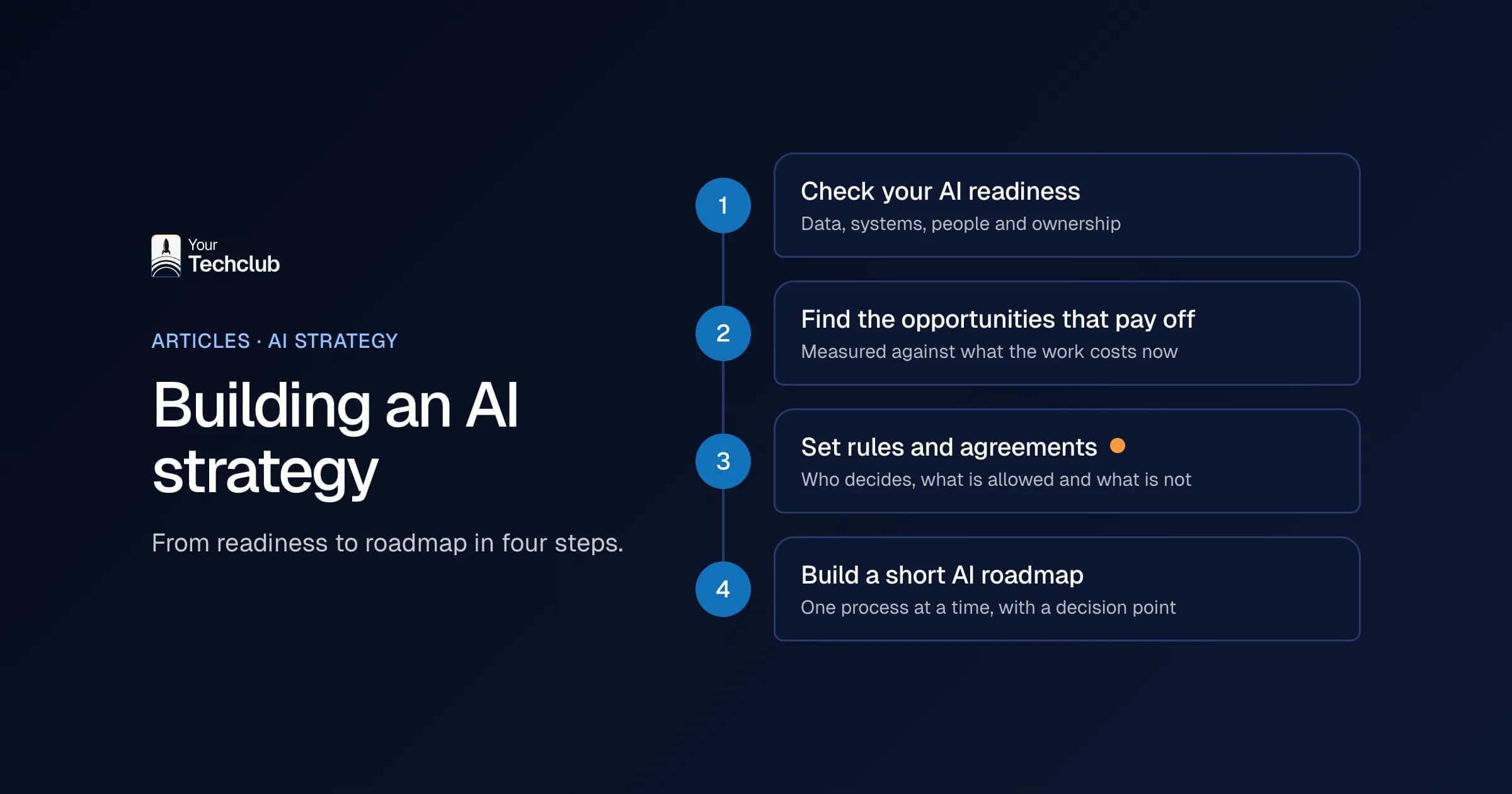
- Step 1: how do you check your AI readiness?
- Step 2: how do you find the opportunities that really deliver?
- Step 3: which rules and agreements belong in your AI strategy?
- Step 4: how do you build an AI roadmap?
- Which mistakes do you often see in an AI strategy?
- Who writes the AI strategy?
- How often do you update the AI strategy?
- Frequently asked questions
For most companies, an AI strategy is not a forty-page document. It is an answer to three questions: where does AI deliver something for us, what do we need to arrange for it, and in what order do we tackle it? If you can answer those three questions, you have an AI strategy. If you cannot, you have a list of ideas.
I often see the reverse. A board wants "an AI strategy", there is a workshop, a nice slide with opportunities appears, and then little happens. In this article you will read how to build an AI strategy that does lead somewhere.
What is an AI strategy?
An AI strategy is a plan that describes where AI adds value in your business, what you need to do that safely and in what order you tackle it. A good AI strategy fits on a few pages and has three parts: a readiness check, a list of opportunities with a baseline, and a roadmap with the first processes.
So the difference from an IT strategy is that AI does not start with systems, but with work. The question is not "which tool do we buy?" but "which work costs us most right now, and can AI do something about it?" That is why an AI strategy belongs with the board and the people who do the work, not only with IT.
Why do you need an AI strategy?
Because your people already use AI, with or without a plan. According to Statistics Netherlands (CBS), around one in six Dutch companies used AI in 2025 (CBS, December 2025). Without a strategy, everyone picks their own tool, data ends up in places nobody knows about and nobody knows what it delivers.
An AI strategy therefore prevents three things. First, that you invest in a process that delivers little. Second, that you build a pilot that never reaches production. And third, that you only discover during a customer question or a tender that you cannot explain how you handle AI and data. More on that second point is in why AI pilots fail.
Step 1: how do you check your AI readiness?
AI readiness is the degree to which your business is ready to use AI. You test four things: is your data digital and accessible, can your systems connect, do your people know enough about AI, and is there someone who wants to own it? If one of the four scores low, you start there.
A quick check with four questions:
- Data: is the information you need digital and in one place, or does it sit in mailboxes, Excel files and people's heads?
- Systems: do your main packages have an API? You can check this per package in our integrations.
- People: do the people who work with AI know what a language model can and cannot do? Since 2 February 2025 the EU AI Act asks you to take measures for it; see the AI literacy requirement.
- Ownership: is there someone who steers it every week and may make decisions?
The short definition is in our glossary under AI readiness. What I would not do: wait until everything is in order, because that moment never comes. Instead, start with a process where the data is already good enough.
Step 2: how do you find the opportunities that really deliver?
Make a list of tasks where people spend a lot of time and that come back often. For each task, measure how often it occurs, how many minutes it takes and how often something goes wrong. Then compare the candidates on return and feasibility. The task with the best combination is your first opportunity.
Think in tasks, not departments: sorting email, checking invoices, gathering quote information. Also talk to the people who do the work, because they know where it gets stuck. How to weigh candidates against each other is in which business processes suit AI. The calculation for what the work costs now is at what manual work costs.
An AI strategy without numbers is a wish list. With a baseline per opportunity you can choose, and later you can show what it delivered. For how to set returns against costs honestly, read the AI business case.
Step 3: which rules and agreements belong in your AI strategy?
Three things. A short house rule on which AI tools people may use and which data they may put into them. A list of all AI applications with an owner for each one. And for each application, the risk under the EU AI Act and the GDPR. That does not have to be a thick policy document; one A4 page per part is enough.
What you have to comply with is in EU AI Act and GDPR: what to sort out. How to write such a house rule is in writing an AI policy. And how to keep it up to date without grinding to a halt is in AI governance for SMEs.
Step 4: how do you build an AI roadmap?
An AI roadmap puts your opportunities in order, with a start, a decision point and an owner for each one. Begin with one process that shows results quickly and carries little risk. Next, add the processes that build on the same integrations or data. Then plan a moment every quarter to adjust the roadmap.
A simple AI roadmap has four columns:
| When | Process | Goal and baseline | Decision point |
|---|---|---|---|
| Quarter 1 | The first process from step 2 | For example minutes per item and error rate | After the pilot: stop, improve or scale up |
| Quarter 2 | A process on the same integrations | Same | Same |
| Quarters 3 and 4 | Larger processes or an AI agent | Same | Same |
Also keep the roadmap short. A two-year roadmap with twenty projects is out of date after three months. The glossary entry AI roadmap explains the term. How you get from the first opportunity to a working application is in the step-by-step plan for AI implementation.
Which mistakes do you often see in an AI strategy?
Most mistakes happen because the strategy starts too big. So it pays to know them in advance, because each one costs months that you could have spent on a working first process. Fortunately they are easy to spot once you know what to look for. These four I see most often:
- Starting with the tool. "We will get Copilot for everyone" is a purchasing decision, not a strategy. Start with the work and only then choose the tool.
- No numbers. Without a baseline you cannot choose, and afterwards you cannot show what it delivered either.
- Too much at once. Ten pilots at the same time means ten pieces of half-finished work. So pick one process and finish it.
- Rules as a brake. A thirty-page policy makes people use AI out of your sight. A short house rule works better, because everyone reads it.
What all these mistakes have in common: the strategy becomes a goal in itself. However, an AI strategy is only good if something is running within a few months that you can measure.
Who writes the AI strategy?
The board, together with the people who do the work. The board sets the goals and the budget, the process experts know the work and the exceptions, and someone who knows your systems judges what is feasible. An outside party can help with the measurement and the technology, but you make the choices yourself.
What I would not do: fully outsource the AI strategy to a consultancy that does not build afterwards. Then you get a report that is correct, but that nobody carries out. What to look for when choosing a partner is in choosing an AI consultant and on our AI consultancy page.
How often do you update the AI strategy?
Every quarter, briefly, because models get better, prices drop and your own processes change. Each quarter, look at which opportunities have delivered, what the baseline says now and whether the order of the roadmap still holds. Once a year you also repeat the readiness check from step 1.
Frequently asked questions
What is the difference between an AI strategy and an AI roadmap?
The AI strategy says where AI adds value and what you arrange for it. The AI roadmap puts the opportunities in order, with a start, an owner and a decision point for each one. The roadmap is the part of the strategy you can carry out.
How long does it take to build an AI strategy?
You can do the readiness check and the list of opportunities in a few weeks, if you take the baseline seriously. The AI Opportunity Audit does it in five working days.
Does a small business need an AI strategy?
Yes, but a small one. A house rule, a list of applications and one first process with a measurement is enough for a company of twenty people.
What is AI readiness?
The degree to which your business is ready to use AI, measured on data, systems, employee knowledge and ownership.