

In this article
- What is SEO for AI?
- What is SEO for AI called: GEO, AEO or LLMO?
- Is SEO for AI different from ordinary SEO?
- How do you write content that AI search engines quote?
- What are entities and why do they matter for AI?
- Do you need schema for SEO for AI?
- Should you create an llms.txt file?
- Which AI crawlers should you allow?
- What does SEO for AI deliver? Our own figures
- How do you measure whether AI search engines mention you?
- Where do you start as an SME?
- Frequently asked questions
On 1 November 2026, according to Ahrefs, our Dutch website yourtechclub.nl was mentioned in 29 AI answers. A month earlier it was 22. I would love to present this as proof that SEO for AI works. I cannot, though, because our own changes only went live on 30 October.
Hence this article, with the figures included. First what SEO for AI is, then what the makers of the AI search engines themselves say works, and after that what we did and how we measure. There is no secret button. What you do control: how easy your site is to find, read and quote. And whether you measure what happens.
What is SEO for AI?
SEO for AI means setting up your website and your name so that AI search engines find your information, understand it and mention it in their answer. The goal differs from classic SEO: not position three in a list of ten links, but a mention in one generated answer. Often only two or three sources appear in it.
An AI search engine is a service that answers a question with text it writes itself, based on sources it fetches at that moment. ChatGPT search, Perplexity, Copilot and the AI Overviews in Google work like this. How the language model underneath works, you can read under what a large language model is. In a list of links, the reader chooses. In an AI answer, the machine chooses.
What is SEO for AI called: GEO, AEO or LLMO?
SEO for AI has no official name. The most common term is GEO, generative engine optimisation. You will also see AEO, answer engine optimisation, and LLMO, large language model optimisation. They mostly mean the same thing: making sure that a system which writes its own answers uses your information and mentions you.
| Term | In full | What it aims at |
|---|---|---|
| GEO | Generative engine optimisation | Being mentioned in answers from AI search engines such as ChatGPT search, Perplexity and AI Overviews |
| AEO | Answer engine optimisation | Supplying the direct answer to a question, also in featured snippets and voice assistants |
| LLMO | Large language model optimisation | Being well represented in what language models know and fetch about you |
| SEO for AI | The everyday umbrella term | Everything above, plus the ordinary SEO underneath |
The term GEO comes from a research paper from November 2023, "GEO: Generative Engine Optimization" by Pranjal Aggarwal and colleagues. Marketers then took it over. My advice: do not worry about the name. Anyone who sells you a separate "GEO package" that stands apart from your normal findability is usually selling you the same foundation twice.
Is SEO for AI different from ordinary SEO?
Mostly not. Google states plainly that there are no extra requirements to appear in AI Overviews or AI Mode: your page has to be indexed and eligible to show with a snippet in the search results. So classic SEO remains the foundation. What AI adds is mainly a different way of writing and measuring.
The source is clear. The page on AI features says you do not need new machine-readable files, AI text files or special schema markup (Google Search Central, "AI features and your website", updated 10 December 2025, accessed October 2026). So for Google, if you do not rank well in the ordinary results, you will not do well in the AI answers either.
What I would not do: have hundreds of pages generated in the hope that one of them ends up in an AI answer. That produces thin content, and neither search engines nor readers like that.
How do you write content that AI search engines quote?
Put the answer at the top. Under every heading, first write a direct answer of 40 to 60 words and only then give the explanation. Use headings in the form of a question, the way people ask ChatGPT. In each section, write one sentence that stands on its own, with a number or a definition.
AI search engines like to cut out a piece of text that is correct without context. That is why this article is built the same way.
A few rules of thumb we stick to in our own texts:
- One question per heading. "What does an integration cost?" works better than "Costs and considerations".
- Specific rather than general. Name a tool, a date, a number. "Within 5 working days" says more than "quickly".
- Sources with a year. An outside figure gets a link and the year it appeared. That way a reader, and a machine, can check it.
- A FAQ at the bottom. Short questions with short answers, exactly in the form people ask an AI.
- A visible update date. For topics that change fast, a reader wants to know whether the text is still correct.
You won't always see whether it works in your numbers, because not every click from an AI answer sends a referral along. My advice: ask every new lead how they found you, and note it when the answer is ChatGPT, Perplexity or another AI search engine.
What are entities and why do they matter for AI?
To a search engine, an entity is a recognisable thing: your company, your founder, your address, your product. AI search engines attach information to entities like these. If your company appears everywhere with the same name, the same address and the same description, the machine knows for sure it is you. If that varies, it has doubts.
In practice it often goes wrong on small things. On your site you are "Your Tech Club", on LinkedIn "YTC" and an old listing still shows a previous address. To a person that is clear. A machine may see three different companies.
So align these details on your site, your Google Business Profile, LinkedIn and listings on other sites:
- Company name, written exactly the same everywhere.
- Address and town or city.
- Names and job titles of the founders.
- One fixed sentence that says what you do.
Mentions outside your own site count too. What you say about yourself is one source. What trade media, industry associations or partners write about you usually carries more weight for an AI assistant. Buying links is not part of that; you have to earn mentions like these.
Do you need schema for SEO for AI?
Schema is a fixed way of putting data into your page, so that machines can read who you are and what you offer. For Google you do not need any special schema to get into AI Overviews. Still, it is useful, because it describes your entity unambiguously: Organization, Person, Article and FAQPage.
Since 30 October 2026 we have used three types on the blogs of our Dutch site. Article (strictly speaking BlogPosting) for the text itself, with publication and update date. Person for the author, with a sameAs link to LinkedIn. And FAQPage for the question block at the bottom. Schema does have to match what is on the page. Questions in your schema that nobody sees on the page are a bad idea. So do not treat schema as a miracle cure, but as admin that is correct.
Should you create an llms.txt file?
It does no harm, but do not expect anything from it. Llms.txt is a proposal from September 2024 for a Markdown file in the root of your site, with a short summary and links to your most important pages. It is not an official standard. Whether AI search engines use it when putting an answer together has not been shown.
Google says you do not need AI text files to appear in its AI features. From the other big providers I have seen no official confirmation that they read llms.txt. My advice: create it if your site is being updated anyway, as it takes an hour. Do not spend budget on it.
Which AI crawlers should you allow?
Check in your robots.txt which crawlers you block. For visibility in AI search results, the search crawlers count most, such as OAI-SearchBot from OpenAI and Claude-SearchBot from Anthropic. Training crawlers, such as GPTBot and ClaudeBot, are separate from those. So you can block training and still allow search.
The overview below comes from the official pages of OpenAI, Google, Anthropic and Perplexity (accessed October and November 2026):
| Name in robots.txt | From | Used for |
|---|---|---|
| OAI-SearchBot | OpenAI | Showing websites in ChatGPT's search features |
| ChatGPT-User | OpenAI | Fetching a page because a user asks for it; not an automatic crawler |
| GPTBot | OpenAI | Content that may be used to train models |
| Google-Extended | Use of content for training and grounding of Gemini; no effect on Google Search | |
| Claude-SearchBot | Anthropic | Indexing content for search results in Claude |
| ClaudeBot | Anthropic | Collecting content that may contribute to training |
| PerplexityBot | Perplexity | Showing and linking websites in Perplexity's search results; not for training |
Two things stand out. OpenAI says that if you block OAI-SearchBot, you will not appear in ChatGPT's search answers (OpenAI, "Overview of OpenAI crawlers", accessed 1 November 2026). A change in robots.txt is picked up there after about 24 hours. And according to Google, Google-Extended has no effect on inclusion or ranking in Google Search.
The robots.txt files of yourtechclub.nl and yourtechclub.com allow the crawlers of OpenAI, Anthropic, Perplexity and Google-Extended by name, along with Bingbot and Applebot among others. That includes GPTBot and ClaudeBot. So we deliberately choose to allow training as well. That is a choice, not advice: a publisher with paid articles may see that very differently.
I regularly come across sites where a security plugin or a hosting company blocks every bot with "AI" or "GPT" in its name. In that case you are invisible to ChatGPT search without knowing it. Also check your firewall and your CDN, because robots.txt is not the only place where a crawler gets stuck.
What does SEO for AI deliver? Our own figures
For our Dutch site, the number of AI mentions in Ahrefs went from 22 in October to 29 on 1 November 2026. That is an increase of 32 percent. Still, I cannot say that our changes caused it, because they had only been live since 30 October. What the figures do show: where you stand, and which AI search engine you are missing.
| AI search engine | October 2026 (baseline) | 1 November 2026 |
|---|---|---|
| Google AI Overviews | 13 | 14 |
| ChatGPT | 4 | 6 |
| Google AI Mode | 2 | 5 |
| Gemini | 2 | 2 |
| Copilot | 1 | 2 |
| Perplexity | 0 | 0 |
| Total | 22 | 29 |
Source: own measurement via Ahrefs (Brand Radar and Site Explorer), yourtechclub.nl, the Netherlands. These are figures for our Dutch-language site in the Dutch market, not for this English site. In the same period the Dutch site had about 264 organic visitors a month and a Domain Rating of 28. In other words, a small, ordinary SME domain.
What stands out? Google supplies 19 of the 29 mentions, if you add AI Overviews and AI Mode together. That fits with what Google itself says: if you appear in the ordinary results, you stand a chance in the AI answers. Perplexity is at zero. That is what I will look at first.
This is what we changed on the Dutch site on 30 October:
- Under every question heading there is now a direct answer first.
- FAQ, Article and Person schema on the blogs.
- A series of glossary pages with short definitions.
- A robots.txt that allows the AI crawlers from the table above by name.
Since 25 October we have also been able to use IndexNow. That protocol notifies search engines such as Bing of new and changed pages straight away (IndexNow FAQ, accessed November 2026). Google does not take part.
How do you measure whether AI search engines mention you?
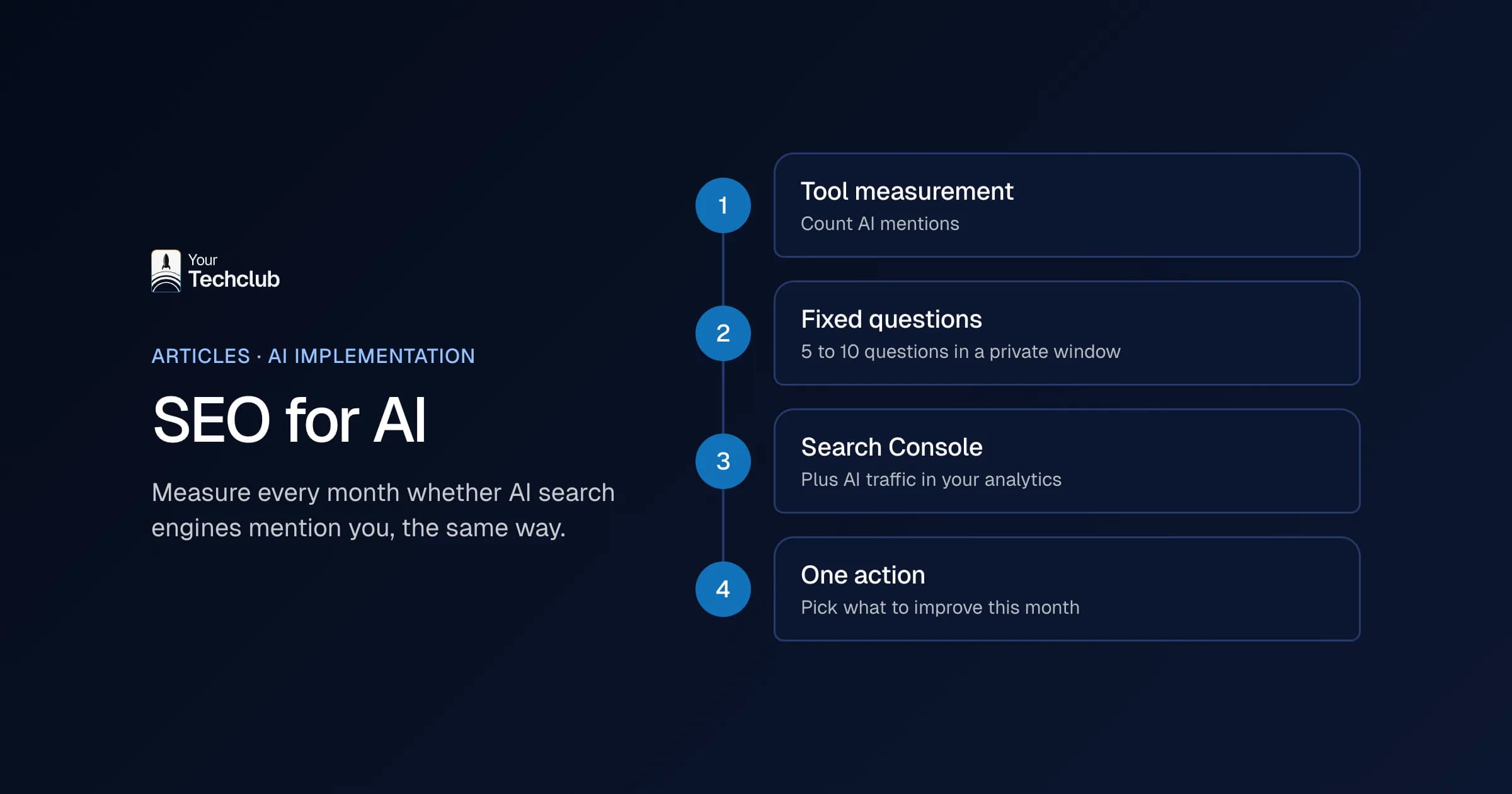
Measure every month in three ways: a tool that counts AI mentions, a fixed set of questions you ask ChatGPT, Perplexity and Google yourself, and the traffic in Search Console and your analytics. One measurement says little, because AI answers vary per day and per user. After six months you will see a trend.
The monthly measurement in four steps
- First working day of the month: tool measurement. Note the number of AI mentions per AI search engine from Ahrefs or a similar tool. Always the same tool, or you are comparing apples with oranges.
- Same day: fixed set of questions. Ask 5 to 10 questions a customer would ask, in a private window and without being logged in. For each question, note whether you are mentioned, whether there is a link and who is mentioned instead of you.
- Search Console and analytics. Google counts clicks from AI Overviews and AI Mode in the normal performance report, under the search type "Web". So you do not see them separately there. In your analytics you sometimes see chatgpt.com or perplexity.ai as a referrer. That is an underestimate, because not every click passes on a referrer like that.
- Pick one action. Who is mentioned while you are not? Look at which page of that competitor gives the answer. That becomes your improvement point for the coming month.
A spreadsheet is enough. These columns work fine:
My advice for the question set: choose questions a customer would really ask, with your service and your region in them, and keep the set the same for a few months. If you change the questions, your measurement starts over.
Where do you start as an SME?
Start with a baseline measurement, so that you know later whether something works. Then check that your robots.txt and firewall do not block AI search crawlers and that your name is the same everywhere. After that, rewrite your five most important pages with the answer at the top. A month later you measure again. We are in that phase ourselves right now.
An order I would stick to:
- Week 1: baseline with a tool and your question set, check robots.txt and firewall.
- Week 2: align name, address and description on your site, Google Business Profile and LinkedIn.
- The two weeks after that: rewrite your most important pages with the answer first and a FAQ.
- After that: measure every month and update your texts every quarter.
Is visibility in AI part of a bigger plan? Then look more broadly first. In our step-by-step plan for AI implementation in SMEs you can read how to decide where AI really pays off in your business. For companies that want to use ChatGPT themselves, there is more in ChatGPT for business. And if you would rather outsource the technical maintenance of your site, see website maintenance with an SLA. What a technically strong foundation looks like, you can see in a headless platform the team maintains itself, also through an AI assistant.
Opportunity first. Then the technology. That applies to AI in your processes, and just as much to your visibility in AI answers.
Frequently asked questions
What is SEO for AI called?
The most common name is GEO, generative engine optimisation. You will also see AEO (answer engine optimisation) and LLMO (large language model optimisation). They are all about being mentioned in answers that an AI writes itself.
Can you guarantee that ChatGPT will mention my company?
No. AI search engines choose their own sources and often change how they work. You can improve your chances with good SEO, clear texts and consistent details, and you can measure. Nobody can guarantee a place in an answer.
How do I measure whether ChatGPT mentions my company?
Every month in the same way: count AI mentions with a tool such as Ahrefs, ask a fixed set of 5 to 10 questions in a private window and look in Search Console and your analytics for traffic from AI. Only after a few months will you see a trend.
Should I block GPTBot?
That is a choice about training, not about visibility. GPTBot collects content for training models. For ChatGPT's search features, OAI-SearchBot is what counts. You can block GPTBot and allow OAI-SearchBot.
Does an llms.txt file help you get found in ChatGPT?
That has not been shown. Llms.txt is a proposal from 2024, not a standard. Google says you do not need AI text files. Feel free to create one, but do not expect a measurable effect.