

Financial lease website for GIJBA: from car to quote
How we built a financial lease website for GIJBA: compare cars, see the monthly cost and request a quote with just three fields. Read the choices we made.

GIJBA arranges financial lease for business owners. We built them a financial lease website where you pick a company car, see what it costs per month and request a quote straight away. Choosing a car is fun. The financing process around it usually isn't.
So I didn't want a site that was mainly good-looking. I wanted a route where every page brings the business owner one step closer to a conversation. Below you can read how we approached it, what we built and where we deliberately did less than usual.
The project in brief
- Client
- GIJBA, financial lease for business owners.
- Sector
- financial services and automotive.
- What we did
- digital strategy and information architecture, UX/UI design with wireflows and prototypes, a reusable design system, front-end development, API integrations, SEO and website migration, analytics, lead tracking and QA.
- Technology
- responsive custom platform with CMS-driven content and API integrations for vehicle data, the Dutch Chamber of Commerce (KvK) and LFH.
What was the challenge with this financial lease website?
GIJBA's visitors have little in common. Start-ups, freelancers and SMEs come by, sometimes without extensive annual accounts. One knows exactly which car they want, another first wants to understand what is possible. One website had to help all of them, without anyone getting lost.

That sounds like an ordinary brief. In practice it asked a lot of one platform at once. The proposition had to be clear within seconds. A large stock had to stay easy to browse. Financial lease had to make sense to someone who had never used it. And the step to a request had to get easier, while everything behind the scenes connected to systems and data sources.
On a classic used-car site, everything revolves around the car. Many financial sites do the opposite: they talk about terms and ignore the car. GIJBA sits right in between. So the site had to do both.
Why did we choose a route instead of separate pages?
Because a standalone page doesn't help anyone who still has to choose. We looked at the whole journey from first visit to lead. For every screen we asked the same question: what information does a business owner need at this moment to take the next step? That led to a six-step route.
The route runs from getting oriented to building trust, and then to discovering the stock. Next, the visitor compares vehicles, reads the lease terms and requests a quote. Every page got a role within the same route. Any page without a role, we removed.
Flow first, screens second
Before we designed a single screen, we mapped the user flows. The main flow became: homepage, stock, filters, vehicle detail, quote request and personal contact. Alongside that fast route, we designed side paths for people who want more certainty first. Think customer reviews, an explanation of financial lease, the terms, frequently asked questions and direct contact by phone or WhatsApp.
I find this the most boring and at the same time the most useful phase of a project. It saves hours of debate about the colour of a button later on.
Want a website that guides visitors to a request too? We map the route first and only then start building.
See custom website development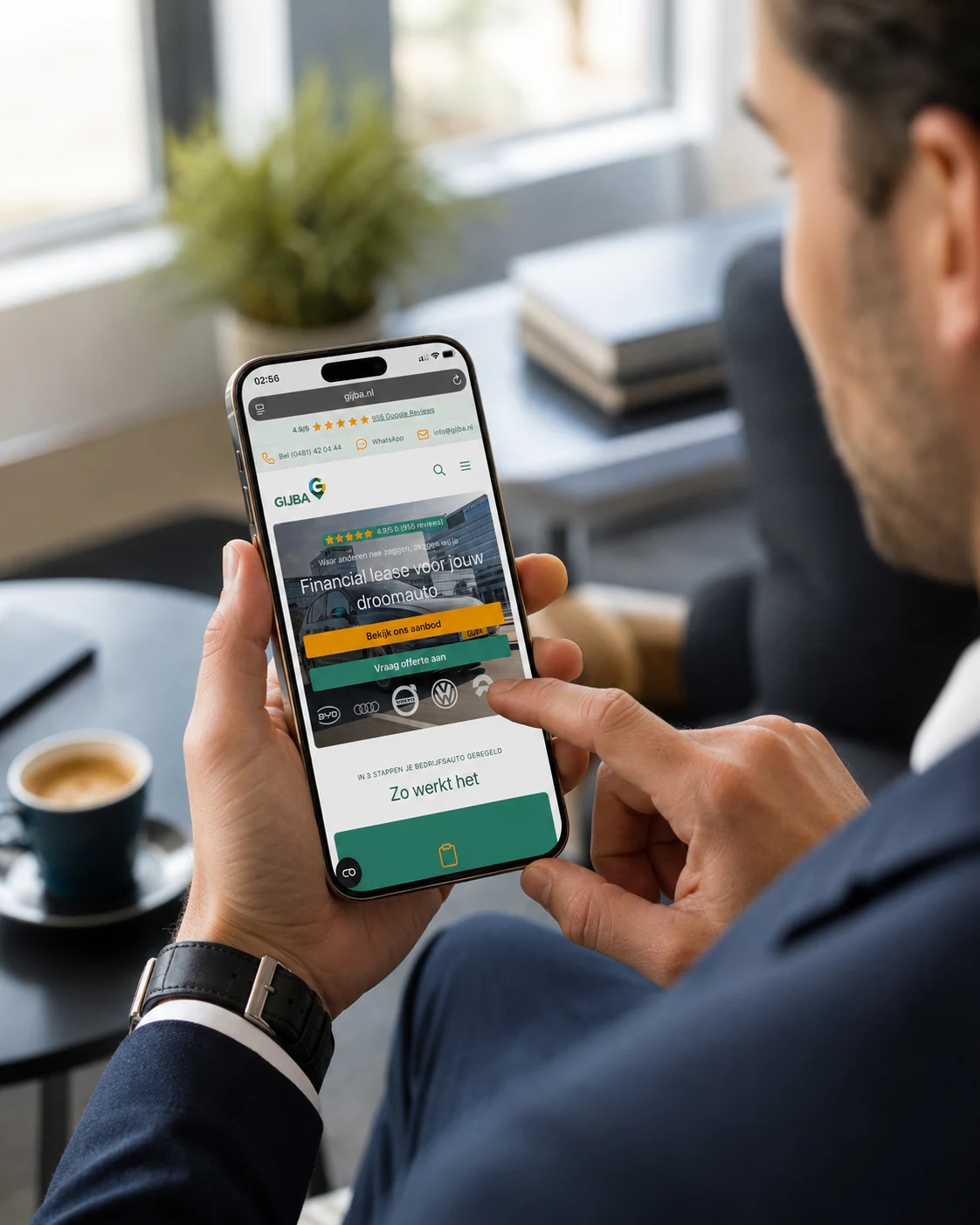
How did we build the stock and the financing?
With a vehicle page that combines three layers. At the top is the car, with photography, specifications and options. Next to it you see the financing, with monthly cost and purchase price. Below that comes the next step: request a quote or get in touch. That way nobody has to switch between websites or separate calculators.
The stock without information overload
An automotive site easily turns into a database full of specifications. At GIJBA, vehicle photography takes centre stage. The information that matters stays visible straight away: make and model, monthly cost, purchase price, mileage, year, power, fuel and transmission. With filters, a visitor goes from a broad stock to the cars that suit them.
Integrations behind the scenes
Under the platform run API integrations with vehicle data, KvK data and LFH. We took those technical constraints into account during design, along with the CMS fields, form logic, validation, analytics and lead tracking. Precisely because UX, development and integrations weren't separate phases, the complexity stays behind the scenes. Want to know what an integration like this involves? Take a look at our integrations. We know LFH well, by the way: we built a lease platform for equipment for them too.
A quote request with three fields
Many financial websites ask visitors for their life story straight away. We deliberately kept the first step light. The request only asks for a company name or KvK number, an email address and a phone number. Then the personal conversation begins. So the form doesn't replace the adviser. It brings the right adviser and the right business owner together faster.
What does the design look like?
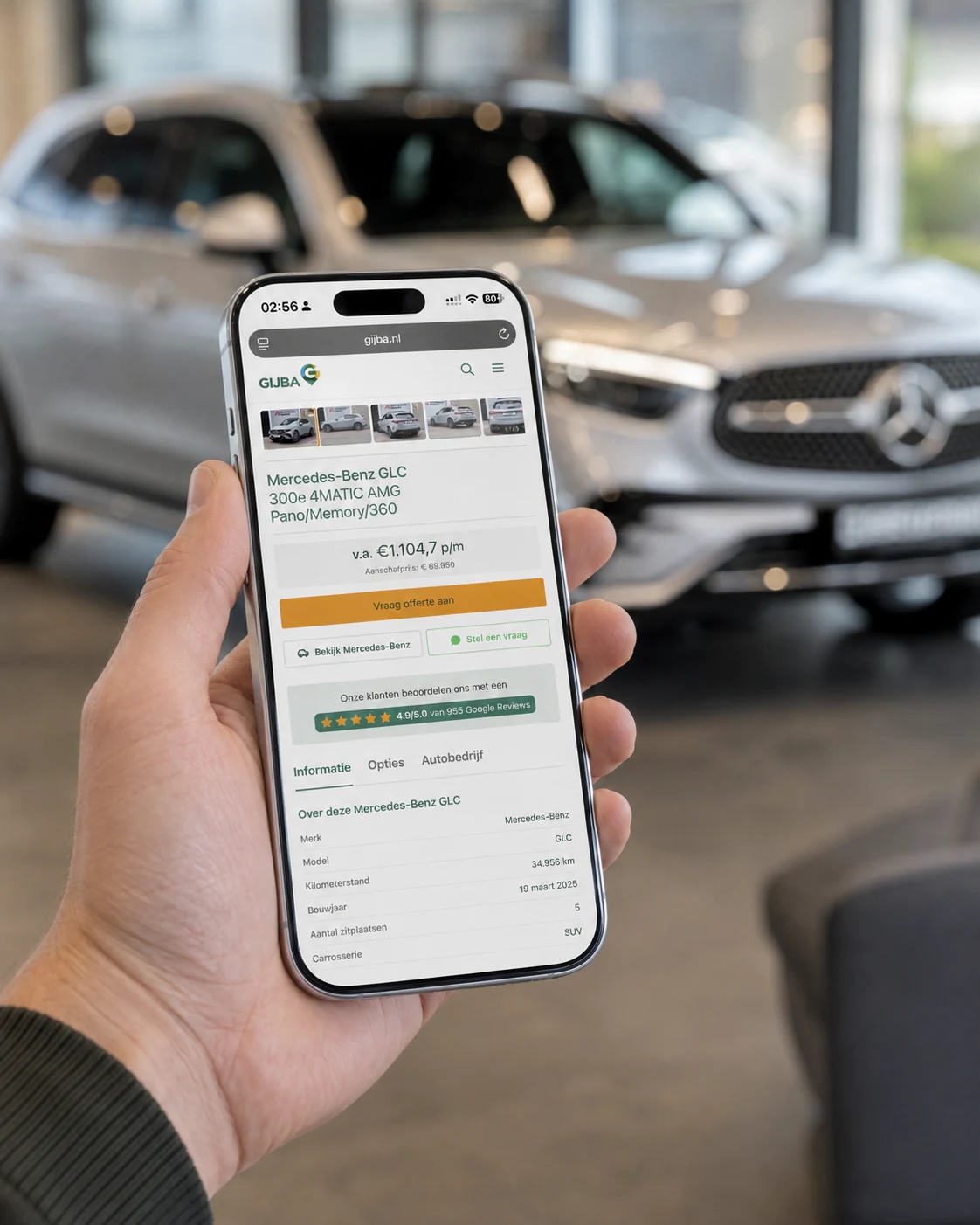
Calm, with plenty of white space and a clear hierarchy. GIJBA's recognisable green and orange run through the whole platform. Customer reviews don't just sit on a review page, but also appear at the moments when a business owner has doubts. With financial lease, trust has to be felt throughout the route.
Mobile got its own design. Navigation, vehicle cards, reviews, forms and buttons were designed for the phone, not shrunk down from desktop. That keeps the key actions close at hand: browse the stock, ask a question, get in touch.
We captured everything in a reusable design system. Colours, typography, spacing, buttons, forms, cards, navigation, interaction patterns and responsive behaviour have one source. A platform with marketing pages, vehicles, forms and reviews needs that. Otherwise you'll have five kinds of buttons a year from now.
How did we keep the old website's search visibility?
By including the migration in the design from day one. In a redesign, search visibility matters as much as the look. So we mapped existing pages, URL structures and organic rankings before anything moved. Wherever an address changed, we added a redirect.
The new foundation supports a clear page hierarchy and indexable vehicle and content pages. It also includes internal links, logical URLs, technical performance and metadata. Want to know roughly what a project like this costs? Read our explanation of the cost of having a website built.
What did the new financial lease website deliver?
Business owners now discover what is possible within one environment. They browse the stock, compare vehicles, read the lease information and request a quote. For GIJBA, the financial lease website is also a foundation for marketing, SEO and conversion optimisation, with analytics and lead tracking that show where visitors drop off.
Want to know what a platform like this could do for your business? I'm happy to help think through the route from visitor to request.
Book an intro callUpdated
Get in touch with us directly. We'll get back to you as soon as we can


 Your message goes straight to our team in Amsterdam.
Who built the GIJBA website?
Your Tech Club designed and developed GIJBA's financial lease platform. The work covered digital strategy, information architecture, UX/UI design, wireflows, a reusable design system, front-end development, API integrations, SEO and analytics.
What technology does the GIJBA website run on?
A responsive custom platform with CMS-driven content and API integrations for vehicle data, Dutch Chamber of Commerce (KvK) data and LFH. The front end is built on a reusable design system.
What makes a financial lease website different from a regular automotive website?
The visitor judges not only the car, but also what it means financially. That is why the vehicle page combines the car, the financing with monthly cost and purchase price, and the step to a quote. That way nobody has to switch between websites or calculators.
How is the quote request set up?
Deliberately light. The first step only asks for a company name or KvK number, an email address and a phone number. Then the personal conversation with an adviser begins. The form doesn't replace that conversation, it brings the right adviser and the right business owner together.
Is search visibility kept during a redesign?
In this migration, existing pages, URL structures and organic rankings were taken into account. The new foundation supports a clear page hierarchy, indexable vehicle and content pages, internal links, redirects and metadata.