

An overview of AI agents for a retail organisation
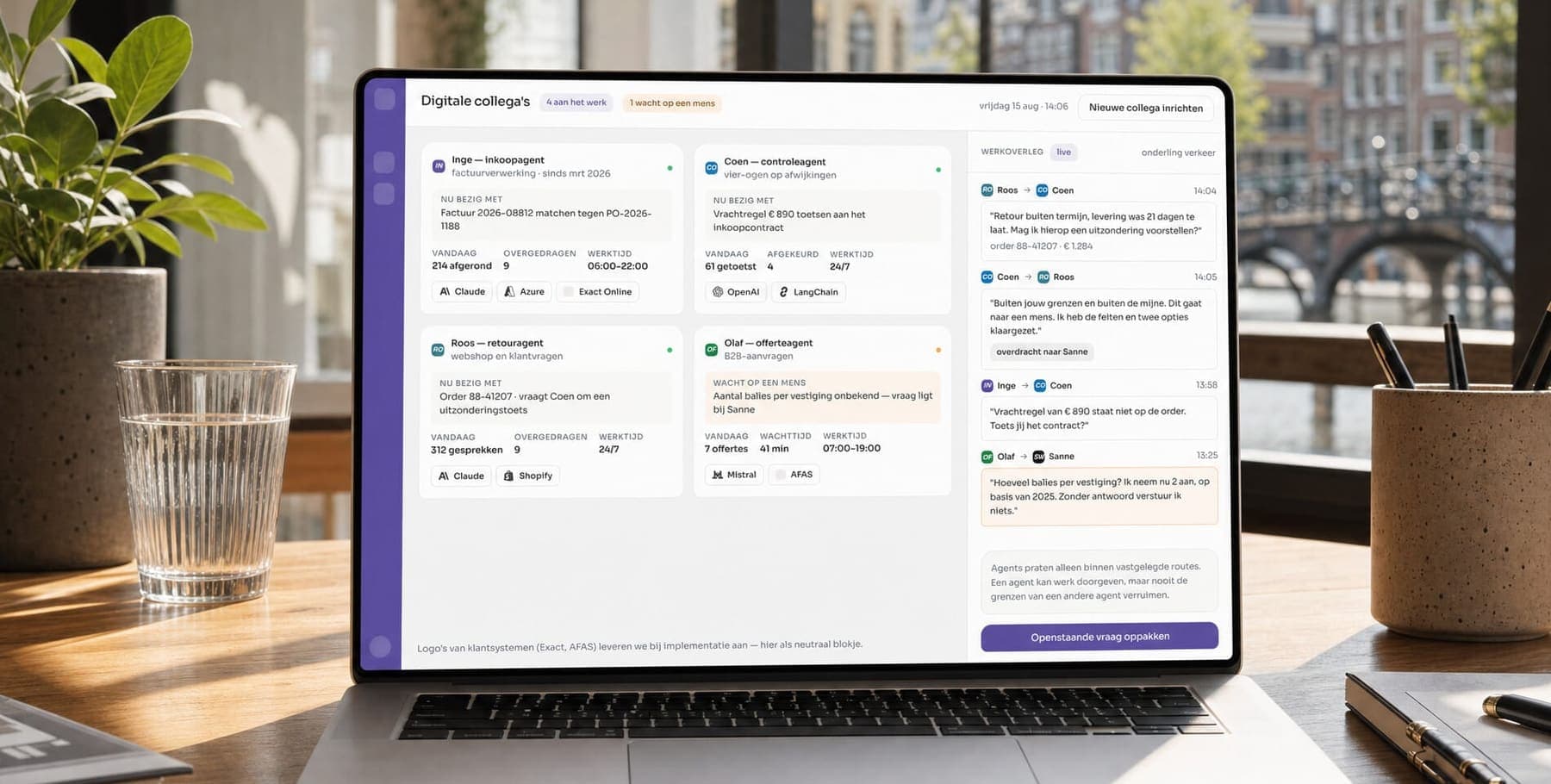
AI agent dashboard for a retail organisation: every agent has a task, fixed limits and a log, so a team lead keeps human oversight of the work.
Deliverables
- UX/UI design
- Web application development
- AI implementation
- Data and AI
Tech stack
- Next.js
- Claude
- OpenAI
- LangChain
- Azure
Our client was running several automations side by side: each set up separately, with no shared overview. Nobody could say what an agent had done that day, who had switched it on, or what happened when it got stuck. Your Tech Club built an overview that treats automation as a team, not as a collection of loose scripts.
What was the problem with the existing automations?
The separate automations did their job, but nobody could see them. There was no central place to check which agent was active, what it was working on, or what happened when it ran into a situation it was not allowed to handle itself.
For a team lead, that meant piecing things together afterwards instead of following along live. For the organisation, it meant a growing number of automations without a clear owner or clear limits.
What did we build?
An overview in which every agent is treated as a digital colleague: with a name, a concrete task, fixed working hours, a manager and explicitly defined permissions. A team lead sees live what each agent is working on, what it has handed over to another agent, and when it needs a person.
Agents can pass work to each other along predefined routes, but can never widen each other's limits. As soon as a situation falls outside an agent's limits, the case goes to a person automatically, with the relevant facts already attached.
How is human oversight ensured?
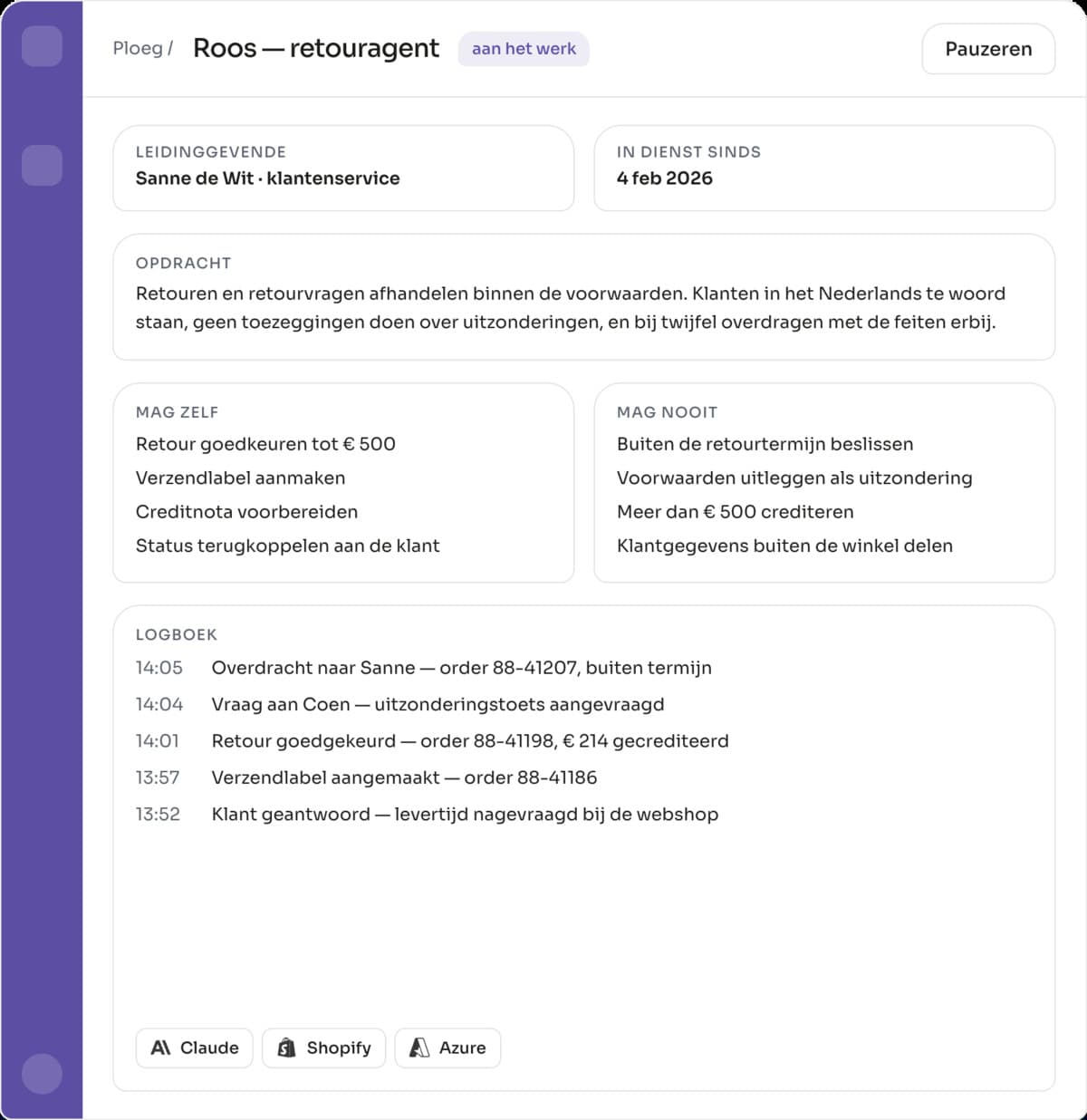
Every agent has an explicit list of what it may decide itself and what must always go to a person. Those limits live in a separate rules system, not scattered across individual scripts, so they can be checked and changed in one place.
What does the technical architecture look like?
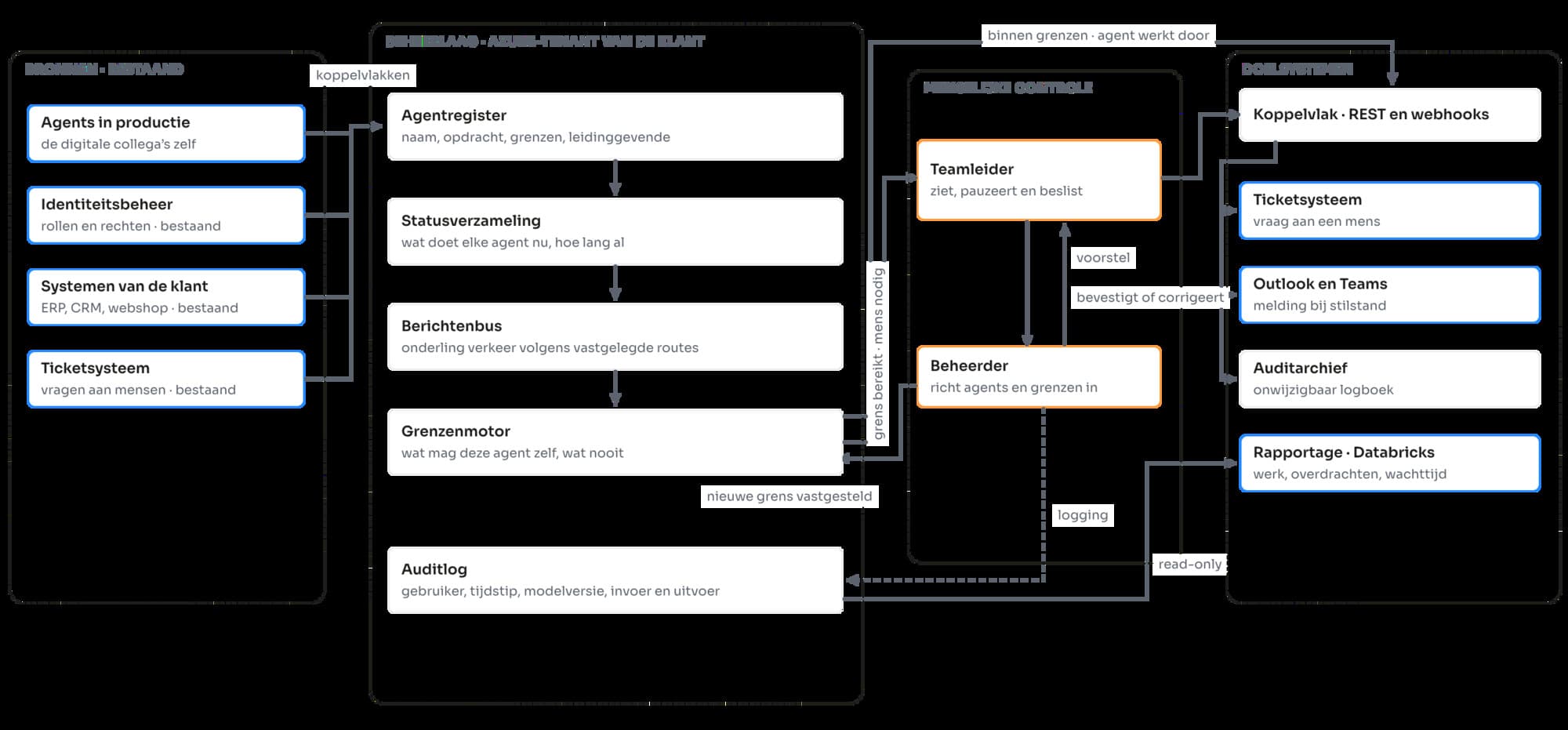
All of this sits in a dedicated layer within the client's Azure tenant: an agent registry with each agent's name, task and limits; a status store that tracks what each agent is doing; a message bus for traffic between agents along fixed routes; and a rules engine that decides, per agent, what it may do itself and what it may never do. The client's existing systems, such as ERP, CRM, online store and ticketing system, stay where they are; the overview layer integrates with them and does not replace them.
Every action, handover and decision is recorded in an immutable audit log: who, when, with which input and output. That makes the agents' work visible and traceable afterwards.
What does the overview deliver?
Oversight instead of detective work
A team lead sees on one screen whether work is flowing, instead of having to reconstruct it afterwards from separate systems.
Fixed limits per agent
What an agent may and may never decide on its own is set down and can be checked, instead of being hidden implicitly in code.
Traceable decisions
Every action can be traced to a moment, an agent and the data the action was based on.

Get in touch with us directly. We'll get back to you as soon as we can


 Your message goes straight to our team in Amsterdam.
Who built this AI agent overview?
Your Tech Club. We did the UX/UI design and the web application development, and set up the agent registry, the rules engine and the audit log within the client's Azure tenant.
What did Your Tech Club build for this retail organisation?
An overview layer on top of existing automations. Every AI agent gets a name, a task, fixed working hours, a manager and explicit permissions, and a team lead sees live what is running and where a person is needed.
What technology does the overview run on?
Next.js on the front end, with Claude, OpenAI and LangChain for the agents themselves, hosted in the client's Azure tenant. Existing systems stay where they are; the overview layer integrates with them.
How do you keep human oversight of AI agents?
By setting down, per agent, what it may decide itself and what always goes to a person, and managing those limits in one place instead of scattered across scripts. If a situation falls outside the limits, the case goes to a person with the relevant facts attached.
Can an AI agent's decisions be traced afterwards?
Yes. Every action, handover and decision goes into an immutable audit log with who, when, which input and which output. That means you can reconstruct afterwards why an agent did what it did.