


VIRPP dashboard: labels search for talent instead of an inbox
The VIRPP dashboard lets labels search demos by genre, location and age. Read how we built it for multiple record labels at once, on a single system.
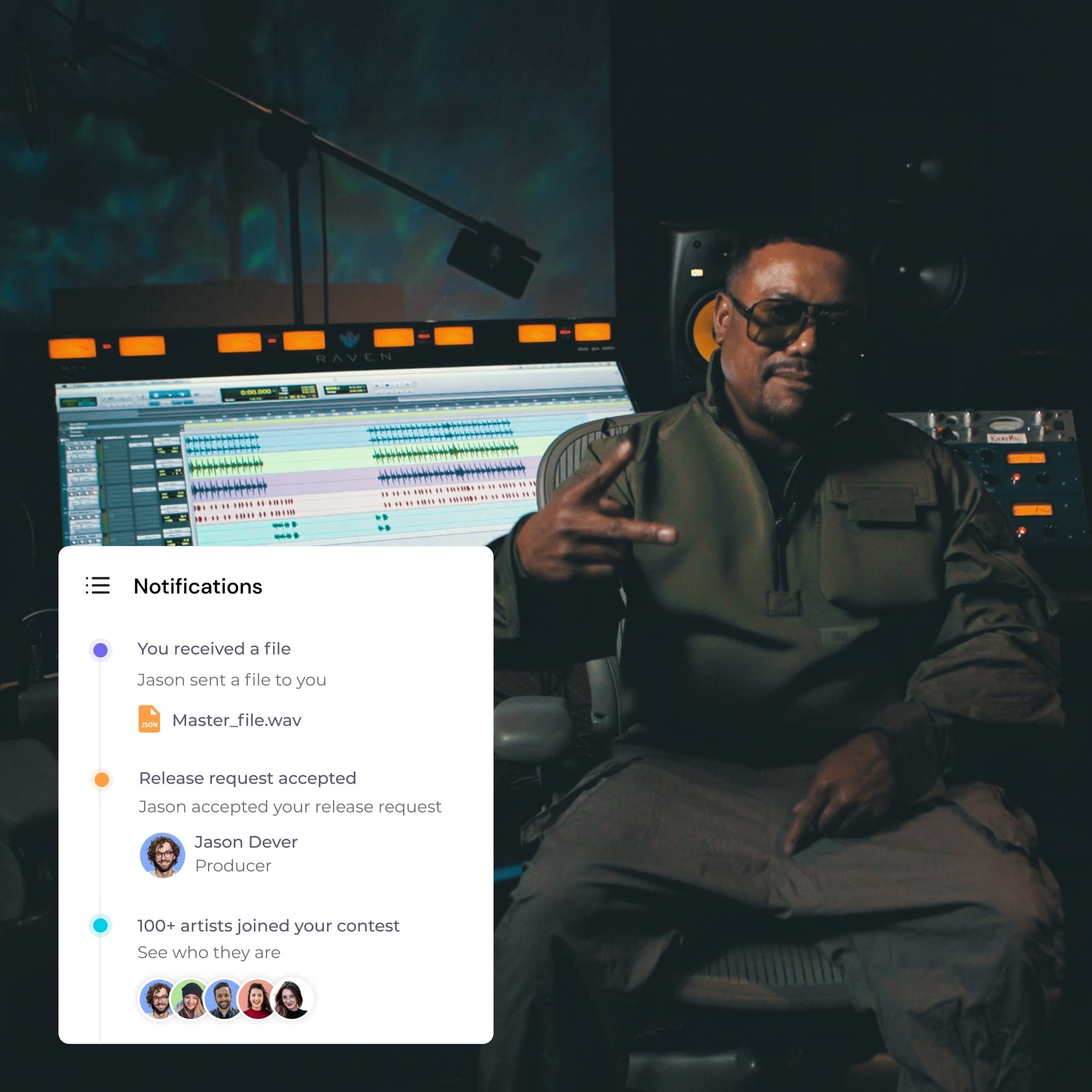
VIRPP brings artists and record labels together. Artists put their music on the VIRPP platform, and labels search it for new talent. For that second side, we built the VIRPP dashboard: the place where a label finds demos that match its direction.
My view on this project is simple. Labels have no shortage of talent, they have a shortage of ways to find it. On this page you can read how we turned that into a dashboard, and why we set it up for multiple labels at once.
The project in brief
- Client
- VIRPP
- Sector
- music
- What we did
- UI/UX design, design system, frontend development, backend development
- Technology
- Figma, Vue.js, Laravel, PHP, AWS
What was the challenge for labels?
Demos reach a label as a stream you work through from top to bottom. Working like that means judging in order of arrival, not by what suits the label. Good material sinks to the bottom as a result. So the bottleneck is not the amount of talent, but finding it.
Think of your own inbox on a Monday morning. Whatever is at the top gets attention. Whatever came in on Friday afternoon, nobody sees any more. It works the same way for a label, except every email contains a track that cost someone months of work.
Honestly, I think that's a waste. Not because labels listen badly, but because the system forces them to sort on the wrong thing. Time is scarce at a label. You want to spend it on music that fits, not on music that happened to arrive first.
Why did we choose search instead of an inbox?
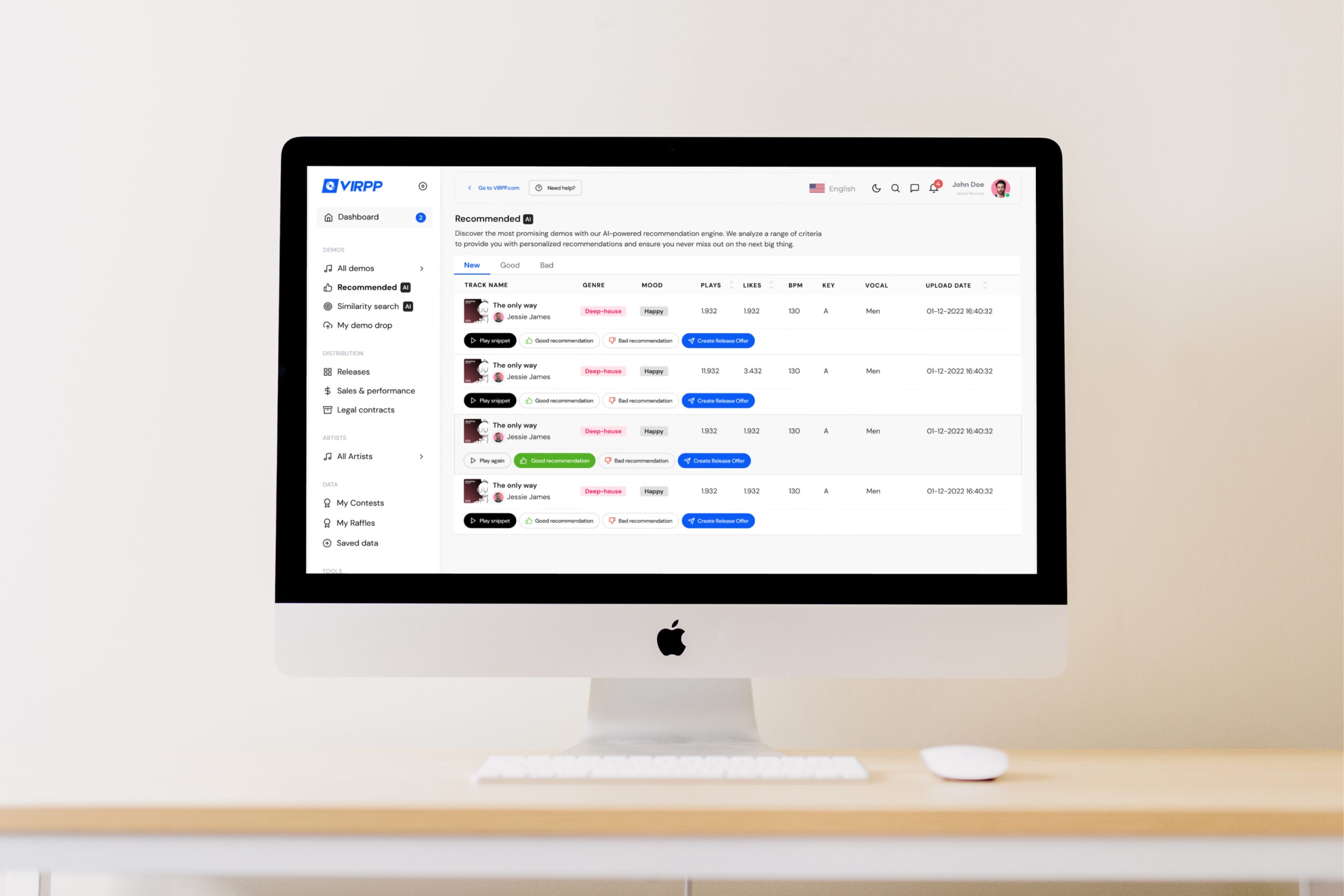
A label usually knows what it is looking for: a genre, a region or a stage in someone's career. So the dashboard revolves around searching and filtering. A label only sees what matches its direction and works from there. As a result, the order depends on the label's taste, not on when something was sent in.
That sounds like a small shift. In practice, it changes an A&R's entire working day. You no longer start at the top of a list, but with a question. For example: who makes techno in Rotterdam and is still at the start of their career? The dashboard then returns the demos that match.
Still, we didn't throw out the inbox because it is old. We replaced it because it answers the wrong question. An inbox tells you what is new. A label wants to know what suits it.
If you have to make a choice like this yourself, our blog on custom software or an off-the-shelf package covers what to look out for.
How did we build the VIRPP dashboard?
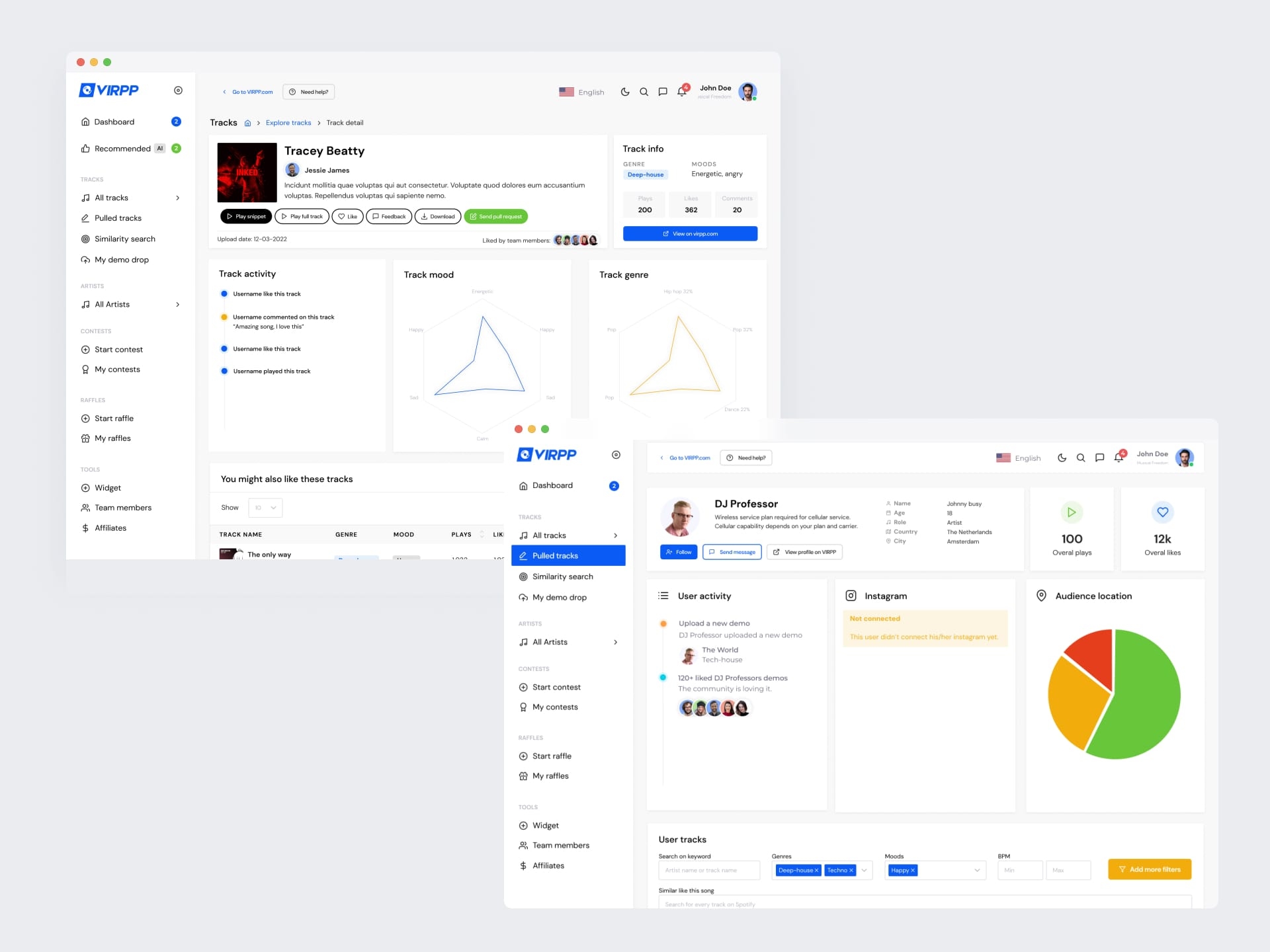
In the dashboard, labels search the catalogue on the VIRPP platform. They filter by genre, location, age and popularity, among other things, and AI-driven search features strengthen that matching with recommendations for the label. Whatever an artist uploads appears in the dashboard straight away. Both sides run on the same data, so no separate submission is needed.
One dashboard for multiple labels
The dashboard is set up as multi-tenant. That means each label works in its own environment, while they all run on the same system. Labels don't see each other's work, but they do share the same technology. Adding a new label is therefore a matter of configuration, not extra development.
For VIRPP, that makes a big difference. Each new partner then doesn't need a new project, only configuration. I would approach any platform with multiple clients this way, even if you start with one.
The technology underneath
We built the frontend in Vue.js, on a backend in Laravel and PHP. Everything runs on AWS. I like this combination when a product needs to keep growing, because it is proven technology that many developers know how to work with. That way VIRPP won't be tied to one agency later on.

Building a platform for multiple clients or partners? We help you with a SaaS set-up that grows without rebuilding for every client.
See our SaaS developmentWhat does the dashboard design look like?
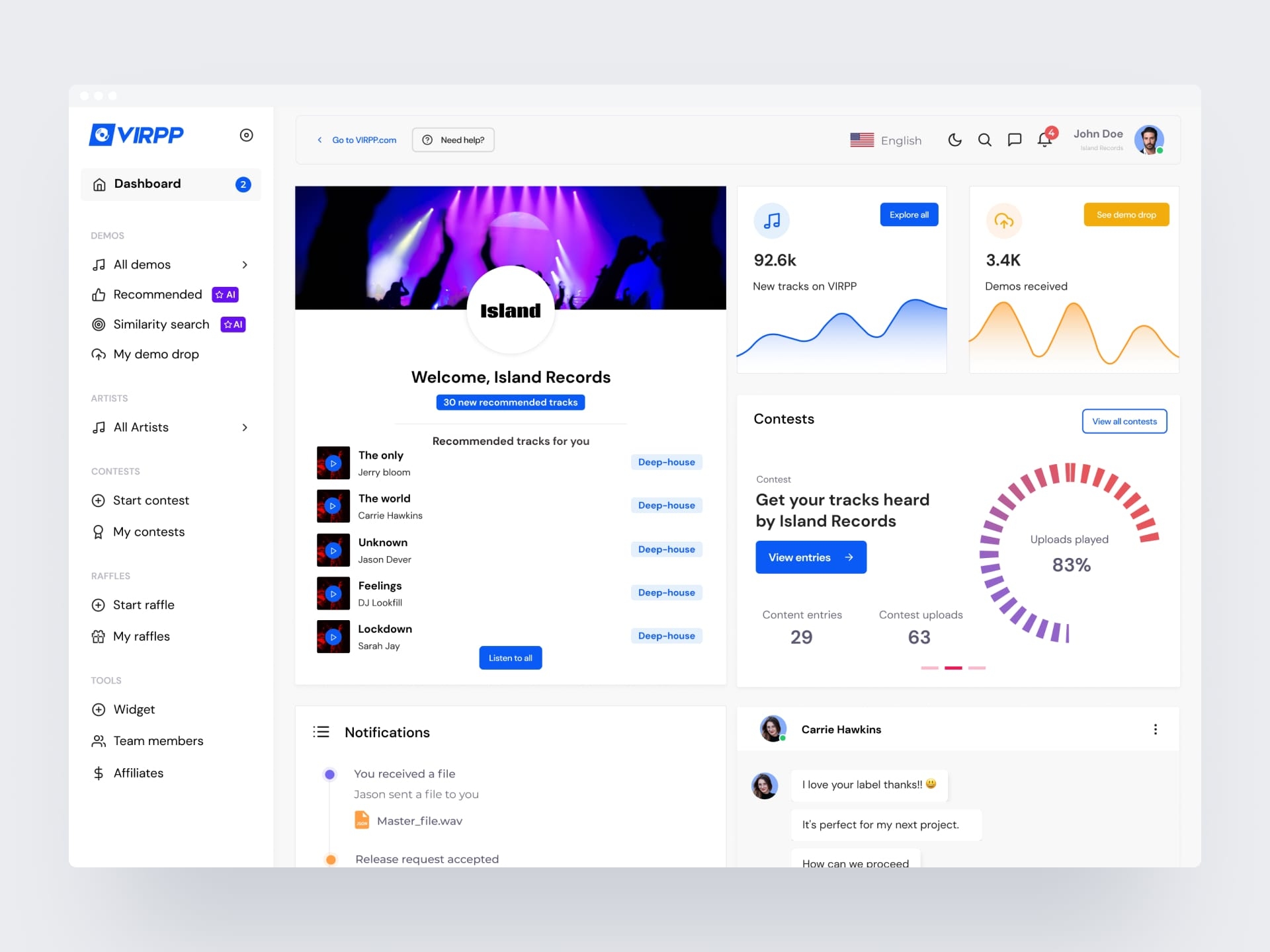
The design was worked out in Figma and captured in a design system. That means new features are added in the same form, without every screen having to be redesigned. On the start screen, a label sees recommended tracks, the number of new demos and a running contest, among other things.
A design system is really a construction kit. Colours, buttons, cards and lists are fixed. When VIRPP wants a new feature, the team takes existing components and builds on them. That saves time, and the dashboard keeps feeling like one product.
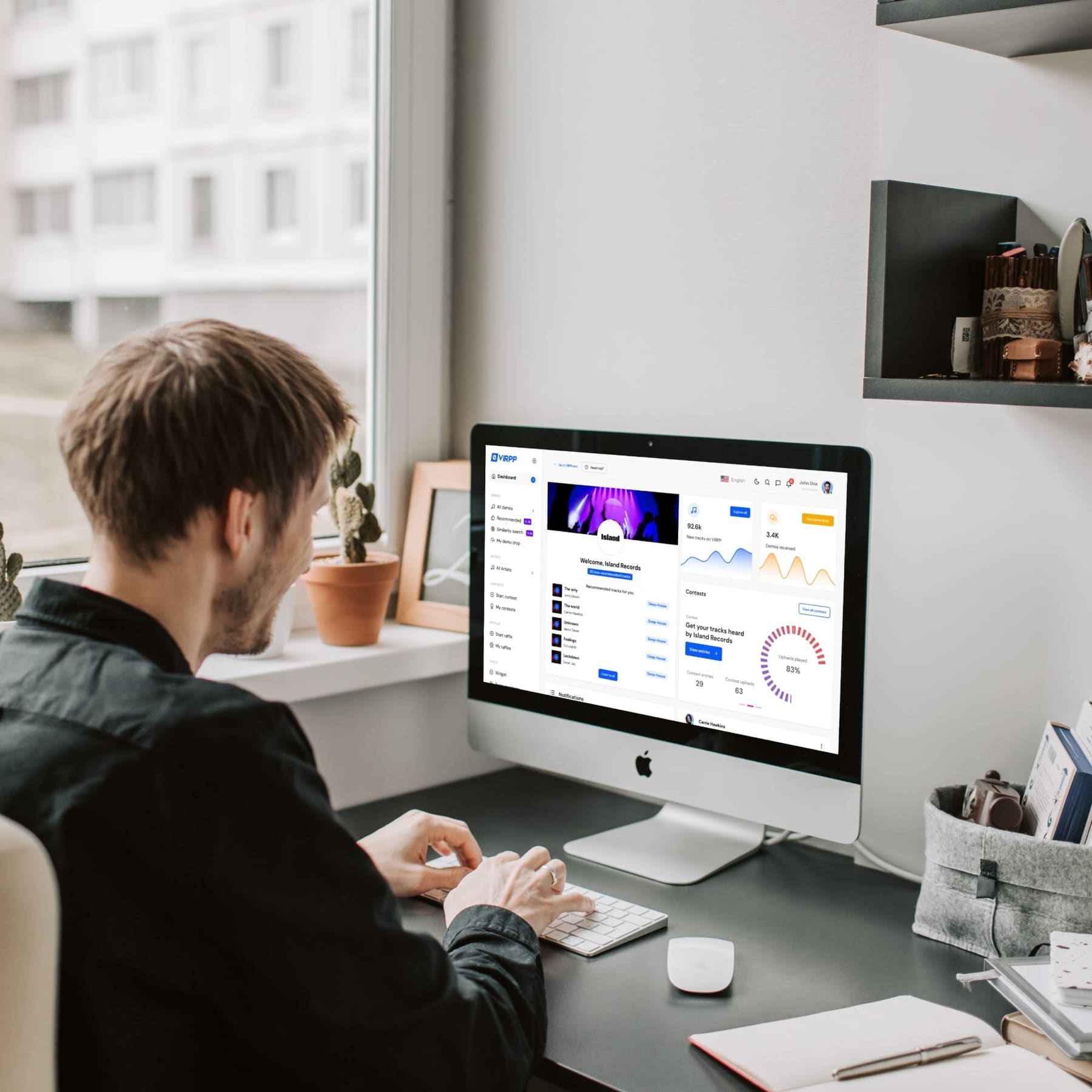
I also have a fixed rule for dashboards like this: an A&R is not a data analyst. They want to listen, not read charts. That is why the music takes centre stage and the filters are there to make the list shorter.
What did the VIRPP dashboard deliver?
Several labels have discovered and signed new talent through the dashboard. The platform was developed in collaboration with VIRPP's international partners, such as Nicky Romero, Amsterdam Dance Event and Steve Aoki. The dashboard is part of VIRPP's wider music platform, which we also designed and built.
The other side of the story is ours too. In the case about the VIRPP music platform you can read how artists put their music on the platform. And for ADE, we built the demo upload platform for ADE with VIRPP, where producers submit their demo for Demolition.
Do you have a stream of requests, leads or submissions you can no longer keep up with? Let's see whether searching works better than working through it.
Book an intro callUpdated
Get in touch with us directly. We'll get back to you as soon as we can


 Your message goes straight to our team in Amsterdam.
Who built the VIRPP label dashboard?
Your Tech Club. We did the UI/UX design and the design system, and built the frontend and backend of the dashboard.
What technology does the VIRPP label dashboard run on?
A Vue.js frontend with a Laravel and PHP backend, hosted on AWS. The design was worked out in Figma and captured in a design system.
Can multiple labels use the dashboard at the same time?
Yes. The dashboard is set up as multi-tenant: each label works in its own environment on the same system. Adding a new label takes configuration, not new development.
How does a label filter on this dashboard?
By criteria such as genre, location, age and popularity, supplemented by AI-driven search features that match demos to the label's direction. That way you work in a targeted way instead of chronologically through an inbox.
How does the dashboard relate to the artist platform?
They are directly connected. Whatever an artist uploads to the VIRPP platform is immediately available in the label dashboard. So no separate submission is needed.
Do real labels use it?
Yes. Several labels have discovered and signed new talent through the dashboard. The platform was developed in collaboration with VIRPP partners such as Nicky Romero, Amsterdam Dance Event and Steve Aoki.