

De Duurzame Jongens: from Excel pricing model to request in the CRM
Quote tool with price estimate for De Duurzame Jongens, plus an integration with the Sollit CRM and conversion tracking for Google Ads and Meta.
Deliverables
- Quote tool with price estimate
- Pricing model from Excel to code
- Short form that pre-fills the quote tool
- Integration with the Sollit CRM
- Checks for duplicate and abandoned requests
- Conversion tracking for Google Ads and Meta, including offline conversions
- Passing cookie consent on to the quote tool
- Admin environment in WordPress
Tech stack
- React and TypeScript
- Vite and Tailwind CSS
- WordPress plugins in PHP
- Gravity Forms
- Sollit API (formerly 2Solar)
- Meta Conversions API
- Google Ads API
- Google Tag Manager
- Complianz
De Duurzame Jongens install solar panels, heat pumps, home batteries, air conditioning and EV chargers. People who request a quote on de-duurzame-jongens.nl first want to know what making their home more sustainable costs and saves. Your Tech Club built the quote tool that shows them, the integration that puts requests into the CRM, and the tracking that tells Google Ads and Meta which requests turned into something.
What needed to improve?
The pricing rules already existed, in an Excel model built by De Duurzame Jongens: installation prices by number of panels, mounting systems, inverters, savings per product. But that model lived in a spreadsheet. Website visitors saw none of it.
The second problem came after the form. Whether a request leads to an advice appointment or a signed quote is recorded in Sollit, their CRM. Google Ads and Meta only see a completed form. So they optimise for forms instead of customers.
One line from click to signed quote
So we looked at the whole route, not a single form. A visitor clicks an ad, works out their situation and requests a quote. The team receives that request in full in Sollit. And when its status changes there, the ad platforms hear about it.
A quote tool in four steps
The quote tool is at de-duurzame-jongens.nl/offerte-aanvragen. Step one asks for contact details, address and whether the visitor prefers a call, an email or a WhatsApp message. These come first, so a request is already in after the first step, even if someone stops after that.
Home and energy use
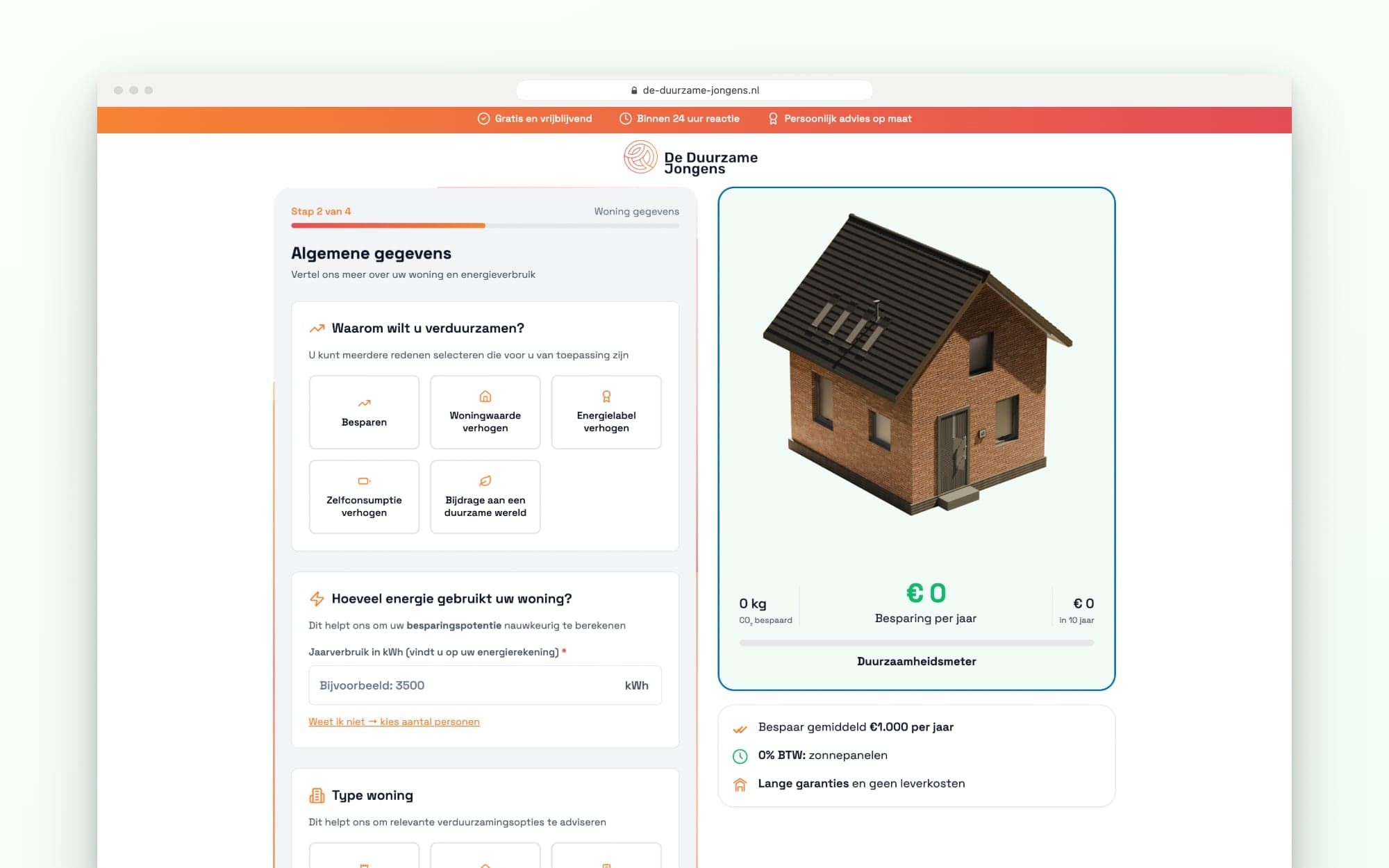
In step two, visitors choose their reason for going sustainable, such as saving money or increasing the value of their home, and the type of home. They enter their annual energy use, or the number of people in the household if they don't know it. The tool then works with an estimated figure.
A house that builds along
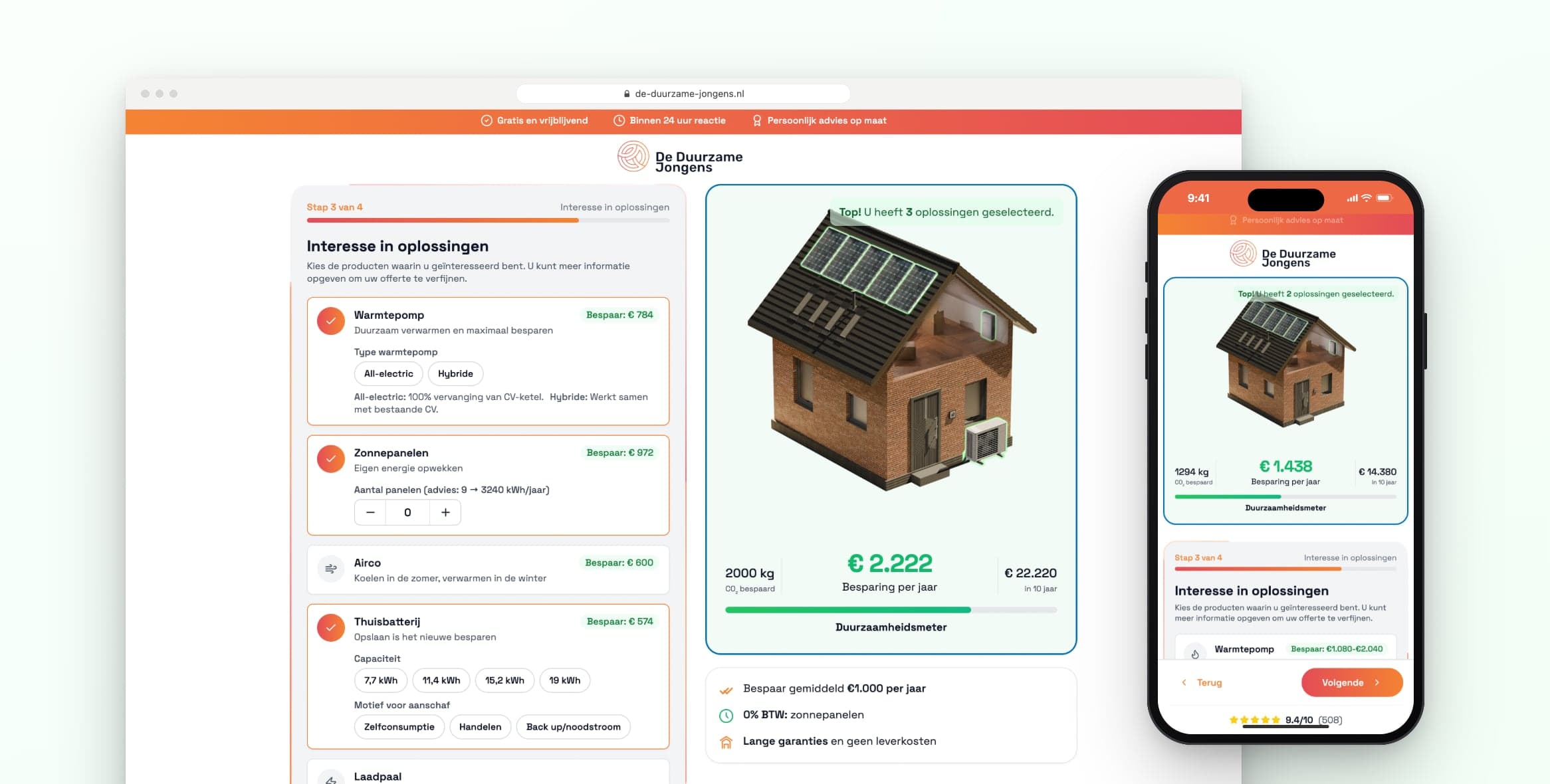
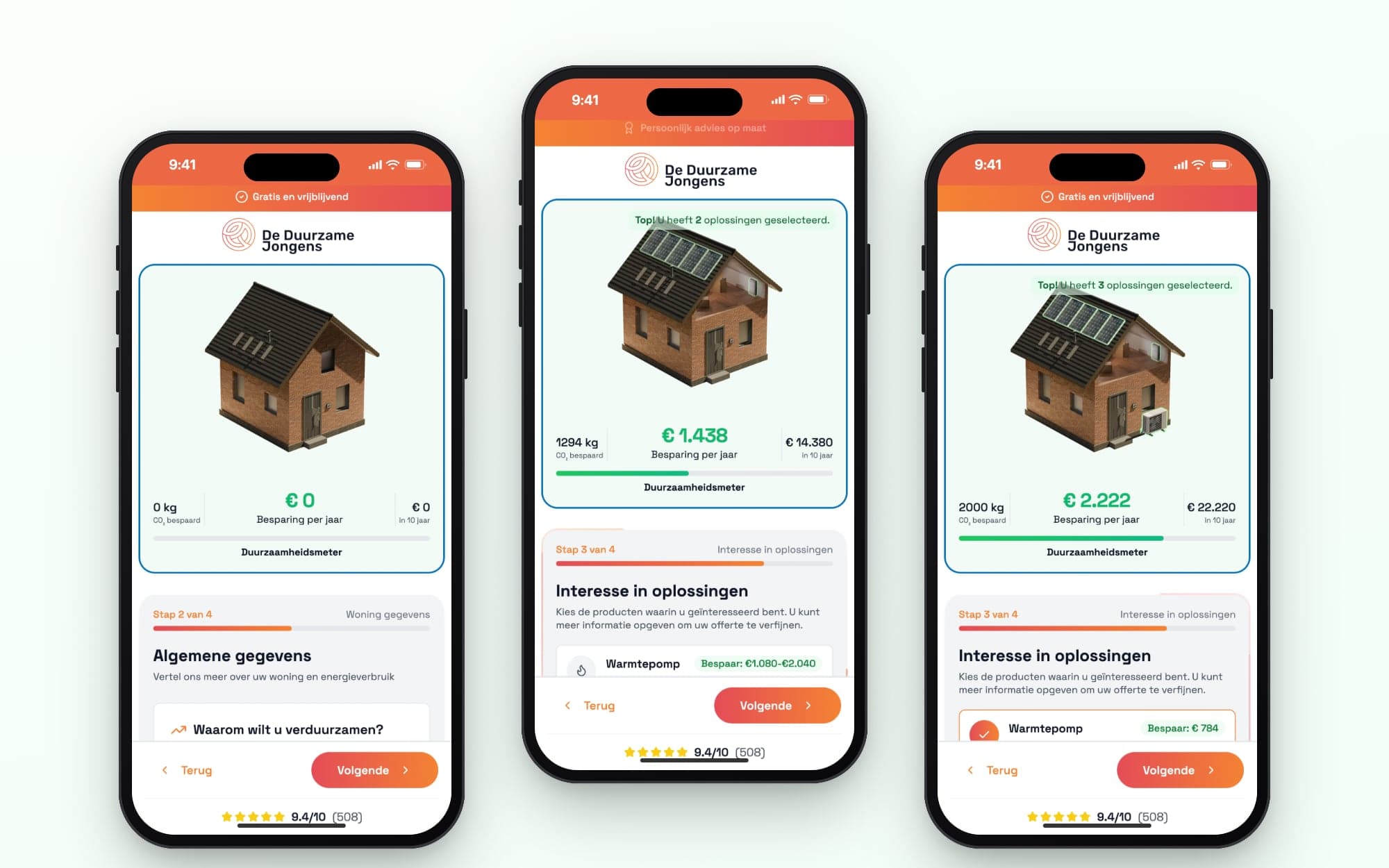
In step three, visitors choose solar panels, a heat pump, air conditioning, a home battery or an EV charger, and set the key options for each: the number of panels, hybrid or all-electric, the number of rooms, the battery capacity. For solar panels, the tool gives advice based on energy use.
Next to the form is a 3D house. Choose solar panels, a heat pump, an EV charger or a home battery, and a short animation plays and the product appears on or next to the house. Below it, the savings per year and over ten years update as you go. On a phone, the house sits above the form.
The price estimate
The final step shows the total investment, the savings per year and a monthly amount with financing over fifteen years. Anything not yet chosen is listed below, with what it would save. The full request is only sent after clicking Request a quote.
De Duurzame Jongens' pricing model, in code
We converted every pricing rule in the Excel model into code, product by product. For solar panels, the tool adds up installation costs that rise in steps with the number of panels, the mounting system per panel, fixed items such as cabling, an inverter that matches the number of panels, and the panels themselves. The savings follow from the yield per panel.
For a heat pump, the price depends on the type and the household, and the savings come from the gas no longer used. Air conditioning costs an amount per room and saves gas because it also heats. A home battery is calculated on the electricity it stores per year. An EV charger has a fixed price. VAT also follows the Excel model. A document explains every pricing rule, with the tab and column in Excel. That way the team can trace where a number comes from.
Starting from any page
The homepage and product pages have a short form: name, email and phone. After submitting, visitors see that their details have arrived and move on to the calculation. In the quote tool, what they already entered is ready and waiting. Just before the redirect, the tracking tools already receive the form. Anyone who wants to calculate straight away reaches the same tool via Request a quote in the menu.

From form to Sollit
A submitted request first arrives in a custom WordPress plugin. It stores the request, checks the data and then puts it into Sollit: one person, with a separate request for each product chosen.
When someone stops halfway
If a visitor clicks through after step one, their contact details already go to Sollit. If they then complete the tool, they would come in twice. The plugin recognises this from the same email address, postcode and house number within a short time, adds to the existing request and posts the new details as a note in Sollit.
When forwarding fails
If Sollit does not respond for a moment, the request stays in the queue and the plugin tries again after a few minutes. If it still fails, the request is marked as failed in the dashboard and can be resent manually. As long as there are failed requests, an email goes out every day.
What the De Duurzame Jongens team sees
In Sollit, the request arrives with a note: type of home, energy use or estimated use, the chosen products with their settings, the price estimate with investment, savings and monthly amount, the reason for going sustainable, and the preference for phone, email or WhatsApp. Whoever calls the customer already has all of that in front of them.
In WordPress, the team has a dashboard: how many requests came in, what is still in the queue and what failed. Each request links to the person in Sollit. A log shows what was sent and what Sollit replied, and an overview shows which statuses changed recently.
Reporting back what a request led to
A click on an ad gets a code from Google or Meta in the link: the click ID. On the website, a script stores that code in a cookie for ninety days and adds it to the forms; the quote tool reads it from the link. That way the click ID is attached to the request in WordPress and to the note in Sollit.
Google Ads and Meta are notified as soon as a form is submitted. The real signal comes later. Every day, the integration fetches the status of requests from Sollit. A second plugin checks every fifteen minutes which requests from the past sixty days have a click ID and a status that counts as a conversion, and reports them to Meta and Google Ads, with the investment from the price estimate as the value.
Email address and phone number are only sent hashed: made unreadable, but still matchable to the click. The plugin keeps track of what has already been reported, so nothing is counted twice. In a separate overview, the team sees which conversions have been sent and where something went wrong.
Which statuses count
Which Sollit statuses count as qualified or won can be set per status. For example: a scheduled advice appointment counts as qualified, a signed quote as won. Meta receives a qualified request as a lead and a won request as a purchase. Google Ads receives them as two separate conversions.
Tracking only after consent
In the quote tool, the tracking scripts are off by default. They only load after consent in the cookie banner. If the visitor already made a choice on the rest of the website, the tool adopts it. If they come in directly, they see the same cookie banner.
What can De Duurzame Jongens do now?
In four steps, visitors see what making their home more sustainable costs and saves, calculated with De Duurzame Jongens' own pricing model. Requests arrive in Sollit in full, including from people who stop halfway. And what happens next goes back to Google Ads and Meta. They now optimise for requests that became an advice appointment or a signed quote, not just for forms.
Next: the AI Opportunity Audit
Later, De Duurzame Jongens did the AI Opportunity Audit with Your Tech Club. In that audit, we found €500,000 a year in growth opportunities.
Managing director Mylene Weijgertse wrote about it: “Thanks to Your Tech Club's sharp insights and strong analysis, we now have a clear picture of where we stand, where the opportunities are and how we want to keep growing over the coming years.”


Get in touch with us directly. We'll get back to you as soon as we can


 Your message goes straight to our team in Amsterdam.
What did Your Tech Club build for De Duurzame Jongens?
A quote tool on de-duurzame-jongens.nl that gives a price estimate in four steps for solar panels, a heat pump, air conditioning, a home battery and an EV charger. Also two WordPress plugins: an integration that puts requests into the Sollit CRM, and a plugin that reports statuses from Sollit back to Google Ads and Meta.
How does a request from the quote tool get into Sollit?
Through a custom WordPress plugin. It stores the request, checks the data and creates a person in Sollit with a request per product, plus a note with the home, energy use, products and price estimate. If that doesn't work straight away, the plugin tries again.
What happens if someone doesn't finish the quote tool?
After the first step, the contact details are already in Sollit. If the visitor completes the tool shortly afterwards, the plugin adds to the same request instead of creating a second one.
What are offline conversions?
An offline conversion is a result that happens outside the website, such as a scheduled advice appointment or a signed quote. The plugin reads that status from the CRM and reports it to Google Ads and Meta, linked to the ad click. The platforms then see which ads bring in requests that turn into something, not just which ads bring in forms.
Where do the amounts in the quote tool come from?
From the pricing model De Duurzame Jongens already had in Excel. We converted the pricing rules for each product into code and documented them, with a reference to the tab and column in Excel. The result is a price estimate; the quote itself comes from De Duurzame Jongens.
Can an integration like this work with a different CRM?
Yes. The approach stays the same: store the request, check it, forward it and fetch the status back. We can integrate any system; there is no restriction on which systems.