

ADE demo submission: the VIRPP × ADE 2026 demo platform
How does the ADE demo submission work? For ADE and VIRPP, we built the platform where producers submit their demo for Demolition and the A&R Listening Room.
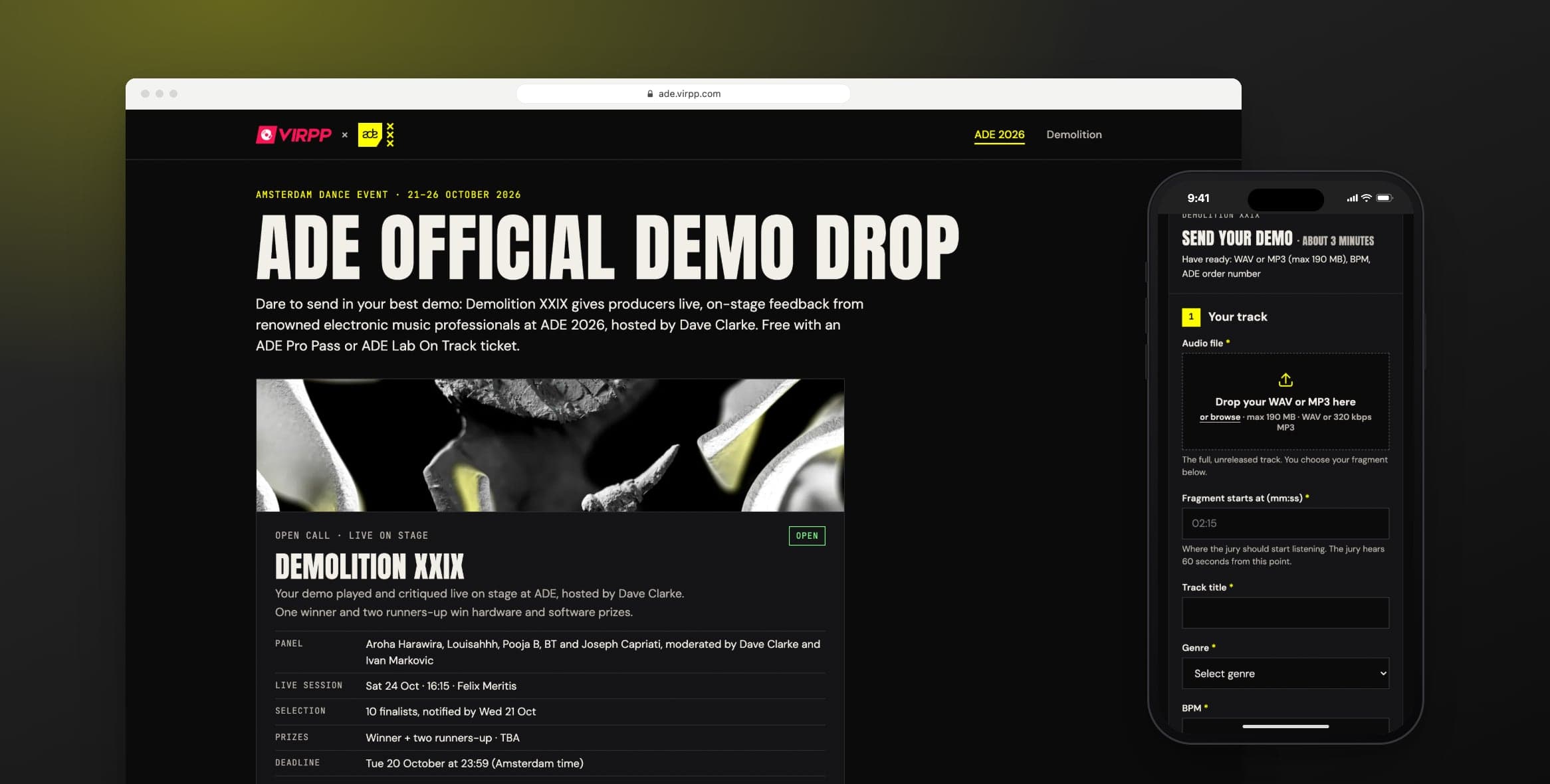
Deliverables
- Submission platform for the ADE demo submission
- Upload flow with waveform and clip selection
- Jury environment with two-step login
- Export of selected tracks as MP3
- Embed kit for the ADE website
- Hosting, backups and monitoring in the EU
- UX/UI design
Tech stack
- Node.js
- SQLite
- Cloudflare Tunnel
- Mailgun
- ffmpeg
Every October, the world of electronic music comes to Amsterdam for Amsterdam Dance Event (ADE). For producers, it is the moment to get their music heard by artists, A&Rs and labels. The official ADE demo submission for 2026 runs through VIRPP, ADE's official partner for demo submissions. Your Tech Club designed and built that platform: the submission pages, the upload flow, the jury environment, the embed kit for the ADE website and the technology underneath.
What is the ADE demo submission?
At ADE 2026, there are two moments when producers can get their demo heard. Both run through the same platform at ade.virpp.com.
Demolition XXIX
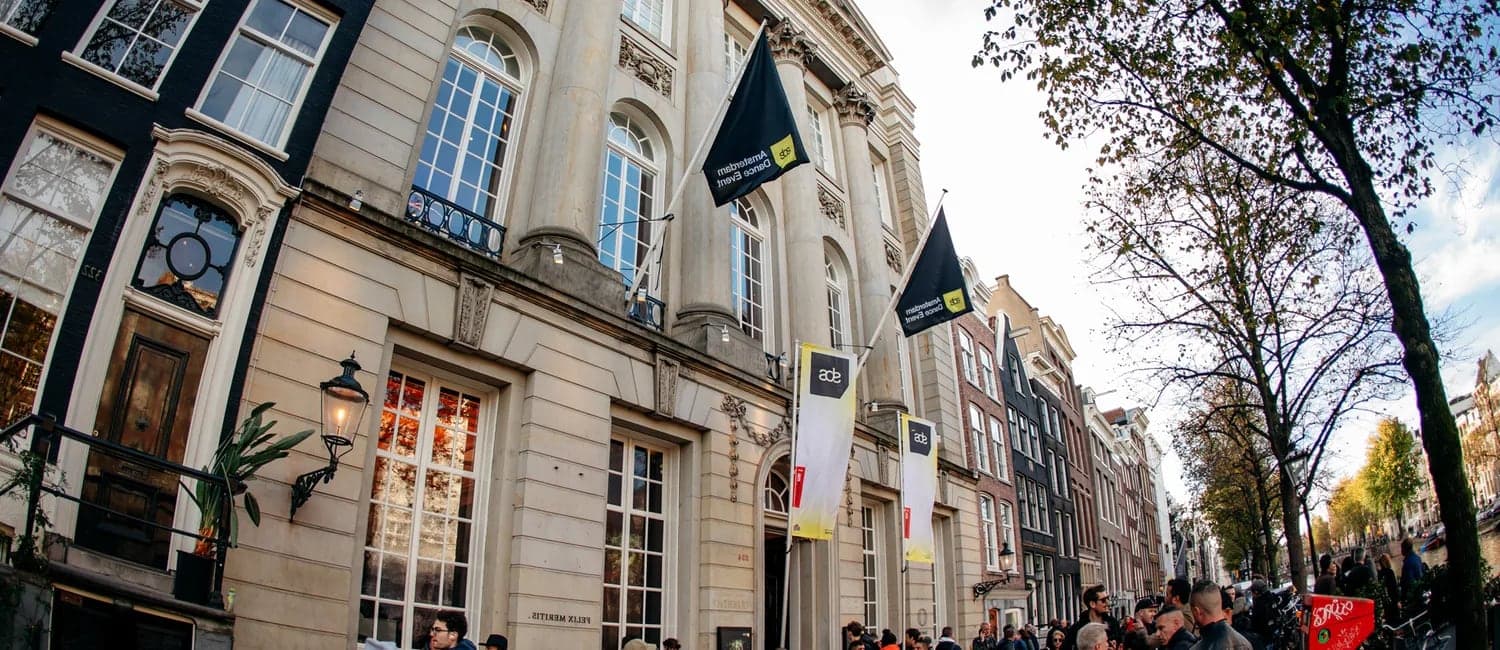
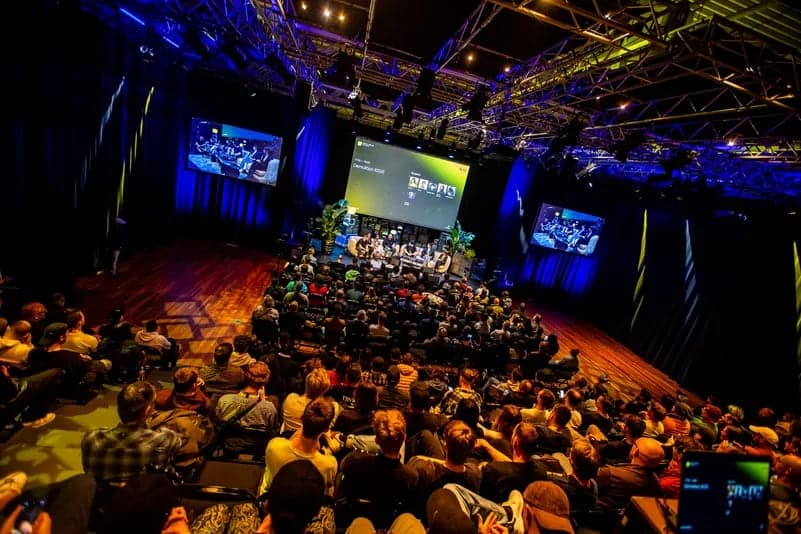
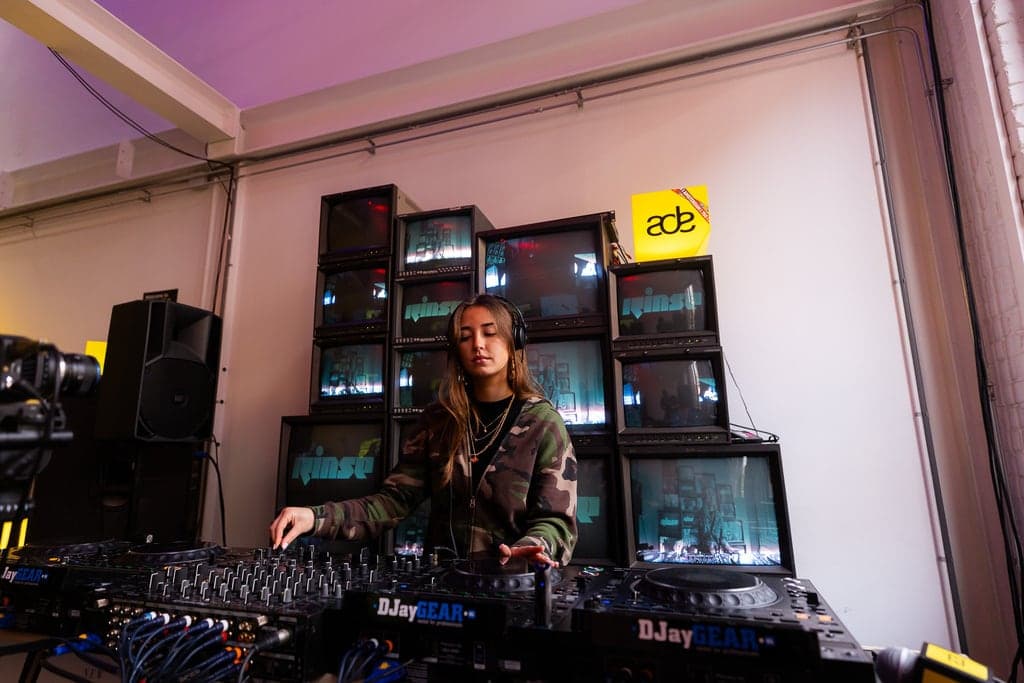
Demolition XXIX is ADE's open call: demos are played live on stage and discussed by a panel of artists and industry figures, hosted by Dave Clarke. In 2026, the panel is Aroha Harawira, Louisahhh, Pooja B, BT and Joseph Capriati, with Dave Clarke and Ivan Markovic as moderators. The session is on Saturday 24 October at Felix Meritis on the Keizersgracht. One winner and two runners-up win hardware and software.
The Live A&R Listening Room
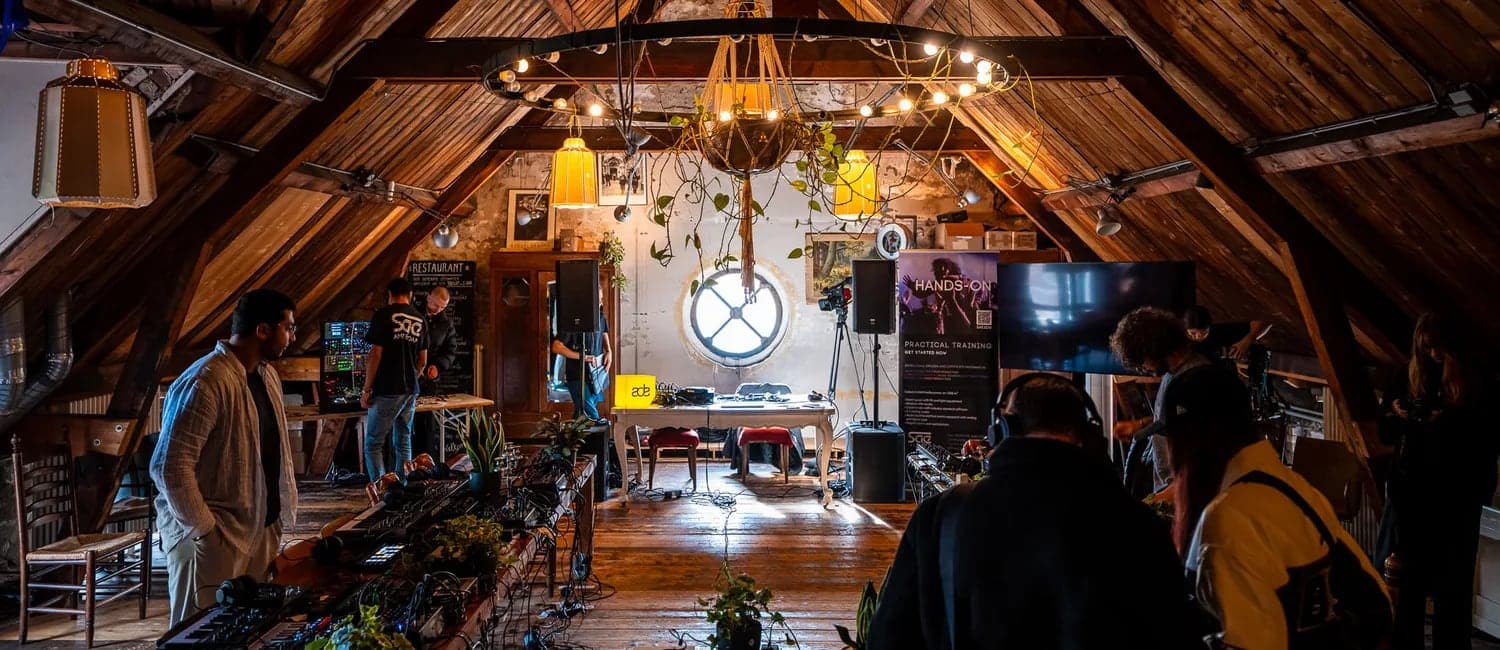
The Live A&R Listening Room is the closing session of ADE Lab On Track. Producers play their track directly to A&Rs from Armada Music, Hotmeal Records, Sony Music and Defected, and hear it back on a proper sound system at WestWeelde. When submitting, the producer chooses which label their music suits best.
What did ADE ask for?
Submitting a demo to ADE had to be as easy as sharing a track is today, without the jury drowning in entries. The window was short: submissions opened on 13 October and closed a few days before the sessions. Within that time everything had to work, for producers all over the world and on any device.
ADE also had three requirements. The jury had to be able to listen and choose quickly. Producers' personal data must not reach the jury. And the selected tracks had to be ready to play live on the day itself.
One app, three addresses
We built a single application that behaves differently depending on the address. ade.virpp.com hosts the public pages where producers submit their demo. The jury environment sits on a separate address, behind a login. And a third address hosts the embed kit for ADE's web team.
That gives one system to maintain and secure, while each group only sees what is meant for them. The public pages may appear in Google; the jury address never does.
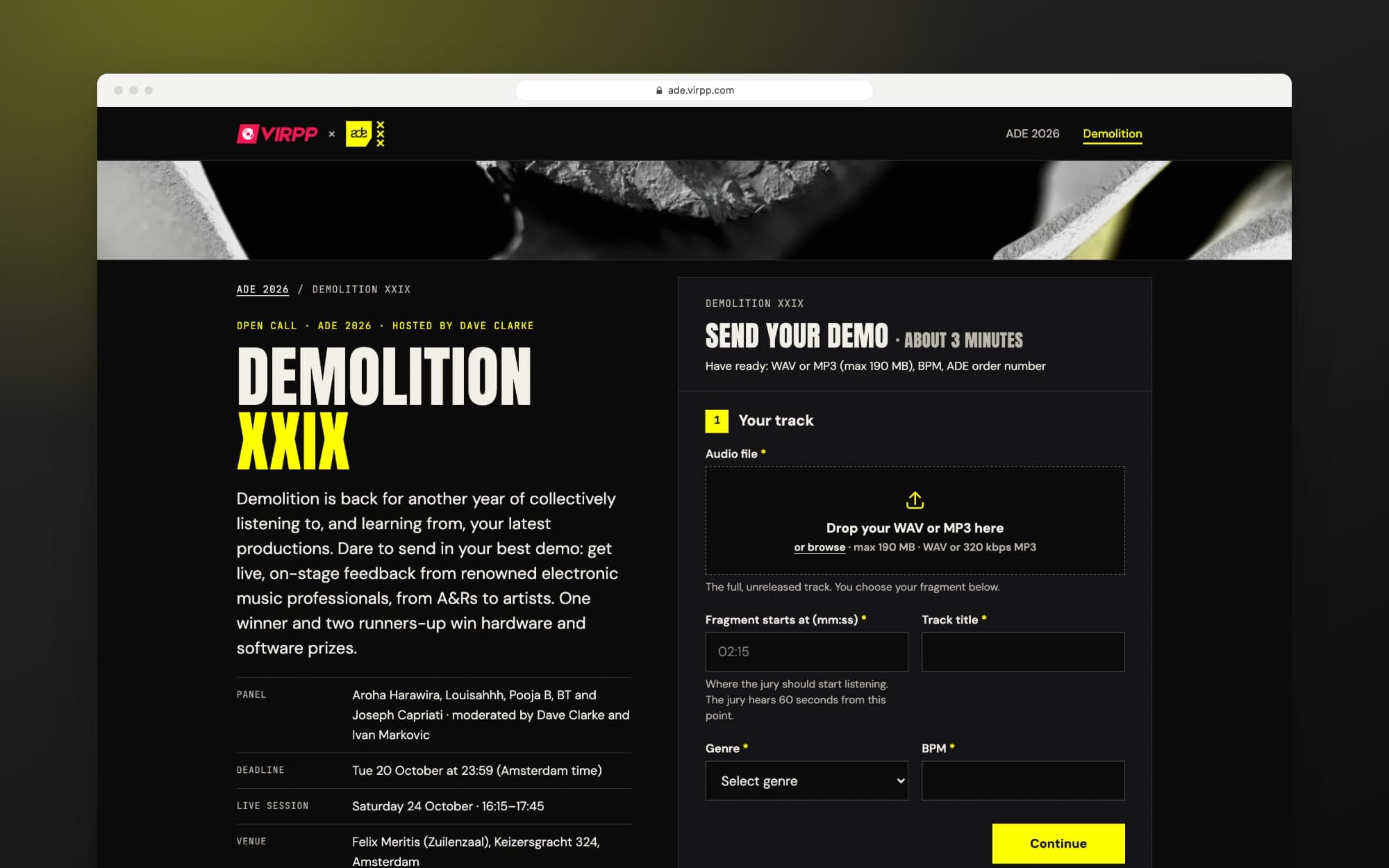
Submit your demo in about three minutes
A producer submits one unreleased track, as a WAV or 320 kbps MP3 of up to 190 MB. The form has three steps that open one after the other: your track, your details, and review and submit. What you need is listed at the top: the audio file, the BPM and the order number of your ADE ticket. The ADE demo submission is free with an ADE Pro Pass or an ADE Lab On Track ticket.
Choose your own clip
The jury doesn't listen to a whole track, but to 60 seconds. As soon as the producer picks a file, the page draws the track's waveform, right in the browser. A yellow window sits on the loudest part by default. The producer drags it to the part they are proudest of, or moves it with the arrow keys, and plays the clip back before submitting.
The file name becomes the title to start with. Anyone who picks a file that is too large, or something that isn't audio, is told straight away, before the upload starts.
Uploading without worry
A large WAV file on a shaky connection is nerve-racking. During the upload, the form shows how much has arrived and how long is left. If the connection drops, the producer can try again without filling in the form again.
After a successful upload, the producer gets a confirmation email with a submission number. That confirmation comes with a fingerprint of the file. So it can always be shown that the track the jury hears is exactly the track that was submitted.
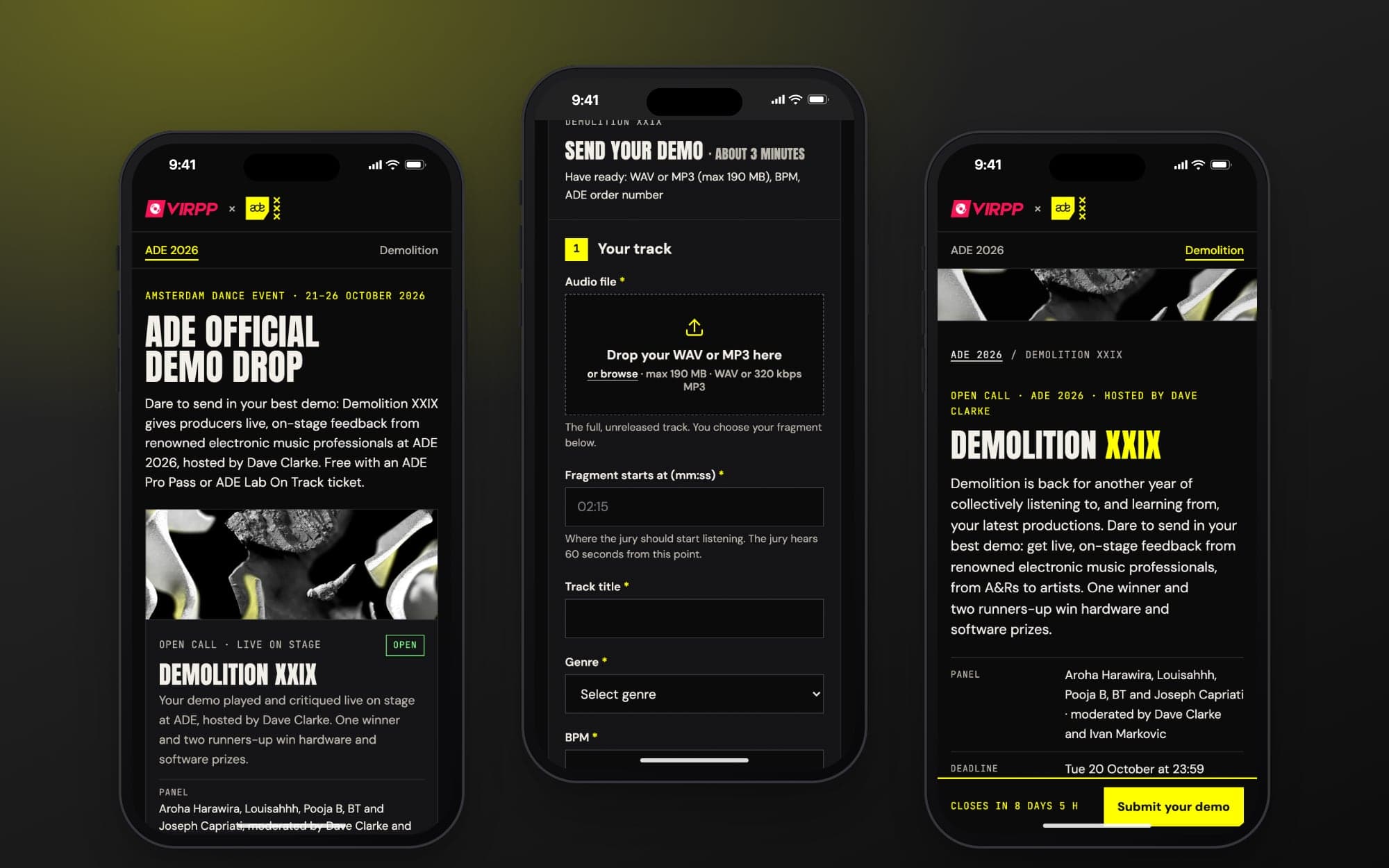
The rules in view
Every page lists the conditions: which ticket you need, when submissions close, and that AI-generated music is not allowed. AI tools for mixing and mastering are fine. A countdown shows how long the ADE demo submission is still open, and a timeline shows what happens after the deadline: the selection, the notification to finalists and the live session.
How the selection works
From all submissions for Demolition, the jury picks ten finalists and ten semi-finalists. Finalists and semi-finalists hear by Wednesday 21 October at the latest. During the live session, the finalists' demos are played and discussed. If a finalist isn't in the room, a random demo from a semi-finalist can take its place. At the end, anyone in the room can hand in a USB stick for a wildcard.
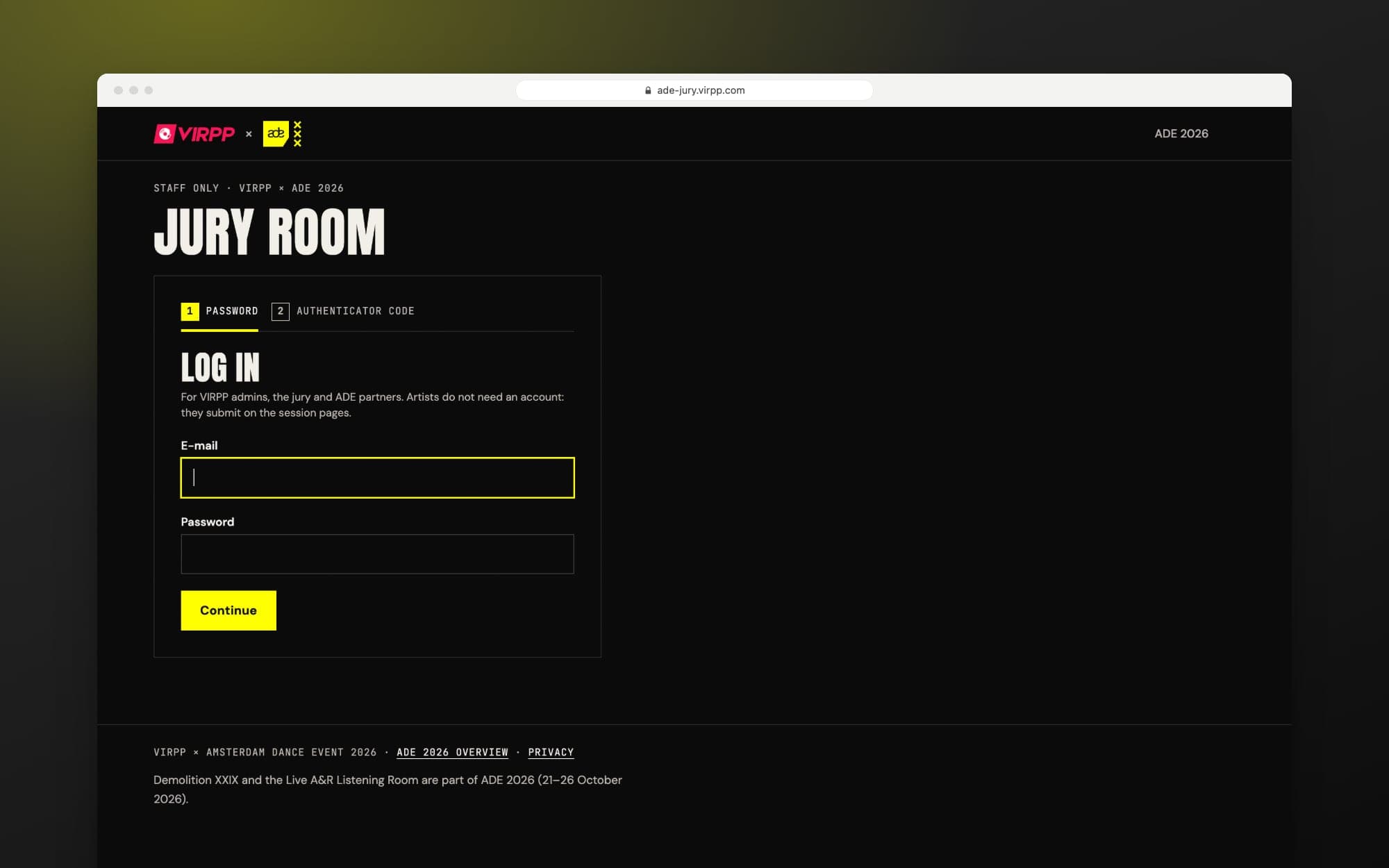
The jury environment
Jury members, ADE and VIRPP's administrators log in on a separate address, with a password and a code by email. They listen to the clips, add tracks to the shortlist and see the genre and BPM for each track.
The jury sees the artist name and the track, but not a producer's real name or contact details. Only an administrator can export: the tracks to be played at the session are ready in one go as MP3s, and the finalists and the rest of the shortlist come with them as a list. The jury environment itself explains how this works.
An embed kit for the ADE website
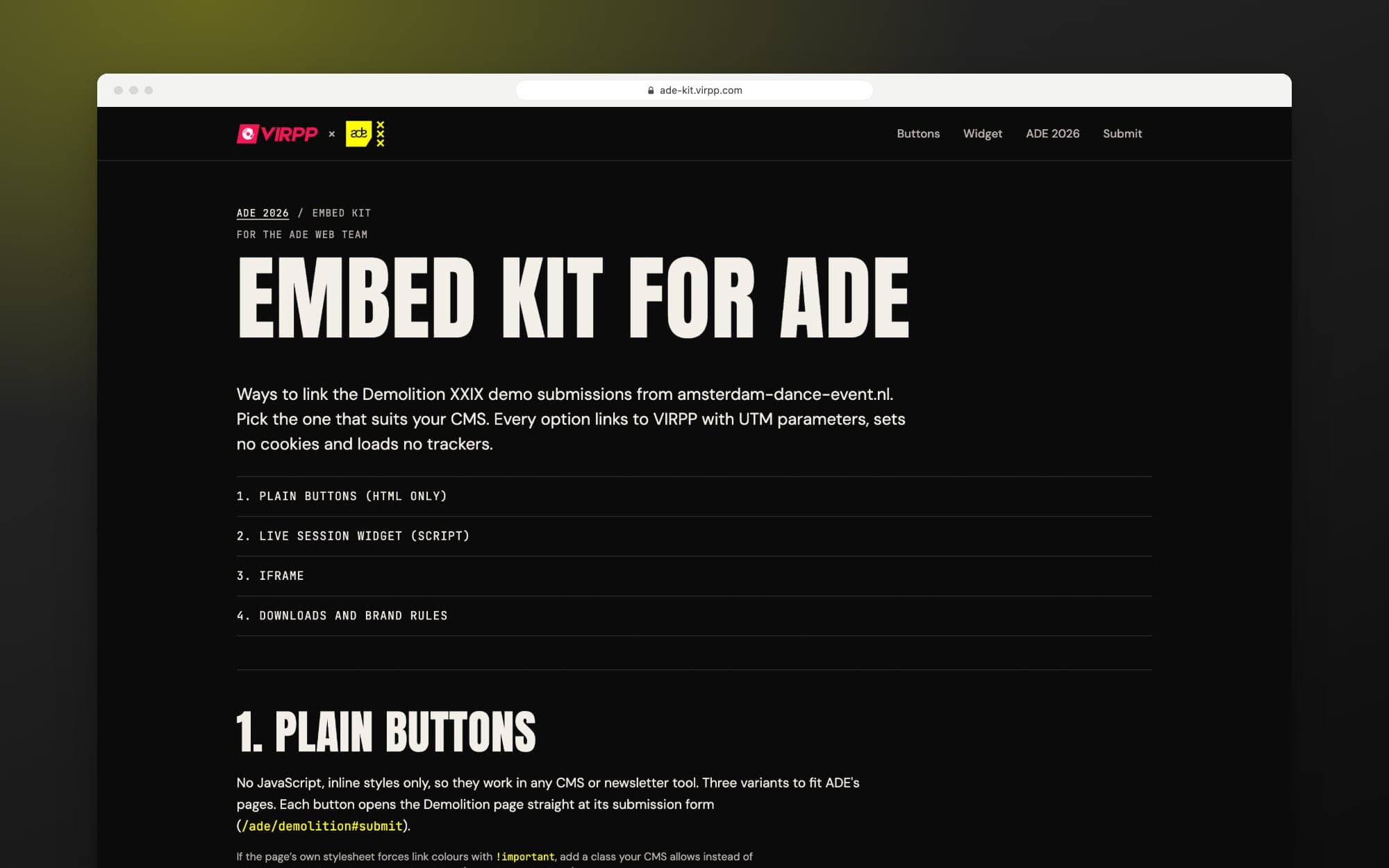
The ADE website has its own CMS, and we can't build anything in it. So ADE's web team got a kit with three ways to link to the ADE demo submission: buttons in plain HTML that work in any CMS and any newsletter, a widget showing the current status of the session, and an iframe.
All options link to VIRPP with campaign parameters, set no cookies and load no trackers. The kit includes the logos and the guidelines for using the ADE brand.
Privacy and producers' data
The platform only asks for what is needed to run the sessions: contact details to reach the producer, the name and order number to check the ticket with ADE, and the track and its details for the jury. Gender is optional and only appears in anonymous totals. Afterwards, data and audio are deleted, within the retention period agreed with ADE.
Under the hood
The platform runs on a single server in the EU, behind a Cloudflare tunnel. The server has no open ports: all traffic comes in through Cloudflare, with protection against abuse and a limit on the number of requests per visitor.
The database is backed up continuously and the audio files every hour, to storage in the EU. On a restore, every audio file is checked against its fingerprint. The app is checked every minute, and a new version only goes live if it starts up healthy; otherwise the previous version comes back automatically.
The application refuses to start if a setting is unsafe or incomplete. Two-step login is always on in production. And the whole app is guarded by automated tests that run on every change.
What's live now?
The ADE demo submission is live at ade.virpp.com, with the pages for Demolition XXIX and the Live A&R Listening Room, the jury environment and the embed kit for ADE. Producers can submit until the deadlines in ADE week, from 21 to 26 October 2026. After that, the jury and ADE choose the finalists, and the selected demos are played live at Felix Meritis and WestWeelde.
For VIRPP, we previously built the music distribution platform and the label dashboard as well. The ADE platform is separate from them, but comes from the same idea: getting new artists' music to the right ears.

Get in touch with us directly. We'll get back to you as soon as we can


 Your message goes straight to our team in Amsterdam.
How do you submit a demo for ADE 2026?
Through ade.virpp.com, the official platform for the ADE demo submission. You submit one unreleased track as a WAV or 320 kbps MP3 of up to 190 MB, with title, genre, BPM and the order number of your ADE ticket, and you choose where the 60-second clip starts. It takes about three minutes.
What is Demolition at ADE?
Demolition is Amsterdam Dance Event's open call, where demos are played live on stage and discussed by a panel of artists and A&Rs, hosted by Dave Clarke. Demolition XXIX is on Saturday 24 October 2026 at Felix Meritis.
Which ticket do you need to submit a demo?
The ADE demo submission is free with an ADE Pro Pass or an ADE Lab On Track ticket. You enter your ticket's order number in the form.
Can you use AI for your demo?
AI-generated music is not allowed and submissions may be checked for it. AI tools for mixing and mastering are fine.
What did Your Tech Club build for ADE and VIRPP?
The platform for the ADE demo submission: the submission pages with the upload flow, the jury environment with the export of selected tracks, an embed kit for the ADE website, and the hosting, backups and monitoring in the EU.
Can the jury see who submitted a demo?
The jury sees the artist name and the track, but not the producer's real name or contact details. That keeps the judgement on the music.