

Pin game for Waar de F*ck is STUK?: searching along without a hitch
How we built StukTV's pin game for the peak after every call to action: a 3D map, playing without an account and a lock that stays shut.
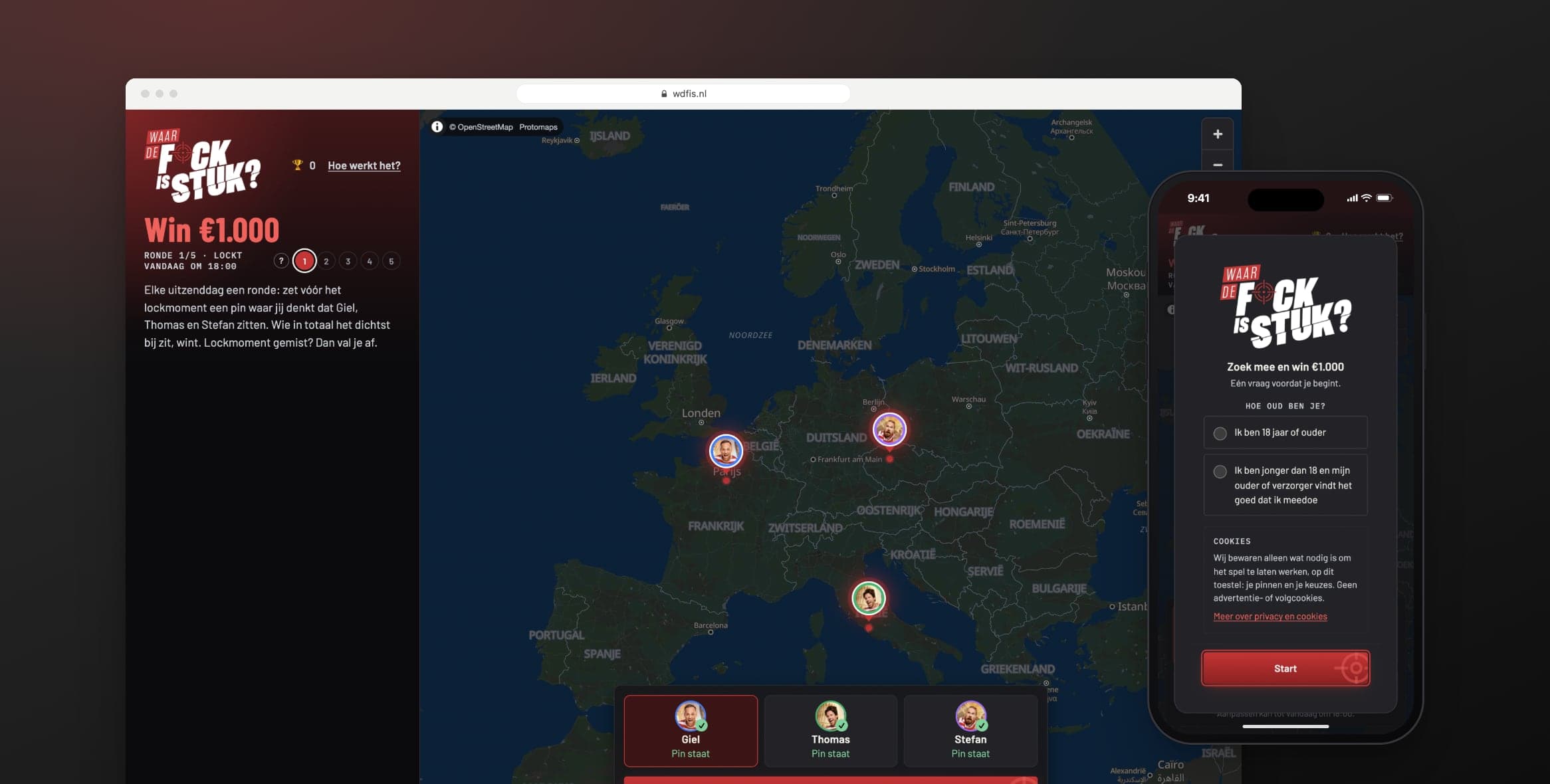
In Waar de F*ck is STUK?, Giel, Thomas and Stefan of StukTV hide somewhere in Europe. For that show, we built the pin game on wdfis.nl. Viewers join the search there. Every broadcast day, they drop three pins on the map, and whoever is closest in total after five days wins €1,000.
We made the game for Signal and StukTV.
In this case, I show how you build a game that is busiest at exactly the moments when it cannot go down. A TV show does not give you a second broadcast to try again.
The project in brief
- Client
- Signal and StukTV, for the show Waar de F*ck is STUK?
- Sector
- media and entertainment
- What we did
- UX and UI design in the show's house style, the game with a 3D globe and a custom map of Europe, taking part without an account with confirmation by email, guided tour, badges, sharing and reminders, an admin environment for the editorial team with two-step login, a leaderboard with fraud signals and hosting in Amsterdam
- Technology
- Next.js, TypeScript, Supabase (Postgres), MapLibre and OpenStreetMap, Valkey, Mailgun, DigitalOcean
- Period
- live during the broadcast week from 19 to 23 October 2026.
What did the pin game need to do?
The pin game had to be clear in a few taps, stay fair because there was €1,000 to win, and stay up at the busiest moments. There were five rounds, one per broadcast day. Each round closed at a fixed lock time: Monday to Thursday at 18:00, Friday at 13:00.
Until that lock time, a viewer could move their pins. After that, they were fixed. Anyone who missed a lock time was out.
Many viewers opened the site for the first time from TikTok or Instagram. They do not read rules, so the game had to explain itself. At the same time, real prize money calls for watertight rules. Easy and strict in one product: that was the puzzle for me.

Why did we build for the peak and not for an average day?
Because a game tied to a TV show does not grow steadily. There are two kinds of peak. After a call to action in the broadcast, a wave of viewers opens the site within seconds. And just before each lock time, everyone still in doubt places their pins at the last minute. At both moments, nothing could stutter.
My view: if you plan a TV campaign around average traffic, you are fooling yourself. That is why we designed the whole system around those two peaks.
How did we build the pin game?
We kept the database out of the firing line as much as possible. The home page comes from a CDN, submitting takes one database step and the confirmation email goes through a queue. Before every broadcast, we raised capacity in advance. And the database handles the lock itself, so nobody can change a closed round.
The home page never reaches the database
The page everyone sees first is rebuilt by the system every 15 seconds and served from a CDN in between. So a wave of viewers does not ask the database for anything per person.
Submitting is one step, the email follows
Submitting pins makes one call to the database. The confirmation email goes through a queue that sends a batch every 15 seconds. A busy mail server therefore does not slow down submissions. An email that arrives later costs the viewer nothing either: their pins count from the moment of submission, as long as they click the link within 48 hours.
Capacity is ready before the broadcast
The site runs on several servers in Amsterdam that scale up automatically. But scaling up takes minutes, while a wave after a call to action arrives in seconds. So we raised capacity before every broadcast, based on a load test that mimics exactly that wave.
The lock is fixed in the database
At 18:00 a round closes, and the database handles that itself. After the lock time, it rejects any change to the pins for that round, including from administrators and developers. A closed round never reopens. On top of that, no new versions went live in the two hours before each lock time.
Running a campaign with a peak you cannot miss? We build web applications designed for the busiest minute, not for an average day.
See how we develop web applicationsWhat does the design of the pin game look like?
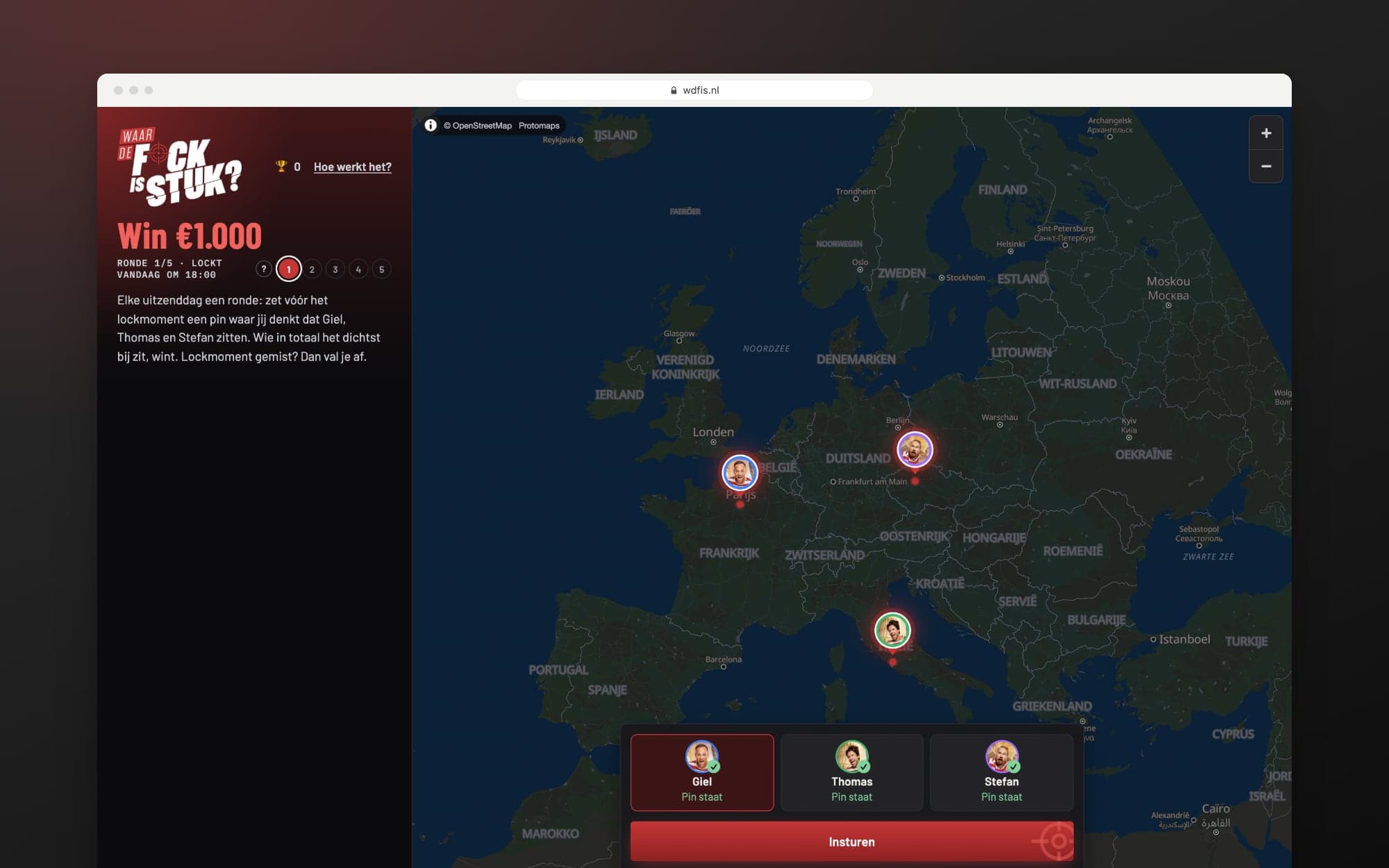
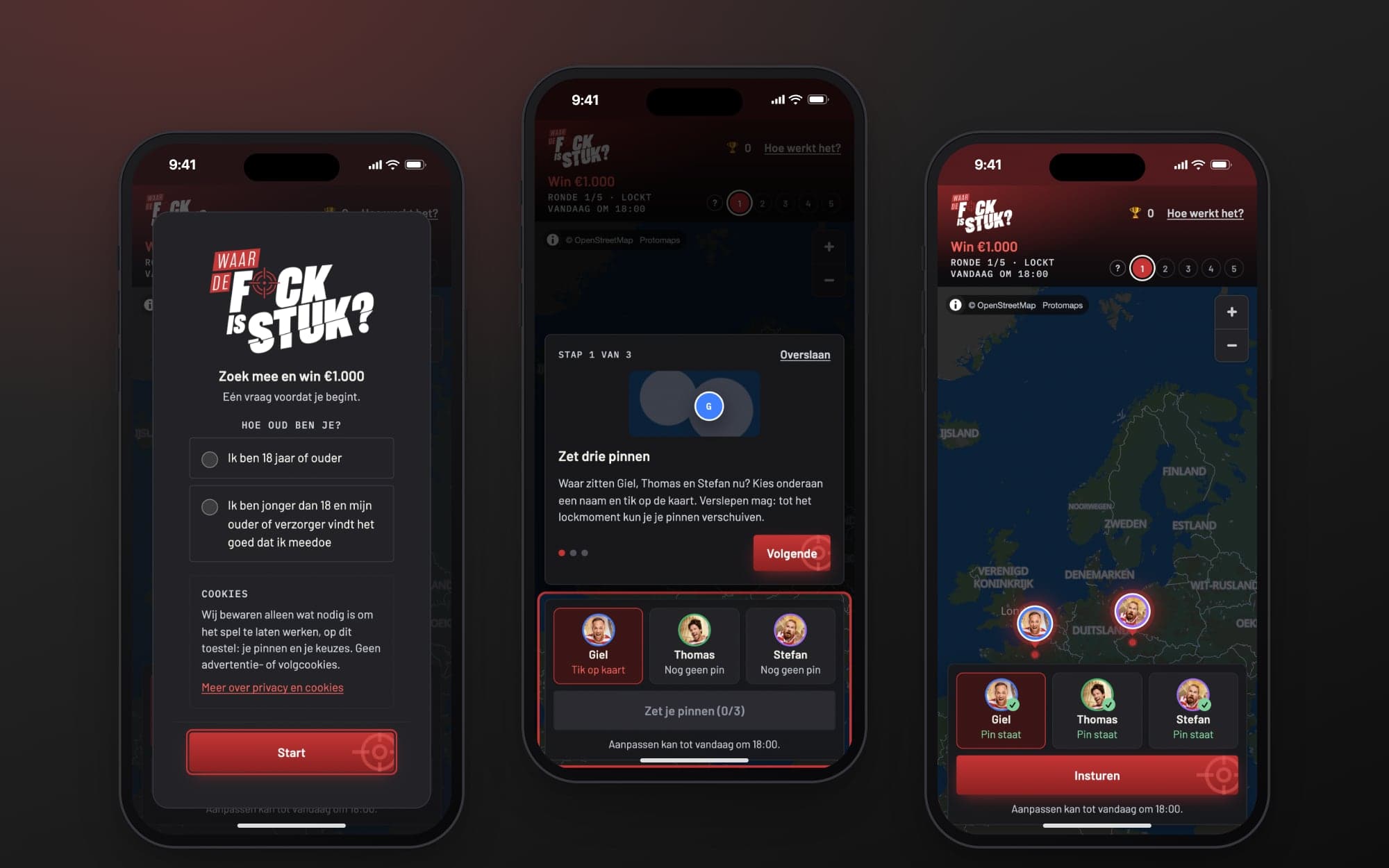
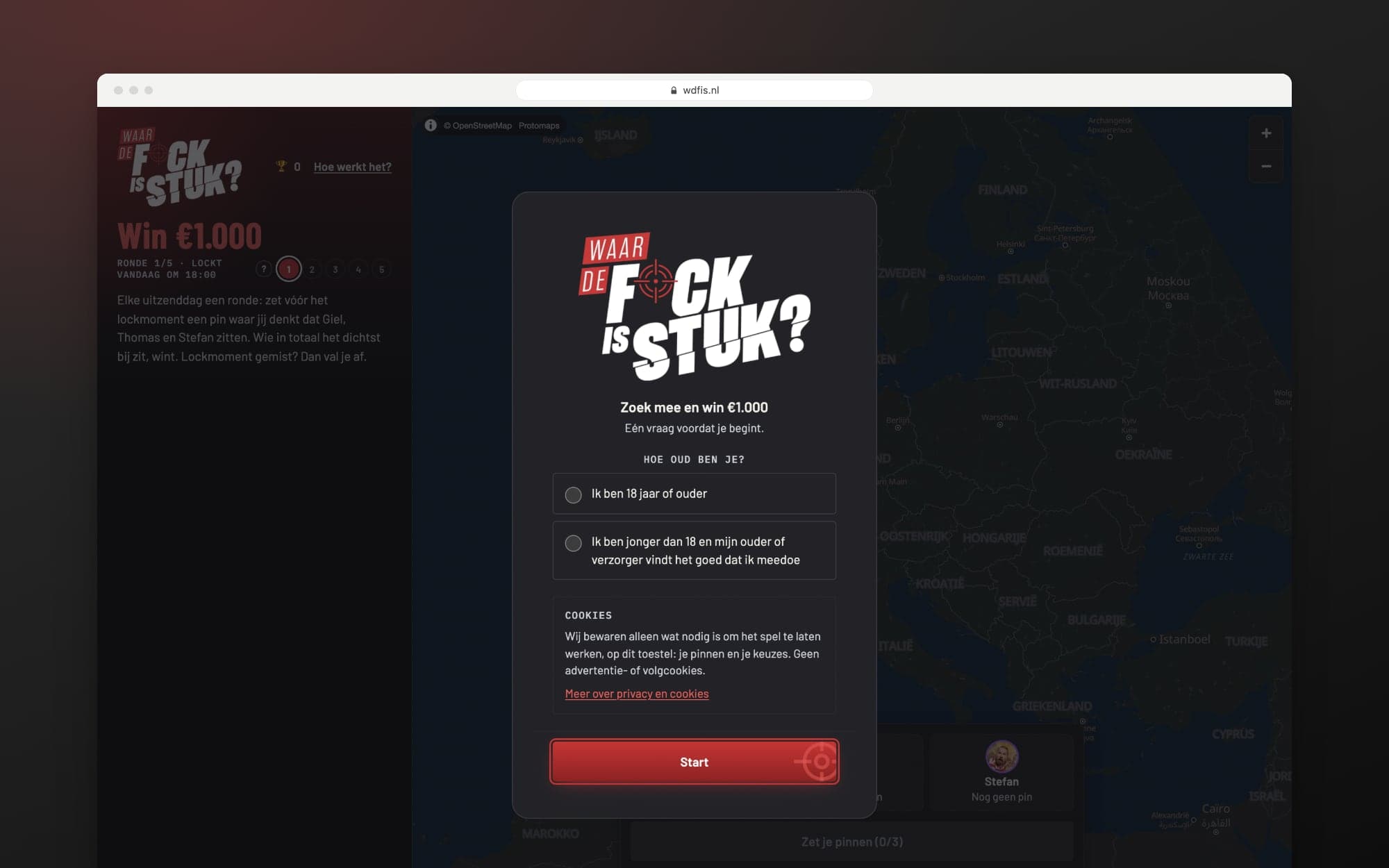
The game follows the show's house style. On their first visit, a viewer chooses their age: 18 or over, or younger with a parent's permission. Then a short three-step tour points out the real screen. The map is a 3D globe of Europe that you can zoom in on down to the buildings.
At the bottom are the three of them, with their photos. Choose a name, tap the map. That is all there is to it, and that is the point.
No account, but one entrant per person
There is no account. The first time, a viewer enters their name and email address and confirms via a link in the email. After that, their phone remembers them. On another device, the login link only replaces pins if the entrant chooses to. Variants of the same address, such as a +label or dots in a Gmail address, count as one entrant. A bot check also stops automated entries.
Rewarding taking part, not the score
Viewers do not see a score, because StukTV only announces the winner after the last broadcast. To give something back anyway, a viewer earns badges for taking part, such as Vroege vogel (early bird) and Alle vijf (all five). With one button, they share an image of their pins. Anyone who wants one gets a reminder two hours before the lock time.
How does the editorial team keep control of the game?
The editorial team works in its own admin environment, with a password and a code from an authenticator app. There, they prepare hints from TikTok, YouTube and Instagram and adjust lock times while a round is open. After each lock time, they enter the real locations, and the leaderboard calculates the distances.
Because there is money to win, the leaderboard also shows signals that may point to fraud, such as several entrants on the same network. Those are indications, not proof. So someone always checks the winner by hand before any money changes hands.
The game only asks for a name, email address and age choice. The data is stored in the EU and there are no tracking or advertising cookies.
How did we know the game was right?
By testing with every change. More than 600 automated tests run on the app and the game rules, plus 146 tests that check the rules in the database itself, such as the lock and who can access which data. On top of that, a test plays through the viewer's whole journey, on desktop and mobile.
A lot, for a five-day game? Perhaps. But I would rather test too much than have to explain why a round opened again.
What did the pin game deliver?
The pin game ran throughout the broadcast week, from Monday 19 to Friday 23 October 2026, on wdfis.nl. Viewers placed their pins every day, and StukTV announces the winner after the last broadcast. We will add the figures on participation and traffic once they are released.
Want to see how we work with media companies more often? Read the case on Spectre, an AI platform for reality TV, or on the demo upload platform for ADE and VIRPP. If you are curious what a similar project costs, the page on the cost of a web application will help.
Building something for an audience that arrives all at once? Tell me what you are planning, and we will work out together where the peak is.
Book an intro callUpdated
Get in touch with us directly. We'll get back to you as soon as we can


 Your message goes straight to our team in Amsterdam.
Who made the Waar de F*ck is STUK? pin game?
Your Tech Club designed and built the pin game on wdfis.nl for Signal and StukTV. That covers the game for viewers, the admin environment for the editorial team and the hosting in Amsterdam, set up for the peak after a call to action.
How does the pin game work?
There is a round every broadcast day. Before the lock time, viewers drop three pins on the map of Europe: one for Giel, one for Thomas and one for Stefan. Anyone who misses a lock time is out. Whoever is closest in total after five rounds wins €1,000.
How does the game handle the rush after a call to action in the broadcast?
The home page comes from a CDN and is refreshed every 15 seconds, so a wave of viewers does not hit the database per person. Submitting is one database step and the email goes through a queue. Capacity goes up before every broadcast, based on a load test that mimics the wave after a call to action.
What happens to entrants' data?
The game only asks for a name, email address and age choice, for the prize. The data is stored in the EU, there are no tracking or advertising cookies and unconfirmed sign-ups are deleted automatically.