

Bar-4-Bar: from track link to festival stage
Music competition platform for Bar-le-Duc: artists enter Bar-4-Bar with a link to their music, on a platform where every campaign gets its own setup.
Deliverables
- Campaign site, from announcement to closing page
- Entry form with track links and socials
- Campaign platform for multiple promotions
- Admin environment with statistics and export
- Age check and confirmation email
- Protection against bots and duplicate entries
Tech stack
- React and TypeScript
- Vite and Tailwind CSS
- Laravel
- SendGrid
- Google Tag Manager with Consent Mode
With Bar-4-Bar, Bar-le-Duc is looking for up-and-coming musical talent. Artists aged 18 and over choose a genre, share a link to their music and explain in a short pitch why they belong. Bar-le-Duc picks four of them. They get a studio programme and a performance on one of the brand's festival stages. Your Tech Club built the campaign site, the admin environment and the platform the campaign runs on.
Why couldn't the existing system do this?
We had previously built Bar-le-Duc's promotion with codes on the bottle. That system had one way to take part: enter a code and see straight away whether you have won. Everything was built around that, from the fields in the form to the rule that decides who wins.
Bar-4-Bar works differently. There is no code and no instant prize. Artists submit their music and Bar-le-Duc chooses afterwards. More campaigns were planned for 2026, each with its own rules. Building a separate system for each one means building, securing and maintaining it all over again every time.
There was also a fixed date: entries had to open on 1 March 2026. Work on the site started in early February, work on the platform in mid-February.
One platform, a separate setup for each campaign
We turned the existing system into a platform where a campaign is a configuration. Security, storage and admin are shared by all campaigns. What differs sits in the setup.
What a campaign's setup contains
On the platform, a campaign is a description in plain terms: a name, a run time and a status. How the winner is chosen: instantly on entry, by draw or by the brand itself. How many promo codes someone enters. And which fields the form has, with for each field whether it is required, how long it may be and which options it offers.
It also sets how often one email address may enter, whether a phone number is required and what the confirmation email says. The platform builds the validation rules from the fields itself. A link field requires a valid link and a choice field only accepts the options given.
For Bar-4-Bar, that means: no code, no uploads, selection by the brand, one entry per email address and a required phone number. The form has fields for four kinds of track link, Instagram and TikTok, age, the pitch and the genre.
The same foundation for the 10K campaign
Bar-le-Duc's 10K campaign runs on the same platform. It works very differently. Participants enter two promo codes, say which product they bought and where, and pitch their plan. The winner comes from a draw. For the platform, that is a different setup, not a different system.
An existing frontend as the starting point
We built the campaign site on the frontend of an earlier Bar-le-Duc campaign. First we removed what no longer fitted: the steps for code entry, address and phone verification, and the pop-ups for winning, losing and consolation prizes. The prize overview became the genre overview. The prize page with the code form became the genre page with the entry form.
What already worked stayed: the site header and footer, the FAQs, the fonts and Bar-le-Duc's blue. Old links from the previous campaign redirect to the new pages.
Entering with a link
In the first plan, artists could upload audio files. In the end we chose links. Artists who have released something share a link to Spotify, YouTube or SoundCloud. Those who haven't share a Dropbox link. Nobody has to upload large files and the platform stores no audio.
The entry form
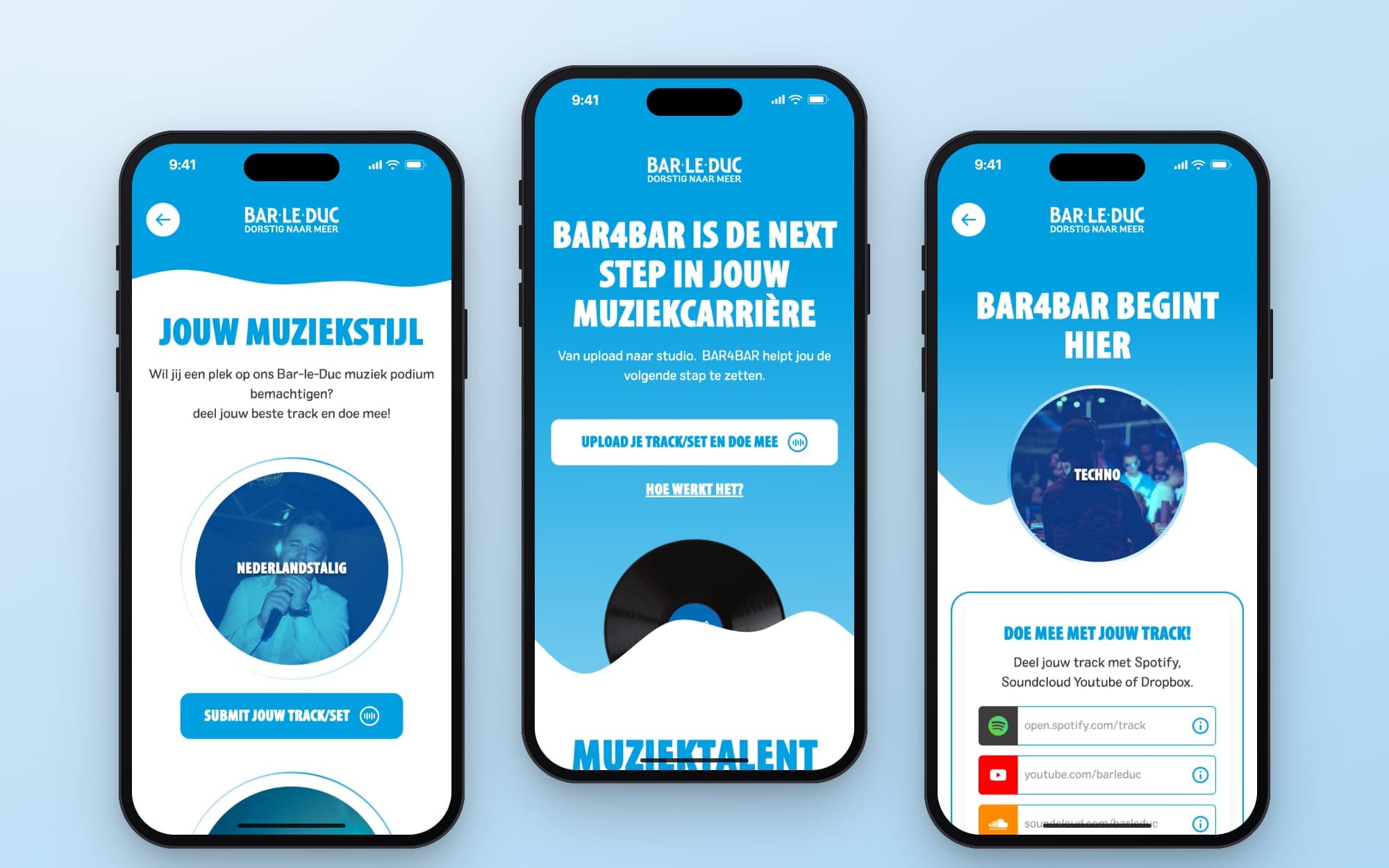
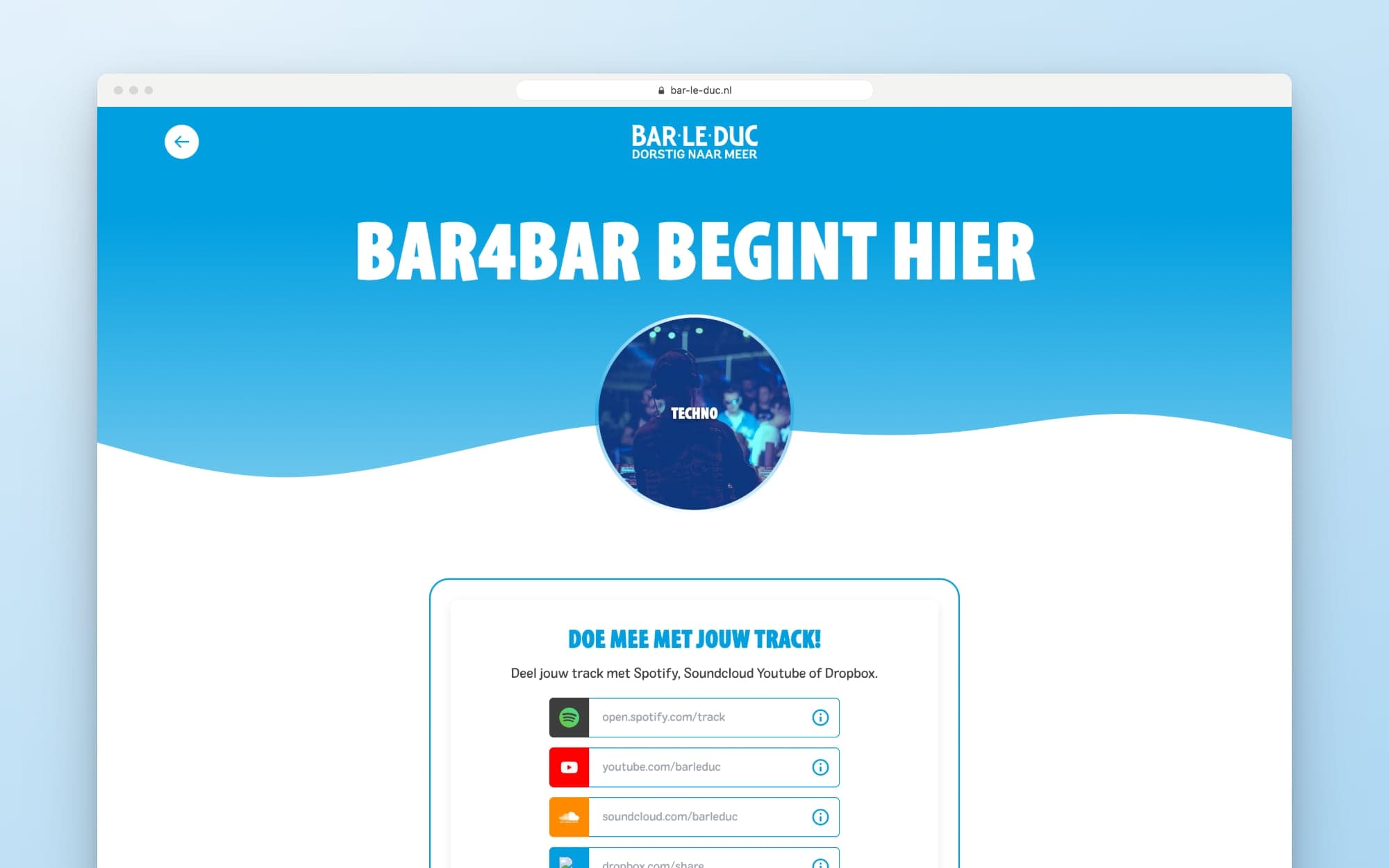
The form sits on the page of the chosen genre. First the music: four fields, one per platform, each with the logo and an example link. At least one is required. Then at least one Instagram or TikTok account. A link is fine, and so is just the handle: the site turns @artist into a link to the profile itself.
Then come email, name, phone number and date of birth, and the pitch: "Why do you belong at Bar4Bar?" in no more than 180 characters. Anyone under 18 cannot submit.
If something is missing, the form says what. If an email address has already been used to enter, that shows up straight away.
What did we build?
A site that moves with the campaign
Bar-4-Bar runs longer than the entry period. The site shows the year in three phases: entries in March and April, the programme with the artists and their festival performances from May to September, and a look back from October to December.
Before the launch, there was an announcement with the start date. During the entry period, the whole route was live: landing page, genre choice, form and confirmation. After closing, every address leads to one closing page. We later added the winners, their festivals, a video of a performance and videos from Instagram.
The announcement
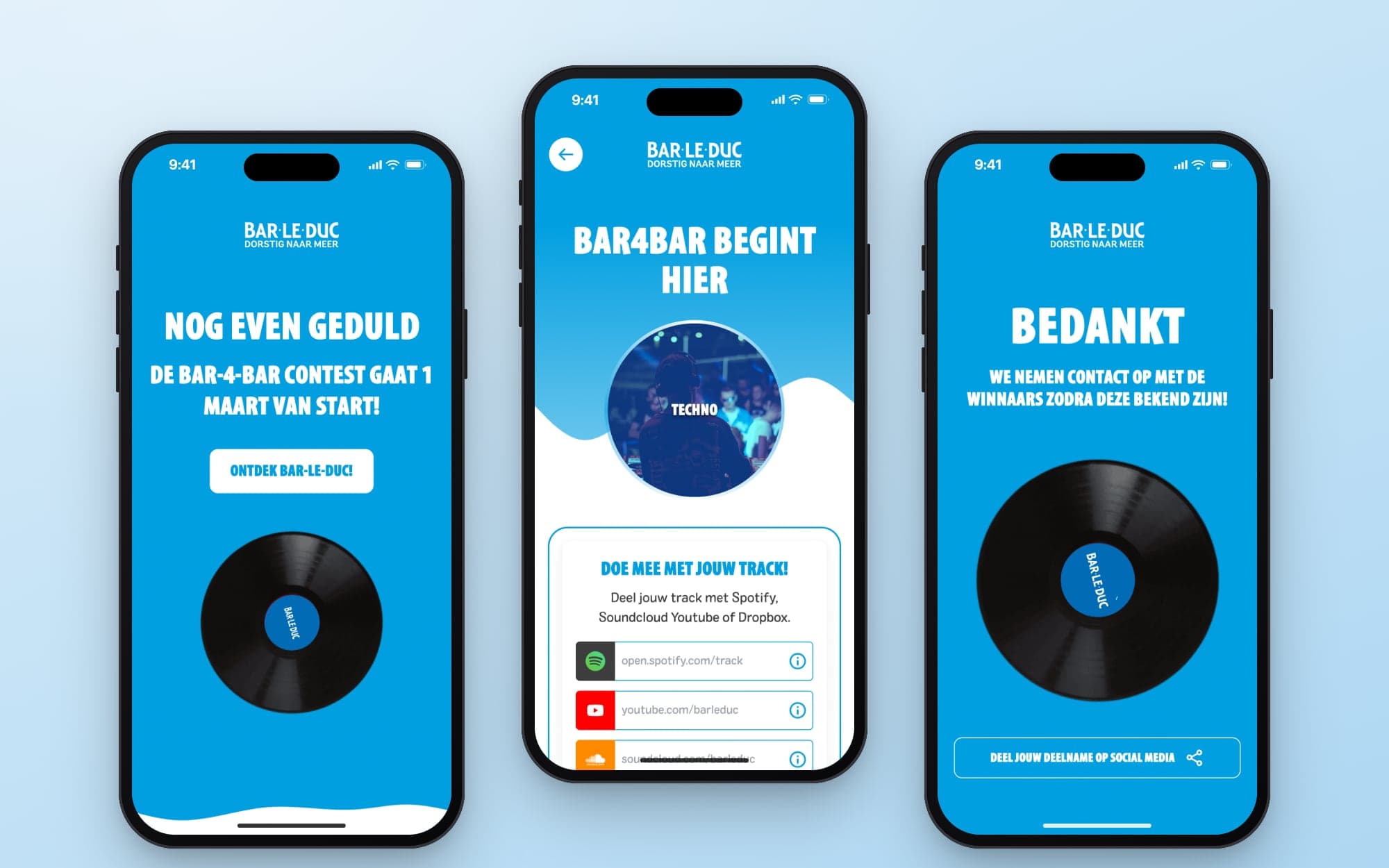
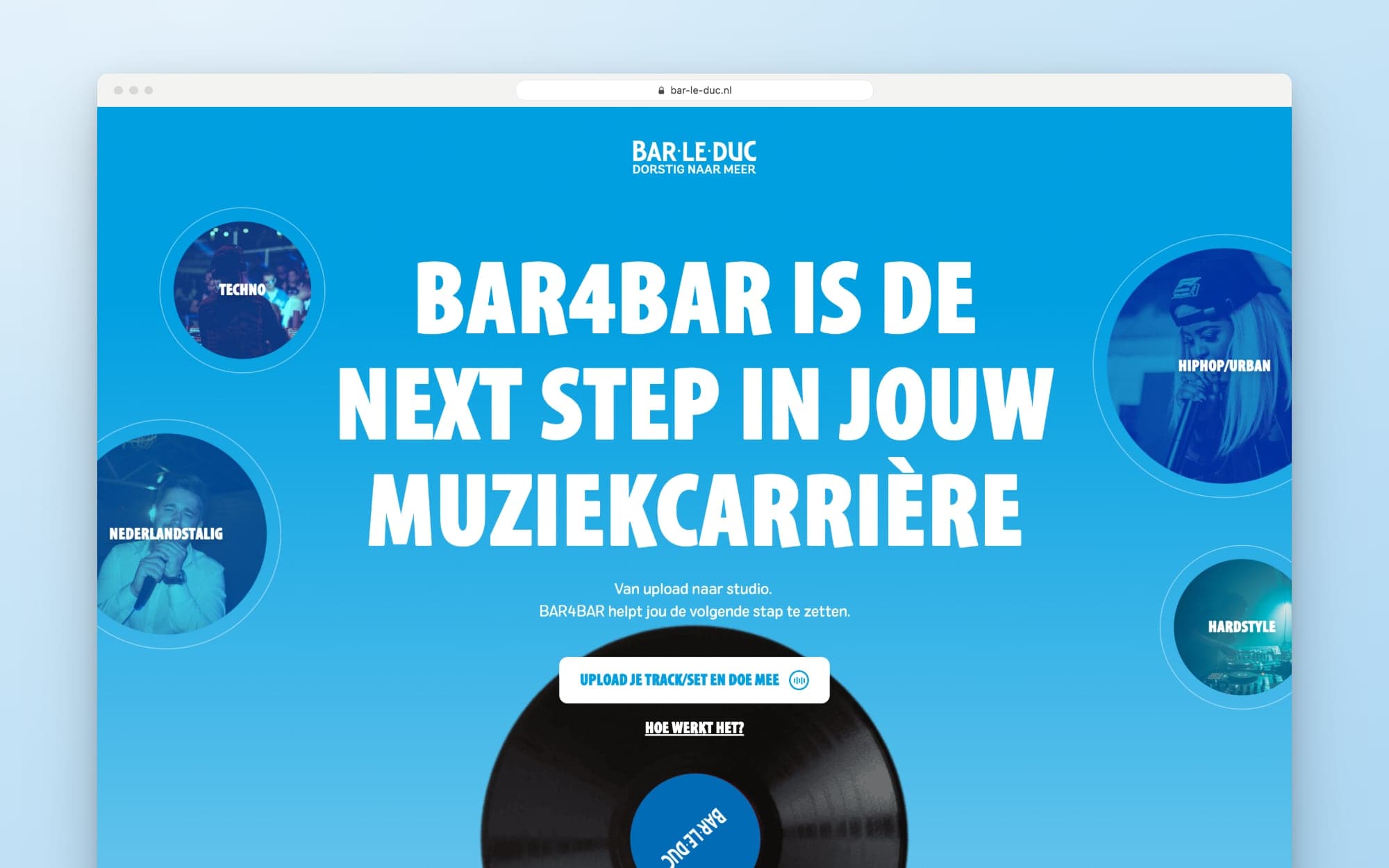
The announcement says "Just a little longer" and gives the start date. The genres float around the text as round photos, with a vinyl record beneath them.
The landing page
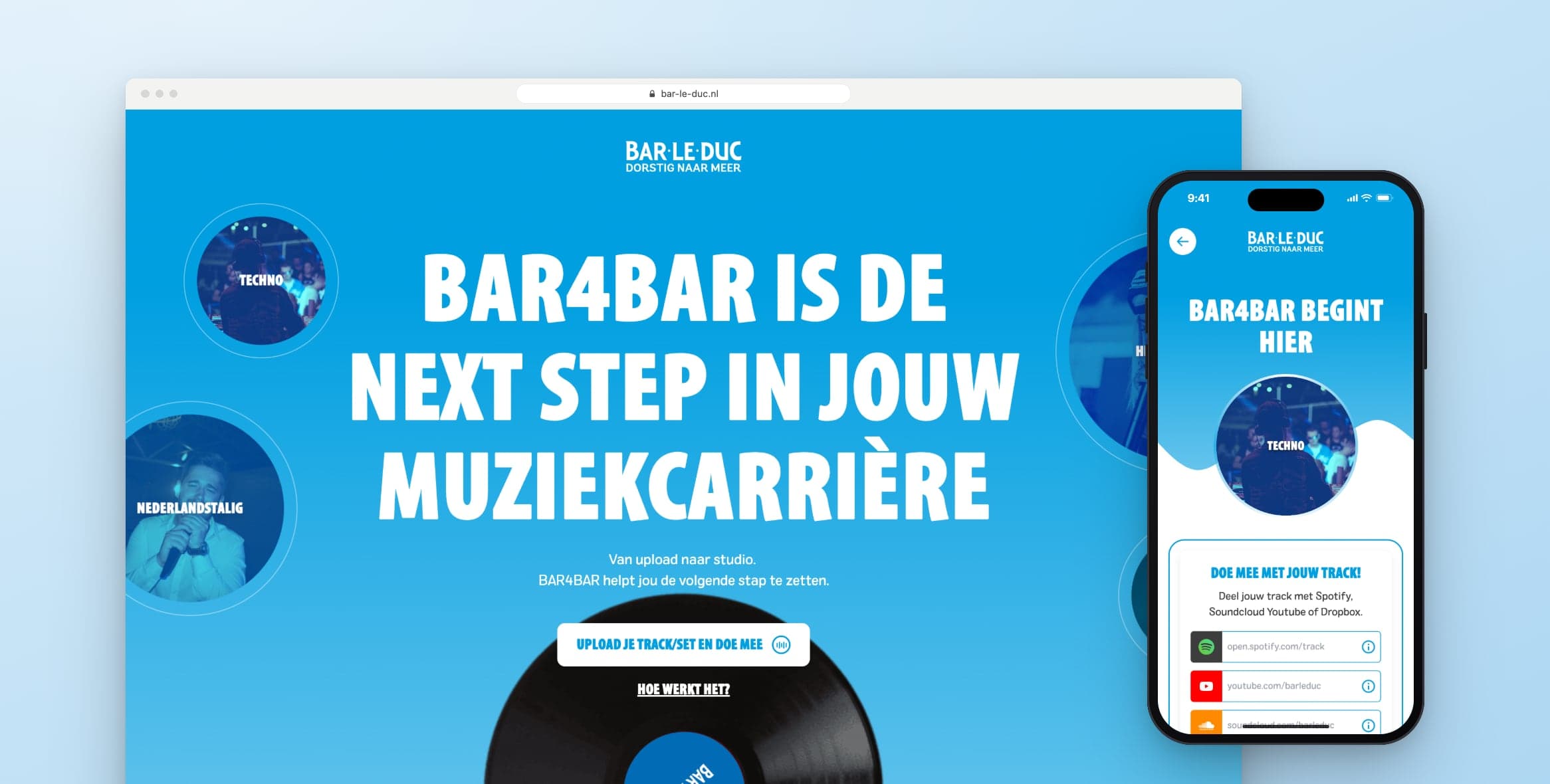
The landing page opens with "BAR4BAR is the next step in your music career" and a button to enter straight away. Below that come the genres, a three-step explanation, the timeline and the festivals where winners can play, each with a pop-up that explains more. The FAQs close the page.
On arrival, visitors confirm they are 18 or over. Anyone who says they are younger is sent back to the Bar-le-Duc website.
Six genres
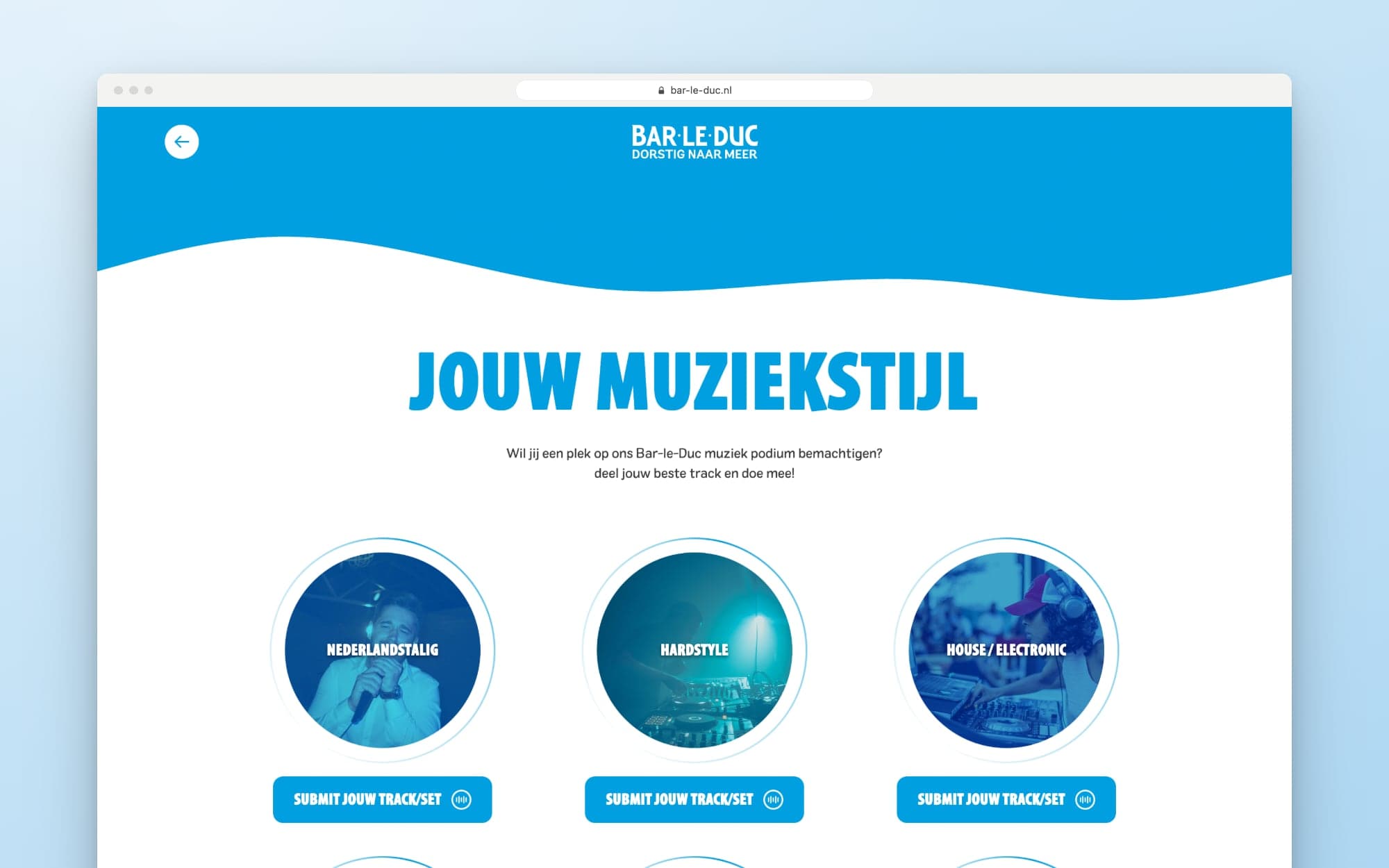
Artists choose from six genres: Dutch-language, Hardstyle, House/Electronic, Techno, HipHop/Urban and Other. The design started with nine; the list Bar-le-Duc approved has six. Anyone who doesn't fit anywhere chooses Other.
After submitting
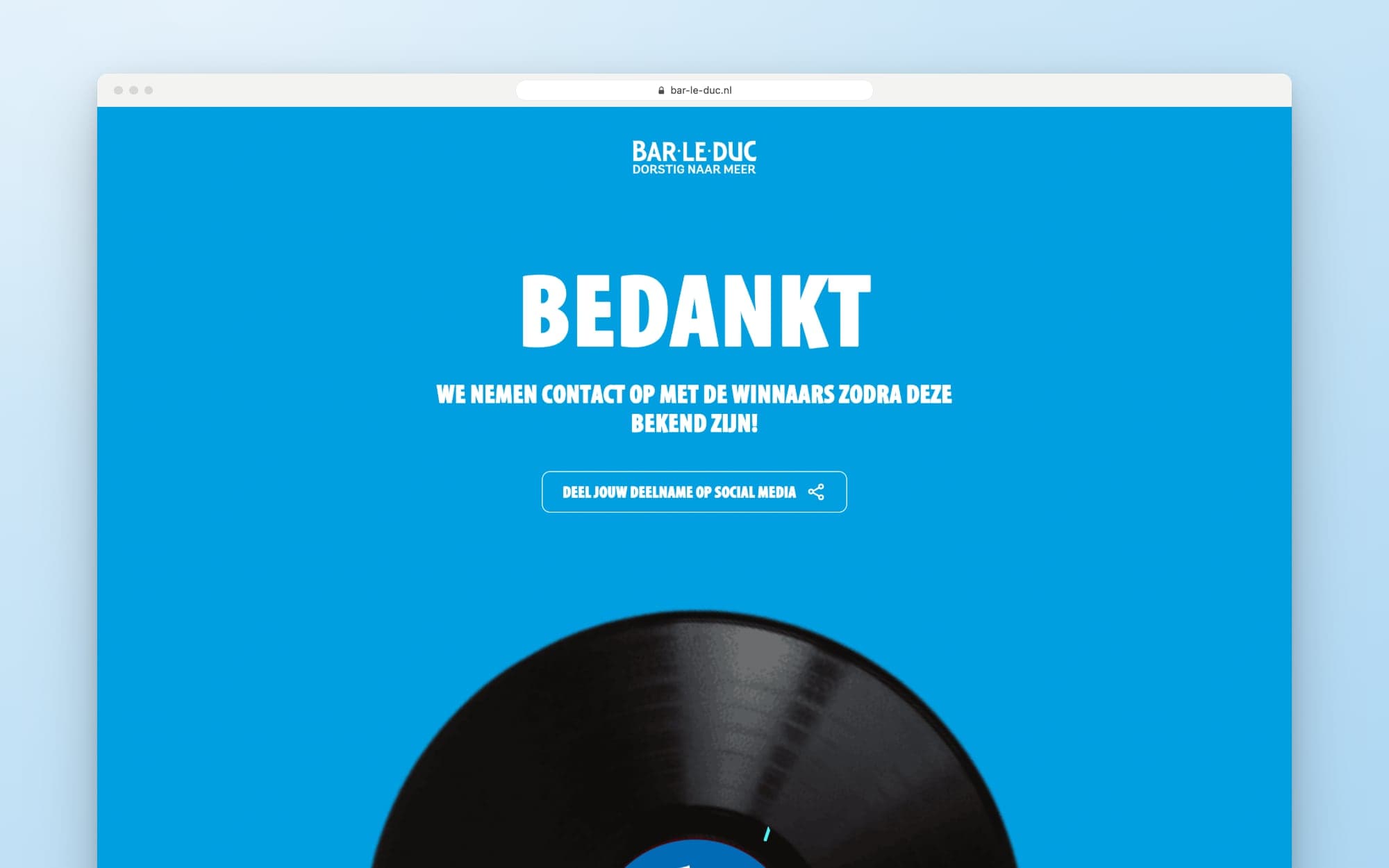
A successful entry is followed by a confirmation with confetti and a spinning vinyl record. From there, artists can share their entry, on a phone through the built-in share menu, with a separate route to Instagram Stories.
The artist also receives a confirmation email: the entry is in and will be considered in the selection. Under "What now?" it says Bar-le-Duc will announce four artists and contact them by email or phone. The text of the email lives in the campaign's setup, not in the code.
Cookies and tracking
Bar-4-Bar runs under bar-le-duc.nl. Visitors who arrive via the Bar-le-Duc website have already made a cookie choice there, and the campaign site adopts it. Visitors who land on Bar-4-Bar directly choose for themselves: necessary only, or accept all. Tracking through Google Tag Manager only switches on after consent.
Admin that adapts to the campaign
Bar-le-Duc reviews entries in one admin environment for all campaigns. You choose the campaign at the top, and then only see what belongs to it. A campaign with genres gets a Genres tab. A campaign where the brand chooses the winners has no Prizes tab. Columns and charts for product and place of purchase only appear for a campaign that asks for them.
For Bar-4-Bar, the team sees the track links, socials, genre, age and pitch for each entry, and can sort and filter them. Statistics show the entries, the unique participants and the spread across genres and ages.
Entries can also be exported to Excel by period, with the pitch included. After launch, an entry ID, date and time, and the phone number were added.
Fair play
When the form opens, it fetches an encrypted timestamp. If it is submitted within three seconds, or a hidden field that people cannot see has been filled in, the platform treats the entry as coming from a bot. The bot gets a normal confirmation back, but the entry does not count.
The number of attempts per IP address is capped. Each email address can enter once, and variants of the same Gmail address, with a dot or a plus sign, count as the same address.
Before launch, the campaign site went through an internal security review. As a result, the log statements were removed from the production build, among other things, and no source maps are online.
What were the results?
Entries opened on 1 March 2026. Bar-le-Duc chose four artists from the entries. The closing page lists a festival, a date and a Bar-le-Duc stage for each artist.
The same site covered every phase of the campaign, from the announcement to the winners. The platform underneath is also set up for the 10K campaign. A next Bar-le-Duc campaign needs a new setup and new pages, not a new system.

Get in touch with us directly. We'll get back to you as soon as we can


 Your message goes straight to our team in Amsterdam.
What is Bar-4-Bar?
A music competition by Bar-le-Duc for up-and-coming artists aged 18 and over. Artists choose a genre, share a link to their music and write a short pitch. Bar-le-Duc picks four artists for a studio programme and a performance on one of the brand's festival stages.
What did Your Tech Club build for Bar-4-Bar?
The campaign site with announcement, genre choice, entry form, confirmation and closing page; the admin environment where Bar-le-Duc reviews and exports entries; and the campaign platform in Laravel that the campaign runs on.
Why do artists submit a link rather than a file?
A link to Spotify, YouTube, SoundCloud or Dropbox is enough to listen to the music. Artists don't have to upload anything and the platform stores no audio files.
Can the same platform run other campaigns?
Yes. On the platform, a campaign is a setup: which fields the form has, whether a code is needed, how often someone may enter and how the winner is chosen. Bar-le-Duc's 10K campaign runs on it too, with promo codes and a draw.
How do you prevent duplicate or fake entries?
With a hidden field and a timing check against bots, a cap on attempts per IP address and one entry per email address. Variants of the same Gmail address count as one address. The final choice rests with Bar-le-Duc, which reviews every entry.
How does Bar-4-Bar handle cookies?
Tracking is off by default. Visitors who arrive via bar-le-duc.nl bring the cookie choice from that site with them. Visitors who land on Bar-4-Bar directly choose between necessary cookies only or accepting all.