

In this article
- What is a chatbot exactly?
- What types of chatbots are there?
- What is an AI chatbot and how does it work?
- What is the difference between a chatbot and an AI agent?
- Which chatbot examples do you see per department?
- What is the best chatbot for a business?
- What does a chatbot cost to maintain?
- What does the law say about chatbots?
- Does your business need a chatbot?
- Frequently asked questions
What is a chatbot? A chatbot is software that holds a conversation with you in plain language, usually in text. You type a question and the program answers. Still, there is a world of difference between the button menu on your energy supplier's website and an assistant that looks up your order by itself. Below you can read which types exist, what they do per department and how to choose what fits your business.
What is a chatbot exactly?
A chatbot is a computer program that talks to people in plain language, through a chat window on a website, in WhatsApp or in an app. The word is a blend of "chat" and "robot". So the meaning of chatbot is literally a robot that chats. It answers questions, asks questions back and passes you on when it does not know.
The idea is older than you might think. In 1966 Joseph Weizenbaum at MIT built ELIZA, a program that imitated a conversation with a therapist. The trick was simple: ELIZA repeated your words back as a question. Even so, people found it remarkably convincing.
Since large language models arrived, a lot has changed. A chatbot now understands questions it has never seen before. That also makes it easier for it to make up answers that are wrong. More on that shortly.
What types of chatbots are there?
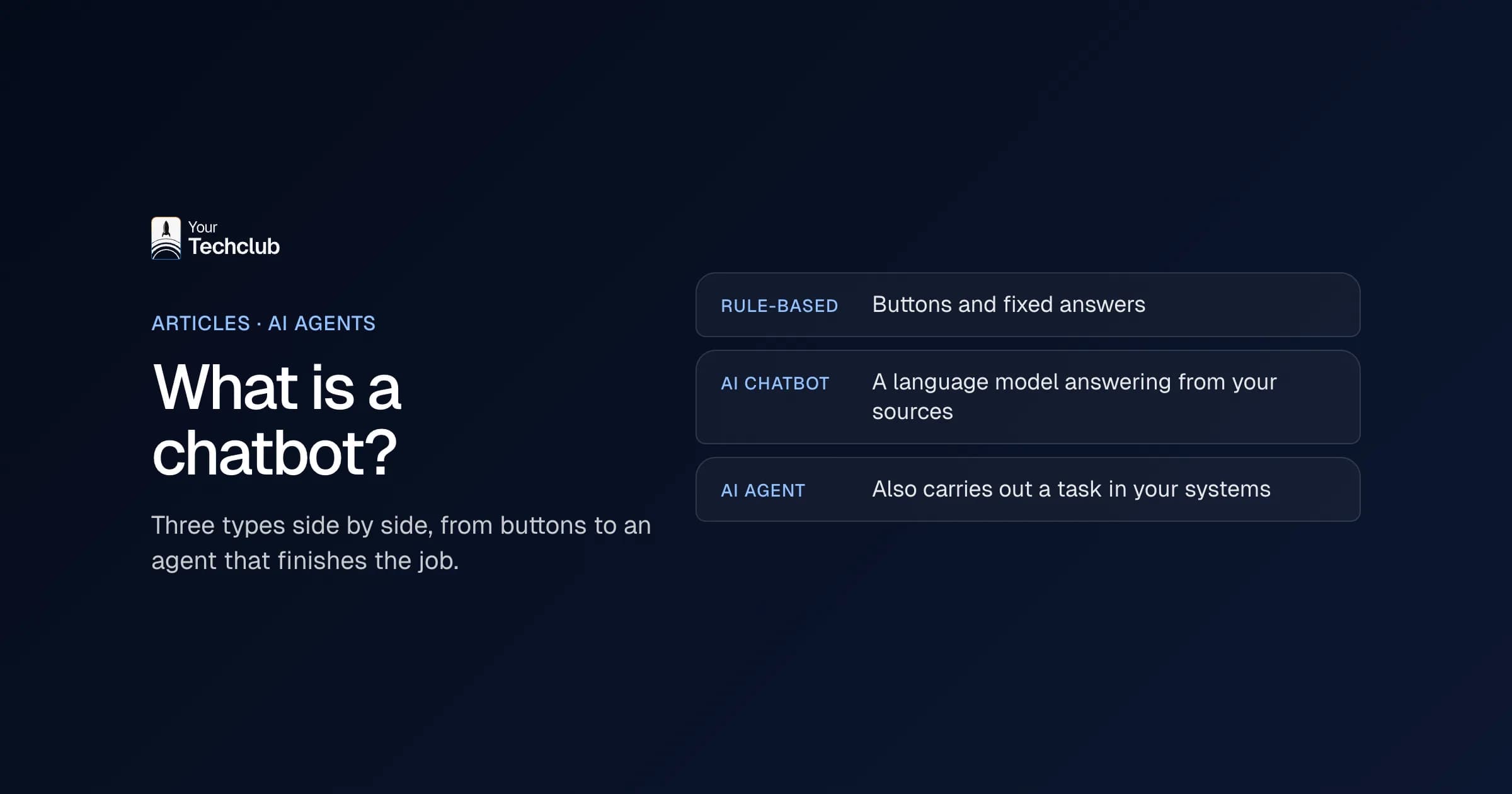
The answer to "what is a chatbot?" depends on which of three types you mean. The first follows a fixed decision tree with buttons. A second type uses a language model and answers in its own words from your sources. An AI agent goes further still and also carries out tasks in your systems. Which type fits depends on what your customers or colleagues ask and whether something has to happen afterwards.
| Type | How it works | Good for | Risk |
|---|---|---|---|
| Rule-based | Fixed decision tree with buttons | A few predictable questions | Customer gets stuck if their question is not on the list |
| AI chatbot with a language model | Understands free text, answers from your sources | Many different questions about products or policy | Can make up an answer if the source is missing |
| AI agent | Understands the question and carries out a task | Questions where something has to happen | Does something wrong if its permissions are too wide |
The rule-based chatbot is the classic form. You pick from buttons such as "Order", "Return" or "Something else", and each choice leads to a next step. It is predictable and cheap to maintain, but also quickly frustrating. Anything the builder did not think of, it cannot do. Even so, I would not write it off. For a fixed choice at the start, such as business or private customer, a button menu works fine.
What is an AI chatbot and how does it work?
An AI chatbot is a chatbot that uses a large language model to understand your question and write an answer itself. A good AI chatbot for a business only answers from fixed sources, such as help pages and terms. Without those sources, the model starts making things up. That is called a hallucination.
In technical terms the language model is a large language model. The technique you use to connect it to your own documents is called RAG: the system first finds the relevant passage and only then lets the model answer. That way you can see for each answer which source it came from. What happens when that source is missing, you can read under AI hallucination. How this works in practice, you can see in an AI assistant that shows the source with every answer.
ChatGPT is an AI chatbot too, but a general one. It knows a little about everything and nothing about your returns policy. A chatbot on your own website should work the other way round.
What is the difference between a chatbot and an AI agent?
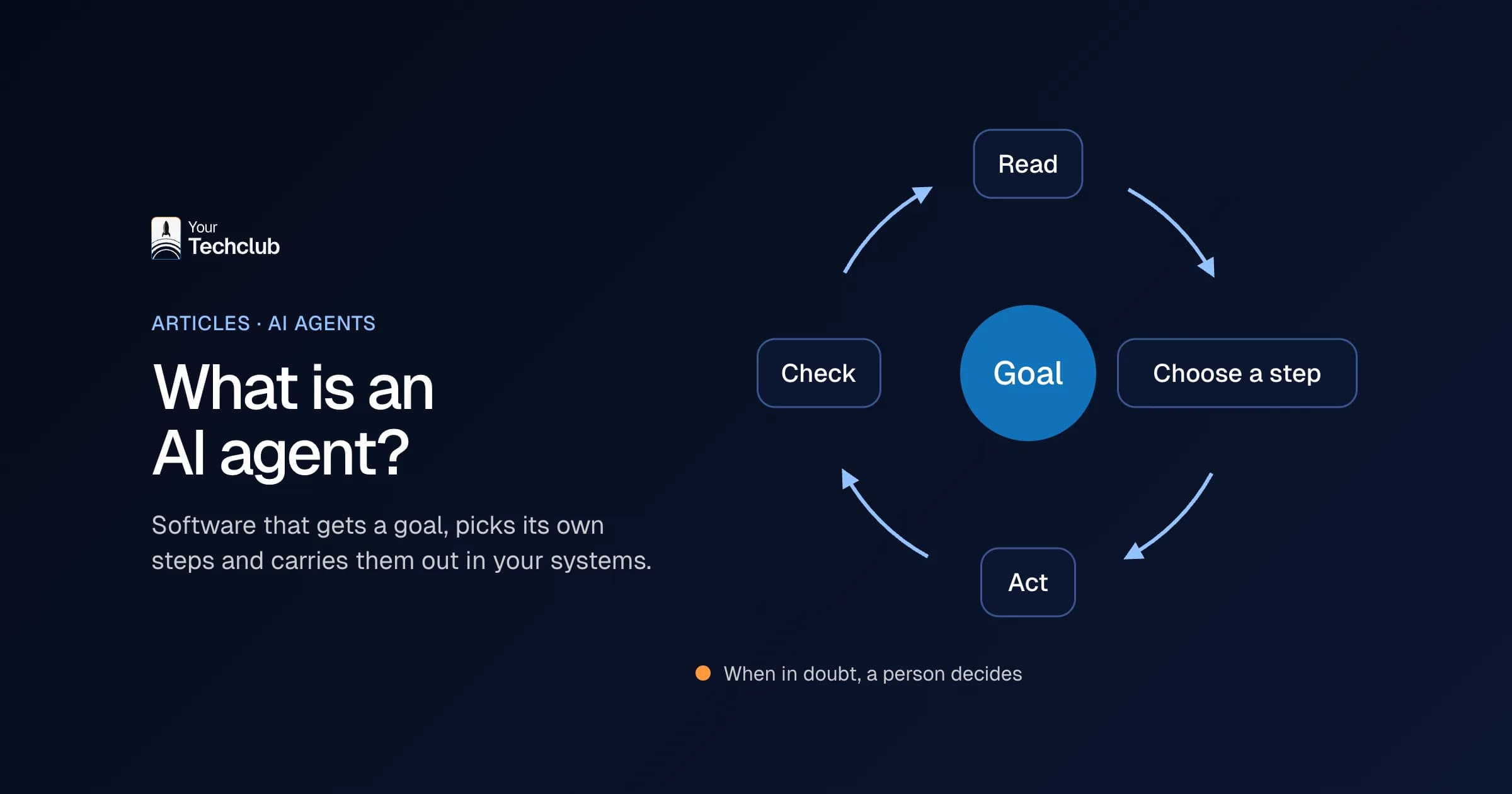
A chatbot answers a question, an AI agent handles a task. If a customer asks "where is my parcel?", the chatbot points to the tracking code. An AI agent looks up the order itself, sees that the parcel is stuck and creates a ticket. So the agent needs integrations and permissions, while the chatbot only needs sources.
| Chatbot | AI agent | |
|---|---|---|
| Does | Gives an answer | Carries out a task |
| Needs | Good sources | Sources, integrations and permissions |
| Worst mistake | Saying something wrong | Doing something wrong |
| Start with | Live after testing with real questions | Drafts that a person approves |
That difference also decides what you need to arrange. At worst, the chatbot says something wrong. An agent can also cancel the wrong order. That is why I always have an agent produce drafts that a person approves at the start.
In practice a chatbot often grows into an agent, once it becomes clear which questions keep needing an action. How an agent works, you can read in What is an AI agent?.
Which chatbot examples do you see per department?
Most chatbots sit in customer service, but internally they often deliver just as much. Every department with a lot of repeated questions qualifies. The pattern is always the same: the answer is in a document somewhere, but nobody reads that document. If something has to happen in a system after the answer, it is really an agent already.
| Department | Typical question | Chatbot or agent? |
|---|---|---|
| Customer service | "How long is the guarantee on this vacuum cleaner?" | Chatbot |
| Online store via WhatsApp | "Can I add another size to my order?" | Agent (puts the order in your store) |
| Sales | "Do you also deliver to Belgium, and when can we talk?" | Chatbot, with a suggested appointment |
| HR | "How many hours of leave do I have left?" | Chatbot on the handbook; agent if it looks up the balance |
| IT | "I cannot get into the shared folder, what now?" | Chatbot that raises a ticket straight away |
| Finance | "Has invoice 2026-118 been paid yet?" | Agent (looks in your accounts) |
| Operations | "The cold store in hall 2 is showing a fault" | Agent (creates a maintenance request) |
Customer service. This is where almost everyone starts. A chatbot answers questions about delivery times, returns and guarantees and passes on the difficult ones. On AI employees for support you can see which tasks we have worked out there.
WhatsApp and online store. More and more customers would rather message than email. If the chatbot also has to take orders, it becomes an agent, such as our AI employee for WhatsApp order processing.
Sales. A chatbot can ask a visitor a few questions and suggest an appointment. Be careful, though, because a wrong answer about price or delivery time is easily given. For a data and AI company we built a contact form that answers by itself. It first asks the visitor about their goal. Only then does the language model assess the question and give a substantive first answer, before a salesperson gets involved.
HR and IT. This is where I see the most quiet gains. Colleagues ask predictable questions, and the answers are in the handbook or the collective labour agreement. See the HR helpdesk and the IT service desk.
Finance and operations. Almost always an agent, because the answer sits in a system rather than in a document. Look at AI in finance and maintenance request routing for what is possible there.
What is the best chatbot for a business?
The best chatbot for a business does not exist as a product. It depends on five things: which questions come in, whether the answer is already in a document, whether something has to happen afterwards, which channel your customers use and who maintains the chatbot. A ranking of brands tells you nothing about that.
I would choose using these questions:
| Question | If the answer is yes |
|---|---|
| Do you get fewer than a handful of questions a day? | Start with a good FAQ page |
| Is the answer already in a document? | An AI chatbot on your own sources fits |
| Does something have to happen in your online store, CRM or accounts? | You are looking for an AI agent |
| Do your customers prefer messaging to email? | Choose a chatbot in WhatsApp, not only on your site |
| Is there nobody to keep the sources up to date? | Hold off on building |
Besides that, watch three things that never stand out in a demo. Can you see which source an answer comes from? Can a customer reach a person in one click? And where are the conversations stored? When we build one ourselves and when we recommend something else, you can read on Chatbot development.
What does a chatbot cost to maintain?
Building is usually not the biggest cost, maintenance is. A chatbot is never finished. Every change in your prices, terms or products has to be in its sources too. On top of that, you read conversations back, pay for using the language model and keep the integrations up to date. Plan time for that from day one.
What people often forget: someone has to read the conversations the chatbot had no answer to. That is exactly where you see which question you have not described properly yet. Our AI employee for knowledge base management helps with that, but a person decides what goes in. The language model costs money too, usually based on the amount of text it reads and writes.
Air Canada showed in 2024 that maintenance matters. The airline's chatbot told a customer that he could apply for a bereavement fare discount afterwards. The official policy said something else. The Canadian tribunal ruled that Air Canada is responsible for everything on its own website, including what the chatbot says (Moffatt v. Air Canada, 2024 BCCRT 149, 14 February 2024). The tribunal called the argument that the chatbot was responsible for its own actions "remarkable".
How much time that takes per month depends on the number of conversations and how often your offer or terms change. My advice: name one person who goes through the unanswered conversations every week and updates the sources.
What does the law say about chatbots?
Since 2 August 2026, a chatbot has to let people know they are talking to AI, at the latest at the first interaction. That is in Article 50 of the EU AI Act. Only when it is already obvious to an attentive user is it not required. In addition, the GDPR applies, because people often share their name, address or order number in a chat.
The text is in Article 50(1) and 50(5) of Regulation (EU) 2024/1689 (EUR-Lex, 2024, accessed October 2026). The notice has to be clear and distinguishable. A fixed line above the chat window, such as "You are chatting with our AI assistant", is therefore the minimum. You can read more about the law in What is the AI Act? and in EU AI Act and GDPR: what to sort out.
Does your business need a chatbot?
Once you know the answer to "what is a chatbot?", the next question is whether you need one. Only if a lot of questions come in that keep coming back and whose answer is already written down somewhere. If you get few questions, a good FAQ page is often better. If something has to happen in your systems with every question, you are more likely to need an AI agent. So count your questions first, before you choose anything.
What I would not do: put up a chatbot because it looks modern. A chatbot appears on the site, nobody updates the sources, and after three months it answers questions about a returns policy that changed long ago. Then you are worse off than without one.
Frequently asked questions
What is the meaning of chatbot?
Chatbot is a blend of "chat" and "robot". It is software that holds a conversation in plain language, usually in text. A chatbot answers questions, asks questions back and hands the conversation to a person when it does not know the answer.
What is an AI chatbot?
An AI chatbot uses a large language model to understand free text and write an answer itself. For a business, that chatbot should only answer from fixed sources, such as your help pages and terms. Otherwise you run the risk of it making up answers.
What is the best AI chatbot?
There is no such thing. General assistants such as ChatGPT, Gemini, Copilot and Claude overtake each other per task and per month, and any ranking is soon out of date. For a business, something else counts: does the chatbot answer from your sources, can a customer reach a person and where are the conversations stored?
Is ChatGPT a chatbot?
Yes. ChatGPT is a general AI chatbot from OpenAI. A chatbot on your own website should work differently: only answer from your sources and hand over to a person when it does not know.
Does a chatbot have to say that it is AI?
Yes. Since 2 August 2026, Article 50 of the EU AI Act says people must know they are talking to an AI system, at the latest at the first interaction. That is only not required when it is already obvious to an attentive user.